
International Federation of Robotics
Service robot sales increase by 37% worldwide
The market for professional service robots grew by 37% worldwide in 2021. The strongest growth came from Europe, according to the annual report 'World Robotics 2022 - Service Robots' by the International Federation of Robotics (IFR).

Manufacturers sold around 121,000 professional service robots worldwide in 2021. Broken down by region, the strongest growth came from Europe with a market share of 38%, followed by North America with 32% and Asia with 30%. At the same time, sales of service robots for private and domestic use increased by 9%.
More than one in three professional service robots are used to transport goods or merchandise. Most of them work indoors, for example in production halls. A total of 286 companies manufacture service robots in this category.
Robots are becoming increasingly popular in the hotel and catering industry. Compared to the market potential, however, the sales figures here are still low: around 20,000 units were sold worldwide in 2021 (+85%). Robots in this category are used either for preparing food and drinks or as mobile stations for information and telepresence.
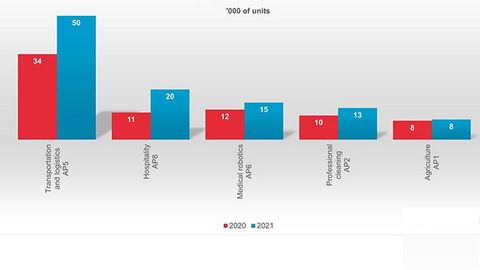
The top 5 applications for service robots, units sold in 2020 and 2021 in comparison.
© IFR World Robotics 2022Sales of medical robots rose by 23% to 14,823 units. Surgical robots represent the largest group, followed by robots that support rehabilitation and assistants for non-invasive therapies. The market share of diagnostic robots is still small in comparison.
Demand for professional cleaning robots rose by 31% to more than 12,600 units sold. The main application in this group is floor cleaning. Disinfection robots that spray liquids for sterilization or use ultraviolet light against viruses have also seen strong growth in demand since the start of the Covid-19 pandemic. Other professional helpers also clean windows, swimming pools and solar panels.
With more than 8,000 units sold (+6%), robotics plays an important role in the digitalization of agriculture. Robots are already well established in milking cows and are supported by models for barn cleaning or feeding. In contrast, robotics is still in its infancy in the cultivation of crops.
"Private users mainly use service robots in the domestic environment: they vacuum, help with floor cleaning or gardening and are also used for social interaction and education," explains Marina Bill, President of the IFR. These service robots are produced for a mass market and therefore come onto the market with a completely different pricing and sales strategy than service robots for professional use. Almost 19 million robots for domestic use were sold in 2021 (+12%). The most popular application is currently robotic vacuum cleaners and other robots for indoor floor cleaning. These models are available in almost every supermarket and are therefore easy for consumers to purchase. Garden robots are usually lawn mower models. This market is expected to grow in the low double-digit range on average over the next few years.
Care robots are a growing niche market: they help older people to remain independent and in their own homes.
Structure of the service robotics industry
Although the dynamically growing service robotics industry is comparatively young, 87% of service robot manufacturers worldwide are considered established companies and were founded before 2017. The proportion of start-ups has declined in recent years. According to the IFR, there are various reasons for this: Some market segments have already reached a higher level of maturity. These include, for example, autonomous mobile robots (AMR) for warehouse logistics. In addition, start-up activities are shifting from the development of hardware to software. Many service applications are based on collaborative industrial robots purchased from industrial manufacturers. These providers of service robots are therefore not counted as robot manufacturers in the IFR industry statistics. Instead, they act like system integrators who combine various components and develop software to offer a solution on the market.


You might also be interested in
Gentle collaboration with people
Halodi Robotics is using Ansys' simulation software as part of a startup program to develop humanoid robots that can safely interact with humans in everyday environments.
 read more...
5 Automation forecasts for 2023
Many companies have introduced technology-based changes at a rapid pace in recent years. In our increasingly digital society, openness to technology and the effective implementation of new processes are the keys to success.
read more...Five current robotics trends
Are robots the saviors of production? Five current trends show how the use of robots can drive digitalization and prevent a shortage of skilled workers.
read more...International Federation of Robotics
China overtakes the USA in terms of robot density
The global average robot density has more than doubled within six years (2015: 69 units). China has become the global leader and has overtaken the United States for the first time thanks to huge investments in industrial robotics.
read more...Germany is European champion in industrial robots
The number of industrial robots installed in Germany in 2021 rose by 6% year-on-year to 23,777 units. With a total of 245,908 units, the German industry ranks first in Europe.
read more...International Federation of Robotics
Robot sales at record level
Global sales of industrial robots rose to 486,800 installed units, an increase of 27% compared to the previous year. This is one of the findings from the preliminary figures for 2021 published by the International Federation of Robotics (IFR).
read more...International Federation of Robotics
New president elected
The Executive Board of the International Federation of Robotics (IFR) has elected Marina Bill from ABB as President. At the same time, Kenji Yamaguchi from Fanuc was appointed as the new Vice President of the IFR.
read more...IFR World Robotics Report 2024
Record number of robots in use worldwide
Over four million robots are in use in factories worldwide, reports the IFR in the current "World Robotics Report 2024" - a record number. However, sales of industrial robots have fallen.
read more...International Federation of Robotics
Beijing wants to use robots to drive growth
During the third plenary session of the Central Committee, China repositioned its economic policy and announced a technology-centered approach. Chinese robot manufacturers are strategically preparing for this.
read more...