
HMI systems
Tablet PCs - fit for production
Tablet PCs have already shaken up the market in the consumer sector. This is a trend that is also set to take hold in the industrial environment. However, in production halls, the devices have to meet special requirements - especially in terms of robustness and interfaces.

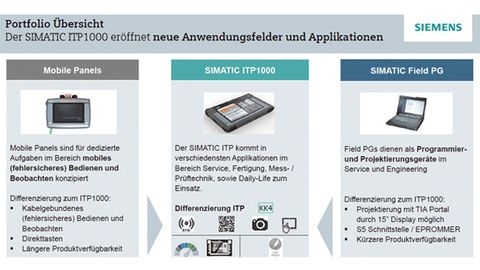
The industrial tablet PC 'Simatic ITP1000' opens up new areas of application in the context of Industry 4.0 thanks to its feature set.
© SiemensThe trend towards using tablet PCs in production as part of digitalization continues unabated. Commercial devices are hardly an option for industrial environments with high EMC requirements or high temperatures. The integrated feature set is usually too small - for example, if there is no LAN interface. In addition, the rapid product life cycles mean that the continuity of machine and system concepts is not always guaranteed. Rugged versions are therefore more interesting for industrial users, such as the new industrial tablet PC 'Simatic ITP1000' from Siemens, which was specially designed for these applications.
Users in the production environment want to achieve greater data transparency through the use of tablet PCs in order to optimize work processes. The idea: access to all relevant information, no matter where the user is located. To achieve this, the information must be available in a central system - such as ERP, MES or SCADA - so that it can be used in a plant on site. This requires a mobile computer.
Wide range of applications
Further starting points for use are digitalization and central management of service orders. For example, the status of a service assignment can be recorded directly on the tablet PC. This gives the entire service team a better overview at all times: Which job has already been completed? Where are there new faults? Another concept for the service area is the decentralized use of collected know-how through remote access to various resources, such as service personnel or tutorial videos. Users can also optimize their workflows and work more productively. Concepts for secure remote access to systems are also possible with the 'Sinema Remote Connect' management platform, for example.
Another area of application is position-dependent visualization. The principle: by registering the tablet in a specific operating area, the operator is shown the corresponding system image. This concept offers an interesting alternative for less frequently used operating stations. In future, users could replace several stationary devices with one mobile device. In future, visualization software will have to take greater account of the requirements of mobile applications.
Mobile devices also offer great potential for measuring and testing tasks. With them, workers will no longer have to write down measured values by hand. Instead, the results will be recorded via a Bluetooth measuring device connected to the tablet PC, for example. The RFID reader built into the 'Simatic ITP1000' also makes it possible to document who recorded the measured value. Performance also plays a particularly important role in testing tasks. In the automotive sector, for example in final vehicle inspections, companies are already using mobile systems. The higher the performance, the faster the test program can be processed. This increases throughput rates and therefore productivity and output. Equipped with a powerful CPU based on Intel's Skylake technology (Intel Core i5-6442EQ), the Siemens device is ideally prepared for such tasks. With up to 16 GB DDR4 RAM and 512 GB SSD, it offers sufficient performance reserves. This means that users can now implement even very performance-hungry applications on a tablet PC basis.
It is important to pay attention to this
When introducing mobile solutions, the challenge is often to rethink an existing stationary concept. However, the concepts are not usually implemented in a disruptive manner - rather, existing functions are mixed with new ones. A LAN cable is also often necessary for mobile devices. However, mobility requires new functions such as logging on to the tablet PC with an employee ID card. With the 'Simatic ITP1000' model, Siemens has therefore attached great importance to continuity and innovation: Interfaces such as LAN, USB and RS232 ensure compatibility with stationary solutions. In addition, RFID, barcode scanners, WLAN and Bluetooth enable the realization of innovative mobile concepts.
In addition to pure functionality, tablet PCs need other features to be used successfully in industry. These include long product life cycles, durability, industrial quality and robustness.
However, users should be particularly careful when it comes to robustness and not compare apples with oranges. Rugged versions often have specifications based on the military standard (MIL standard). Many of the tests used aim to test short-term resilience under extreme conditions - as can occur in military operations. However, the requirement for industrial devices is different: long-term reliability. Users should therefore check the specified standards carefully. Temperature specifications according to MIL often only refer to 30-minute function tests. With the 'Simatic ITP1000', however, continuous operation at +45 °C is guaranteed without any negative effects on the service life.
Caution should also be exercised with very high specifications regarding the running time of the devices. Values of ten hours or more - as sometimes stated by manufacturers - are hardly achievable in real applications. A tip: You should pay attention to the test procedure used by the manufacturer to determine the runtime. Very often, for example, the MobileMark 2007 method is used to determine runtimes. However, these should be treated with caution. This is because the defined test conditions are ten years old and do not take WLAN or Bluetooth into account, among other things. It is therefore essential to carry out a real test to determine whether the battery runtime is sufficient for your own application.

The docking station for the 'Simatic ITP1000': It is designed so that your tablet can be easily and securely docked in the station with one hand.
© SiemensAnother aspect that potential users in an industrial environment should pay attention to are the docking stations, which are already very popular in the consumer market. In an industrial environment, the docking station must be more robust than in an office and must be able to withstand numerous docking processes without damage. In some applications, the device is 'docked' up to a hundred times a day. The user therefore wants to be able to insert and remove the device quickly without jamming. Secure contact must be guaranteed. The engineers developed the docking station of the 'Simatic' model with these aspects in mind. It is designed so that the tablet PC can simply be placed in the station with one hand. Precise adjustment, as known from commercial docking stations, is not necessary. Among other things, this is made possible by the funnel-shaped holder coupled with two magnets, which ensure secure contact.
Profitable after just three years
When users are faced with the decision to purchase a tablet PC, they should keep certain aspects in mind. It sounds tempting: a commercial device is available for less than 500 euros. An industrial version with a 10-inch display, on the other hand, usually starts at a list price of well over 2,000 euros - depending on performance, operating system and additional features. But is the higher investment in hardware worth it? It is important to keep an eye on the total costs over the entire life cycle. In addition to the acquisition costs, IT integration costs are particularly important. The devices must be integrated into the production network. Of course, this must not be at the expense of security. Under certain circumstances, the Android or iOS-based devices may have to be managed by a central IT department in addition to the Windows PCs.
Product availability is almost an even more important factor. If a machine manufacturer integrates a tablet PC into his concept, he wants to sell it unchanged over a long period of time. Many devices from the commercial sector have a short product availability on the market. This often leads to complications when changing models. This is because applications have to be adapted and several versions have to be maintained. The higher IT and software development costs alone ensure that industrial tablet PCs generally offer the better TCO (Total Cost of Owner Ship) after less than three years. The 'Simatic ITP1000' PC is tailored to the needs of industrial users with its long product availability of 4.5 years and five-year warranty for repair and spare parts. Such long-term availability is also rare for many rugged devices.
The path to a paperless factory
Even today, it is always surprising how much paper can still be found in production halls. For example, the assembly instructions for an appliance or data that is required from production and initially documented by hand before being entered into the system at the workstation.
Concepts based on tablet PCs offer enormous advantages here. Paper can be virtually eliminated from the production process. Companies can provide service plans or assembly instructions in digital form, as checklists or utility videos. Mobile access to central systems ensures greater efficiency. The integrated LAN interface ensures that the computer can be easily integrated into the existing infrastructure even if there is no WLAN or if the production network is separated from the company network.
If the mobile computer also serves as a notebook replacement, a Windows operating system and a high-performance CPU are required. Combined with a docking station with connections for an external monitor, LAN and USB, the tablet PC becomes a fully-fledged workstation.
Author:
Sandra Schrickel is Product Manager for the Simatic tablet PCs from Siemens.


You might also be interested in
Siemens and UL Solutions digitize certification process
For the first time, an industrial product was certified for the USA after some of the required tests were digitally simulated and the results confirmed by physical tests. This was made possible with the help of the digital twin.
 read more...
Strong finish to the 2023 financial year
According to Siemens, revenue and order intake increased by 10% and 6% respectively on a comparable basis in the fourth quarter of 2023. In the Industrial Business, Siemens recorded its highest earnings and profitability figures ever.
read more...Security test suite for industrial networks
Siemens has expanded its industrial cybersecurity portfolio by launching an all-in-one security test suite for industrial communication networks.
read more...Innomotics launches as a Siemens subsidiary
Siemens is bundling its range of motor and large drive systems under the name Innomotics. The company was launched in Germany on July 1, 2023 as a wholly owned Siemens subsidiary.
read more...Cooperation expanded
Prostep and Siemens Digital Industries Software have expanded their collaboration: Now the Siemens software Polarion ALM and Teamcenter Manufacturing from the Siemens Xcelerator portfolio can also be connected to Prostep's OpenPDM integration...
read more...Plus 27 % in industrial business
Siemens has continued its strong growth momentum with comparable order growth of 20% since the beginning of the fiscal year, as CEO Roland Busch explained on the occasion of the publication of Siemens' quarterly figures. The figures in detail.
read more...Prototype interface for advanced robotics
The coupling between PLC and robot controller is crucial for the integration of advanced robotics applications in an automation environment. With ArTIA, Artiminds and Siemens have developed a software connector that links their engineering tools.
read more...Siemens stops new business with Russia
More and more German companies are withdrawing from Russia due to the war in Ukraine. Siemens is now discontinuing new business in the country. The impact on sales is likely to be limited.
read more...Siemens raises forecast - also thanks to demerger
Splitting up Siemens was a huge experiment. Less than a year after the IPO of the energy division, the move is proving to be the right one - at least from the perspective of the booming remaining group.
read more...