
Siemens
More advantages in the package
Industrial production only becomes flexible and efficient through data transparency and the intelligent use of data. This means that more and more data needs to be collected and evaluated. Effective interaction between software and hardware is essential for this.

Machines are configured, controlled, monitored, maintained, optimized and much more. At the same time, ever larger amounts of data are being generated in production plants. It is no longer enough to look at machines individually: The data must be collected in the overall context and in interaction with other systems and plants in order to visualize the increasingly complex processes and ensure access to relevant production data. In addition, the classic automation pyramid is dissolving and OT (Operational Technology) and IT (Information Technology) are becoming increasingly interlinked. If you want to maintain an overview and derive the greatest benefit, you need a transparent system that guarantees intelligent evaluation.
This also applies to the automation hardware used: the diagnostic data provided by intelligent components enables emerging problems to be detected at an early stage and preventive maintenance measures to be initiated promptly. Industrial-grade technology is recommended as the hardware platform: in addition to computing power, industrial PCs also offer the necessary openness to connect the automation level via fieldbuses and the higher-level IT structure with maximum system availability.

All relevant process and diagnostic data is monitored in the HMI system. This makes it possible to react to warning messages, which reduces downtime.
© SiemensThe same applies to the software: it should be flexible, reliable, open and modular. The visualization is the most visible and important component in the HMI system for operators and must therefore be easy to adapt and convenient to use. Due to the increase in IT networking, extended security certificates are also required, for example for remote access via a browser, for company-wide or global data exchange or for cloud solutions.
Optimal interaction between hardware and software
Hardware and software are often purchased by different departments in companies. Each department may make a good deal for itself. Follow-up costs and expenses are usually disregarded: long-term tests and problem-solving phases, incompatibility at crucial points that only becomes apparent in the application, or short usage times, as updates destroy the compatibility of both components. Combination packages consisting of industrial PCs and HMI systems offer a solution in which the individual components are optimally matched to each other. They are issued system-tested, have undergone extensive diagnostics and include worldwide approvals and certificates.
Siemens also offers a combination with its Simatic industrial PCs and Simatic WinCC HMI systems. The scalable combination packages, in which hardware and software are already coordinated during development, are available in various configurations and performance ranges. This approach also shortens the subsequent planning phase when new components are added to the existing system. Hardware availability is up to six years, while the repair and spare parts service extends over a further five years. At the same time, the software is continuously kept up to date and accompanies the hardware throughout its entire life cycle.

The interaction between intelligent IPC system diagnostics and efficient HMI systems prevents failures and reduces downtimes.
© SiemensSimatic IPCs are designed for harsh industrial conditions with high temperatures and humidity, are resistant to vibration and are particularly easy to maintain thanks to their sophisticated housing technology. Depending on the location, users can install rack, box or panel PCs.
The panel PCs are designed with IP65 protection and a glass front with capacitive multi-touch capability. The IPCs have worldwide approvals such as CE, UL and, depending on the device, ATEX for potentially explosive atmospheres. High compatibility with the predecessor makes it easy to switch to the latest technology. For particularly high demands on system availability, rack versions can be designed with redundancy - from the power supply unit to the entire device. Hardware RAID systems ensure permanent data storage.
Visualization system with foresight
The scalable Simatic WinCC process visualization system can be implemented for any size and complexity and enables efficient operations management. Depending on the requirements and industry, single-user systems and central servers with numerous remote clients are used. Extensions up to high-performance HMI systems are possible, for example guaranteed by redundancies in the software and hardware (RAID). The modular structure of the software makes it possible to expand the basic functionality for operating and monitoring with options or add-ons for industry-specific requirements. For example, an audit function or order and batch management are available to meet the verification requirements for processes and operations in some industries or the special requirements for documentation and reports in the water and wastewater industry.
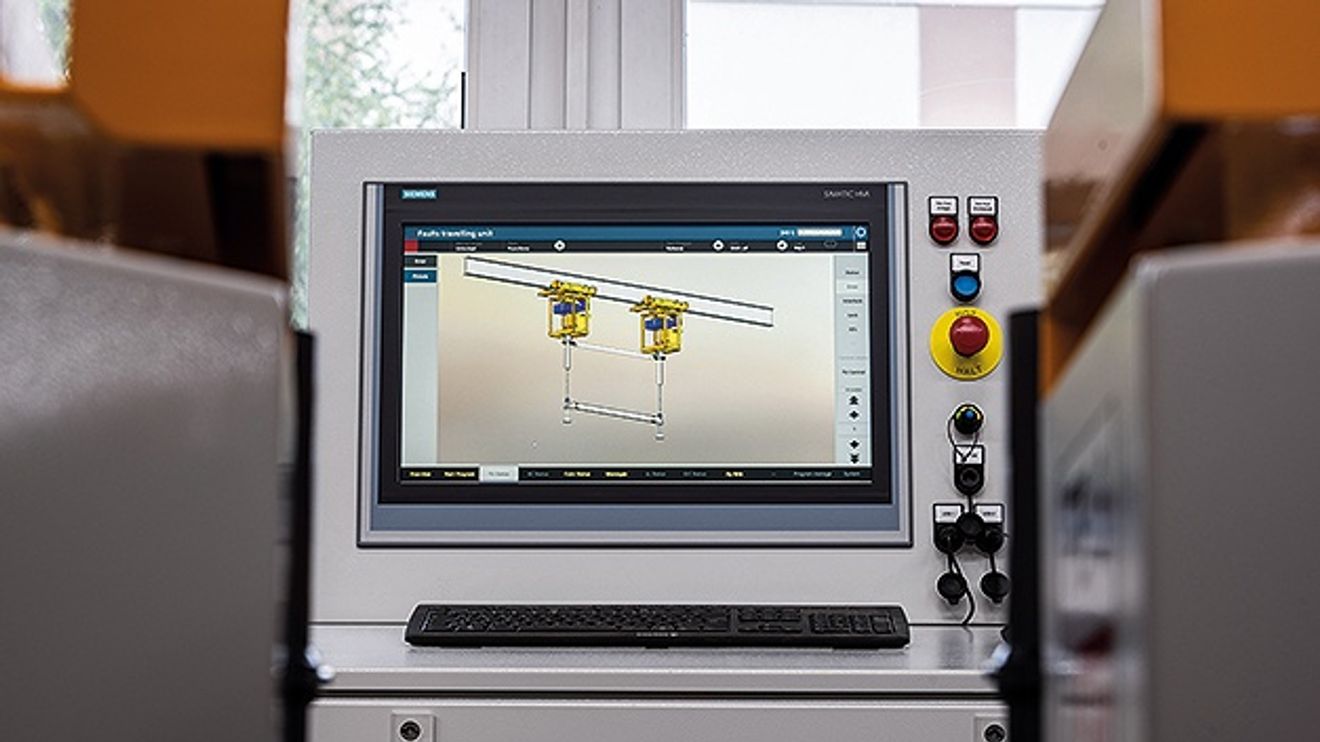
Industrial PC with Simatic WinCC Unified: robust hardware and convenient software for a harsh industrial environment.
© SiemensOther features include flexibility and openness through the support of standard interfaces such as OPC UA, MQTT or REST API. These are crucial for easy integration into existing IT infrastructures, for example into higher-level MES/ERP systems and for connecting third-party automation systems. The completely newly developed WinCC Unified System also impresses with its combination of PC-based visualizations with panels directly on the machine, as a solution with a uniform look and feel and consistent functionality.
Simatic WinCC systems are just as long-term available as the Simatic IPCs, expandable over many years and standardized. Together, they create a flexible, open platform with numerous integrated functionalities such as a library for standardization and more efficient process operation. With the help of software extensions and special certifications (ATEX, marine, etc.), systems can be designed for different industries, from small to complex configurations.

The combination package also scores points in the increasing linking of OT and IT levels: Simatic IPCs are certified for connection to cloud systems from common providers, offer extensive gateway functions and, in conjunction with end-to-end data integrity, enable flexibly scalable networking - from local to global. With the HMI software, data is recorded locally, pre-processed and transferred to the cloud for central evaluation. This makes it possible to set up classic edge structures.
This benefits companies such as Thyssenkrupp Steel Europe, which modernized its almost 60-year-old hot-dip coating plant with an intelligent virtualization and redundancy concept. The existing virtualization solution could not be technically expanded, so the company opted for a combination of Simatic IPC547 and the SCADA system Simatic WinCC V7 as a redundant control system in a virtual IT infrastructure. Thanks to the combination with a central data archive server, detailed long-term evaluations of plant availability, efficiency, energy consumption and quality are now possible. Access is via 27 operating stations or the intranet, which also facilitates support from service technicians.
Ready for the networked future

The authors: Brigitte Händler, Marketing Manager HMI/SCADA (left), and Wolfgang Lay, Marketing Manager IPC, work at Siemens in Nuremberg.
© SiemensThe open architecture of the HMI system combined with a high level of system compatibility enables modernization. Initial approaches for implementing artificial intelligence are already embedded in the diagnostic functions and reduce inspection and test times. Service and maintenance aspects also contribute to a long life cycle: For example, the embedded PCs contain no rotating parts such as fans or hard disks. For all PCs - with and without fans - the operating hours, status of the storage media and other diagnostic data are displayed in the runtime environment of the HMI system and can be called up locally or remotely. Necessary maintenance work can thus be carried out preventively during downtimes. Such integrated diagnostic functions for an overall system consisting of PLC, network components and IPC hardware help to detect and rectify faults more quickly. In addition, long-term service operating systems ensure long-term availability in the same way as visualization software and hardware.
All these factors contribute to increased plant availability, reduced service costs and shorter downtimes, making the combination packages of Simatic IPCs and Simatic WinCC a reliable, high-performance choice.
|
Engineering with Simatic WinCC |
|---|
|
Siemens partner Galva Anlagen-Technik is a manufacturer of transport systems for hot-dip galvanizing plants and a provider of retrofits for existing systems. The environmental conditions in hot-dip galvanizing plants are harsh and demanding. For transport units in such a plant, a visualization solution was sought that could be used for around ten years. Galva not only supplies the drive units, but also looks after the installed systems afterwards. For this reason, the requirements for the HMI system also included the ability to conveniently maintain the systems. In addition to the Simatic HMI Unified Comfort Panels, the choice fell on a central operating station in the form of a combination package of robust Simatic IPCs and the Simatic WinCC Unified Runtime software. On the one hand, the visualization solution benefits the end customer, as the drive units can also be controlled via a central operating station and all process information is available there. On the other hand, Galva also benefits from the shortened engineering of the visualization: When developing projects with up to 20 drive units, the effort required to create templates and make changes is considerable. With Simatic WinCC Unified, the representations of the drive units are generated dynamically and changes are automatically updated in all screens. This means that the integrator only needs 20% of the time for engineering compared to the previous system. For this reason, the company is considering dynamizing scalable vector graphics (SVG) in future in order to be able to display faults with pinpoint accuracy. This is also possible on the basis of Simatic WinCC Unified. You can read more about the application here: https://sie.ag/3oioN4a |


You might also be interested in
Visualization overcomes boundaries
Until now, the worlds of operation and monitoring were separate: here machine-oriented operation, there plant-wide monitoring. Modern visualization systems act as a gateway from OT to the IT world, enabling a consistent solution for HMI and SCADA...
 read more...
Ethernet APL is here!
Ethernet with an Advanced Physical Layer (Ethernet-APL) enables long cable lengths, explosion protection, communication and power supply via two wires. The first devices with this interface are now coming onto the market.
read more...AI classification for safety
Artificial intelligence is seen as a solution to current challenges in various areas of life. Politicians are promoting AI, but would like to assess the consequences of the technology and regulate it if necessary. The use of AI for security tasks is...
read more...First control cabinet made of green steel
The Siemens subsidiary Alpha Verteilertechnik claims to offer the first control cabinet for industry made entirely of green steel.
read more...Siemens quarterly figures Q3-2024
Siemens confirms forecast with a "but"
Siemens is struggling with a weakening automation market in the third quarter. The software business, on the other hand, is developing strongly. It remains to be seen whether this will continue after the switch to a SaaS model.
read more...Edge rack server in robust
The trend towards hyper-convergent infrastructures is not stopping at the manufacturing and automation industry. Siemens has now launched the first edge rack server in robust industrial PC quality. How is the inner workings of the server designed?
read more...The e-paper of issue 07/2024
Read in the current issue of Computer&Automation how ChatGPT can provide support in the conception phase, how LLMs are used in code analysis and whether TSN can be considered as a backbone for virtualized control systems.
read more...For personal use
Siemens operates vertical farming for its own use at its site in Frankfurt. Siemens technology is used here. What works here on a small scale is also a future field for agriculture in general.
read more...Siemens sells Innomotics for 3.5 billion euros
Siemens sells Innomotics to KPS Capital Partners for 3.5 billion euros. Preparations for an IPO of the manufacturer of electric motors and large drives were announced in November.
read more...