
Siemens
AI classification for safety
Artificial intelligence is seen as a solution to current challenges in various areas of life. Politicians are promoting AI, but would like to assess the consequences of the technology and regulate it if necessary. The use of AI for security tasks is considered below.

The concept of AI has changed a lot over the decades since it first appeared. Where once a clever nesting of 'if-then-else' statements was already considered AI, today mechanisms such as machine learning (ML) or knowledge graphs are understood. Various committees have dealt with the topic of an AI definition, but Wikipedia surprises with a practical description with an interesting approach: "Artificial intelligence usually refers to the attempt to emulate certain human decision-making structures, for example by building and programming a computer in such a way that it can process problems relatively independently. However, it is also often used to describe an imitated intelligence, whereby 'intelligent behavior' is simulated using mostly simple algorithms."
It should be noted that in 2021, applied artificial intelligence is still an attempt to simulate certain decision-making structures and, in specific applications, could even be nothing more than an imitation of intelligent behavior. These signs are rather unfavourable for use in the security environment (safety stands for safety and not for security, i.e. information security), as the risk-minimizing properties must be evaluated based on evidence. This means that the first use of AI in security applications - as in other areas when using new technology - raises the question of proportionality.
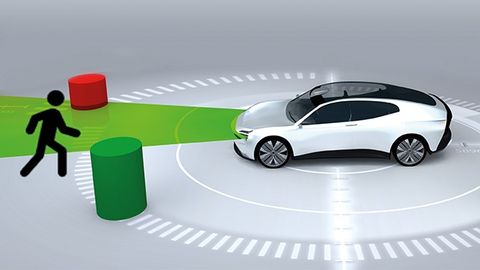
Developing known structured scenarios for safety applications with AI would be the next logical step in the evolutionary development of technology. One example of this is object recognition in vehicles.
© SiemensThese considerations initially mean stability for existing solutions. However, this increases the pressure on solutions with AI for current, more complex problems.
While it was generally sufficient to evaluate switching states, currents or voltages for safety functions in the past, there are now questions regarding the detection of various obstacles or even their characterization. The increase in this systematic complexity goes hand in hand with the use of sensors, such as CCD cameras, which were not previously used in a safety-oriented manner. This difficult task is to be mastered with AI, whereby even simple AI applications pose a challenge when it comes to verifying safety. However, the use of AI for simple applications, such as the evaluation of secure electronic signals, is less attractive in terms of the market and research, even if this would initially be appropriate for the development of suitable methods
Possible approaches are therefore being discussed as part of the standardization process and are to be described in the technical report (ISO/IEC TR 5469 of JTC 1/SC 42/WG 3).
Classification of AI for safety tasks
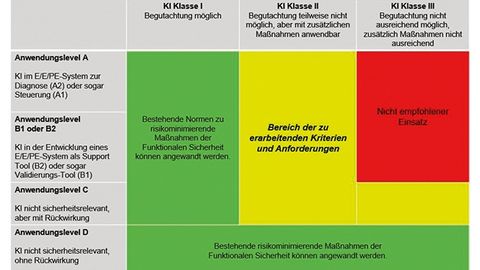
The starting point for the considerations remains the risk analysis, which can be appropriately applied to the conditions in various areas of application. Together with the proposed classification of the safety-related context of AI, specific recommendations can be assigned with regard to the evaluation.
The AI classification represents the context of the use of AI methods/techniques in relation to the E/E/PE system (electrical and/or electronic and/or programmable electronic system; according to IEC 61508), and shows the areas for which AI is assessable according to existing rules of technology, or in which criteria and requirements still need to be developed.
Application levels A to D are intended to help assign requirements to the respective application:
- Application levels C and D use existing security concepts to reduce risk. Artificial intelligence does not yet play a role here.
- Application level B refers to the use of AI in the development of safety systems.
- Application level A stands for the direct use of AI in a safety function. The suffixes '1' and '2' denote the decision-making authority of the AI, with 'A1', for example, standing for direct use in the safety-relevant main channel and 'A2' for indirect use, such as in the context of diagnostics.
The AI classes are not technology-related, i.e. certain technologies such as neural networks or machine learning do not automatically belong in a specific class:
AI Class I, for example, refers to existing classical methods of developing a safe 'intelligent system', for example according to IEC 61508, where the underlying code and its effect are fully traceable and understandable for the developer.
AI Class II is now a system that uses AI methods/techniques that do not lead to results that can be understood by humans in all respects, but it is still possible to meet appropriate criteria and requirements through extended measures. These criteria have yet to be developed.
Class III AI is beyond the scope of Class II and can ultimately only be used for systems of application level D that do not have to rely on AI for safety.
Man as an intelligent entity
The table above shows that it may well be appropriate to use existing standards such as IEC 61508 to evaluate certain applications. This is always the case when it comes to more traditional methods of simulated intelligence (AI Class I). This is because what a person considers to be intelligent behavior of a system is subject to subjectivity anyway and also represents the difficulty in defining AI discussed at the beginning.
This classification of AI applications can help to open up suitable areas for the use of AI in the context of risk analysis, including in a safety-related context, taking into account the existing state of the art. It will be challenging to develop specific requirements in order to be able to adequately assess AI Class II with suitable methods for certain AI technologies in terms of safety.
In conclusion, it should be noted that humans are relevant as intelligent entities in all AI considerations, both in the definition of the application and the selection of the underlying data, as well as in the development of the AI algorithm itself. If this were no longer the case, humans would also have become irrelevant for further evolution. However, the development of AI is not yet foreseeable, but the effects of human decisions in the development and operation of AI are much more far-reaching than is widely perceived.


You might also be interested in
Zero Trust in OT/IT environments
Siemens and Zscaler cooperate
The aim of the cooperation between Siemens and Zscaler is to enable secure and needs-based remote access to OT systems without exposing the OT network to an increased threat potential.
 read more...
The "GeMeKI" research project
The GeMeKI research project at the WZL at RWTH Aachen University is investigating the use of transferable AI applications to optimize production.
read more...Edge AI applications simplified
Aetina's DeviceEdge Mini edge AI-enabled computer extends the company's 'DeviceEdge' platform range.
read more...Portfolio expanded
Siemens is adding new servomotors to its 'Sinamics S210' single-cable servo drive system.
read more...Safety - the winners!
Nomen est omen: The people behind the award-winning products were certainly delighted to receive the award in the Safety category. The winners at a glance.
read more...AI marketplace goes live
Work on the AI marketplace project took a year. Now the platform for artificial intelligence is going live.
read more...Robotic artificial intelligence you can touch
Making artificial intelligence tangible through humanoid robots - this is the aim of the 'Robotic Artificial Intelligence' real-world laboratory at the Karlsruhe Institute of Technology (KIT).
read more...Artificial intelligence at the edge
The edge computer is based on an Intel Celeron or Intel Core i3/i5/i7 processor and has various interfaces, including one HDMI, three USB 3.0, two Gigabit LAN and two wireless expansion slots for Wi-Fi and LTE with four SIM slots.
read more...More software safety and security through coding standards
Software is penetrating products, devices and areas where it seemed impossible. Developers have to deal intensively with the software in these products and the resulting consequences and adopt an engineer's perspective: Engineering is required.
read more...