

Project 'MARI'
Intelligent assistance systems for SMEs
An assistance system for SMEs - mobile, intelligent and modular: This is the aim of the 'MARI' project initiated by the Institute for Industrial Information Technology.
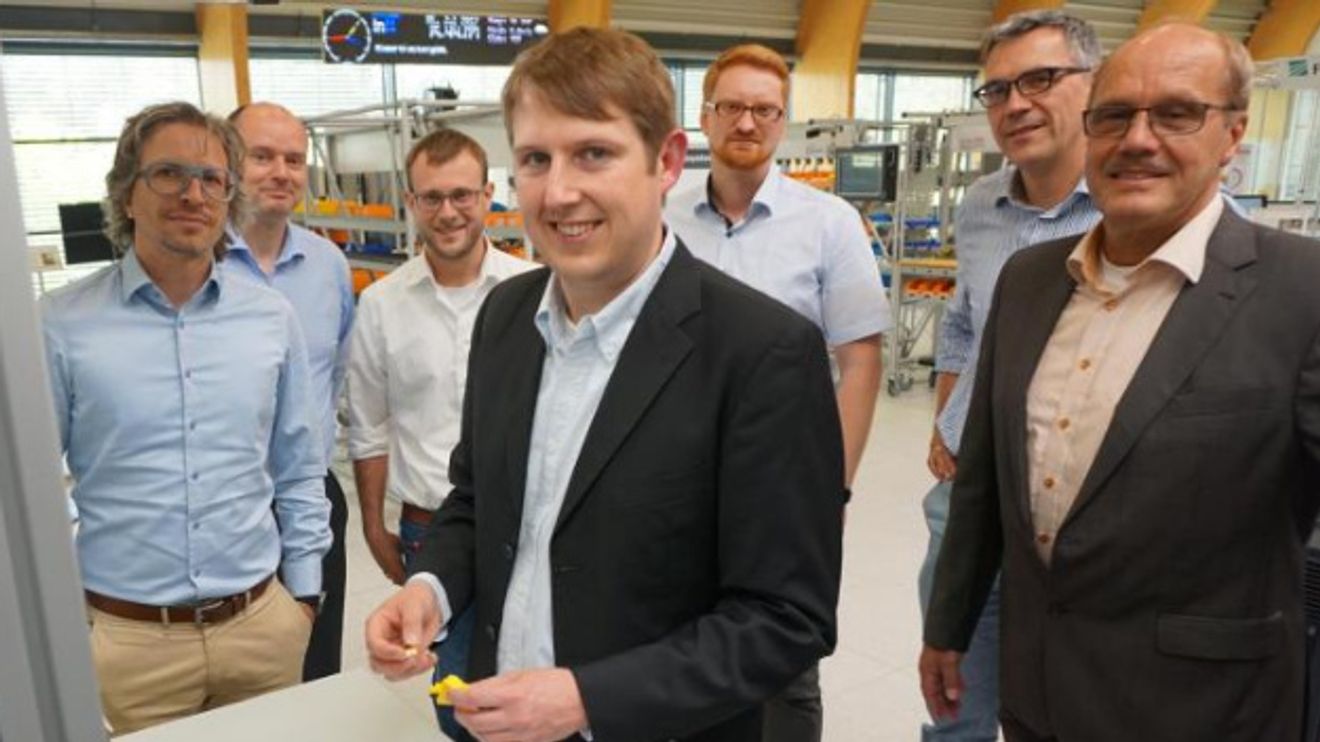
Assistance systems to support production, assembly and quality assurance are currently not very widespread in SMEs. In order to support employees in production with such modern technologies in the future, "new mobile solutions are needed in particular that can be used anywhere in the company and are not tied to stationary workstations," explains Professor Carsten Röcker, project manager and director at the Institute for Industrial Information Technology (inIT).
This is the starting point for the "MARI" research project, which was launched in mid-July and is being funded by the Federal Ministry of Education and Research (BMBF) with around 450,000 euros over a project period of four years. The project name MARI stands for "Augmented Reality Assistance Systems for Mobile Application Scenarios in Industry". In addition to the Institute (inIT) at OWL University, the companies Bosch Rexroth and Wassermann Technologie are involved in the research project as cooperation partners. The Fraunhofer Application Center IOSB-INA is providing scientific support for the project.
Together with the partners from industry and research, the scientists from Lemgo want to develop and evaluate the prototype of a modular and intelligent augmented reality-based assistance system for mobile application scenarios in SMEs.
Mobile, intelligent and modular
Regarding the aim of the research project, Röcker says: "The system to be developed will be mobile and is therefore suitable for many application scenarios. By learning new tasks during the one-time execution and covering a wide range of industrial activities, employees can also be supported using artificial intelligence." The modular structure should enable the system to be adapted quickly and easily to different activities in production, assembly or quality assurance. According to inIT, the system can recognize and analyse work activities multimodally thanks to the integrated sensor technology and use this to create models for the future assistance of manual activities.
The modular design should also allow different interaction components to be combined depending on the application: "Various interaction devices can be connected via a generic interface, such as wearables, AR data glasses or eye trackers, which can be combined with each other," says Röcker, explaining the procedure. This allows employees to use the right interaction devices for the current application: For example, they can switch from a tablet with projection to AR glasses if they need their hands free to repair a system.
For the Lemgo scientists, intelligent assistance systems are the key to making the increasing complexity of systems manageable for people.


You might also be interested in
The flying assistance system
The projects of Festo's 'Bionic Learning Network' are always worth an eye-catcher. This year, the company presented the indoor flying object 'FreeMotionHandling' at the Hannover Messe.
 read more...
Machine optimization through big data and AI
By analysing data using artificial intelligence, production systems should be able to detect errors and optimize themselves in the future. However, the integration of suitable solutions in companies has often failed to date. This is where the...
read more...Follow-up with Alexander von Birgelen
Condition Monitoring 'improved'
New models from the 'Improve' research project promise a universal solution for data-based condition monitoring - also with the help of artificial intelligence, as Alexander von Birgelen from inIT at Ostwestfalen-Lippe University of Applied Sciences...
read more...Real-time networking with 5G
14 German companies and organizations have joined forces in the 'Tacnet 4.0 - Tactile Internet' project. Together, they want to develop a standardized system for industrial communication in real time - based on 5G mobile technology.
read more...A new network architecture
Laying the foundations for the future of the industrial internet - this is the aim of the 'Find' research project. Under the leadership of the DKFI, an intelligent network management system for Industry 4.0 is to be developed.
read more...Lohweg replaces Jasperneite
Volker Lohweg takes over the management of the Institute for Industrial Information Technology (inIT) at OWL University. The former board member replaces Jürgen Jasperneite after eleven years at the helm.
read more...Artificial intelligence in production
BMWi project 'OPAK' completed
Software that largely programs itself - this is the goal that Lemgo scientists have been pursuing together with companies from the automation industry as part of the 'OPAK' project. After three years of research, the project has now been completed.
read more...Intelligence for maintenance
How can companies simplify the maintenance of industrial plants? Scientists at inIT are addressing this question in the 'ADIMA' research project.
read more...Industry 4.0 factory SmartFactoryOWL opened
The SmartFactoryOWL research and demonstration factory was officially opened in Lemgo in mid-April. The future factory is intended to provide scientific support for new Industry 4.0 technologies, test them in practice and make them tangible for SMEs.
read more...