
Start-up
Augmented reality glasses for 29 euros
Five master's students from the University of Twente are launching a pair of augmented reality glasses on the market - for just 29 euros. The glasses add 3D visualizations to the real world.
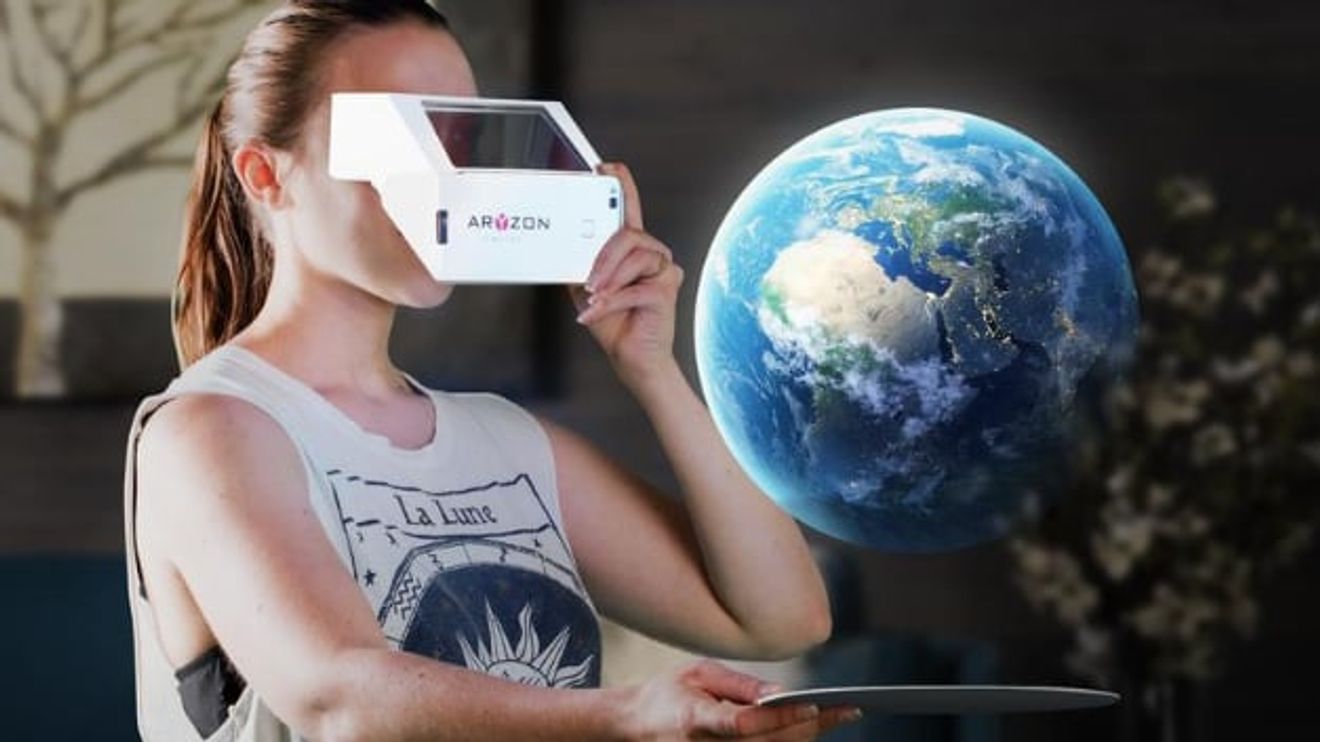
With the augmented reality glasses from Aryzon, the world is within reach - and it's even quite affordable.
© AryzonAryzon, the new augmented reality glasses, fit through any letter slot: the glasses are delivered as a cardboard kit - for 29 euros. They work in combination with a smartphone app and augment the real world with virtual hologram images.
The five master's students from the Industrial Design Engineering course at the University of Twente (UT) have developed an associated online platform that allows users to upload and download visualizations for the VR glasses.
The Twente students hope that the market launch of the Aryzon at a very affordable price will lead to widespread use of augmented reality technology. One of the student entrepreneurs is Leon Schipper. Together with the initiator Maarten Slaa, Kay Hoogsteder, Niels Ruiter and Alex Ceha, he founded the start-up company Aryzon. Schipper: "There are still no comparable glasses that are affordable for the masses."
Aryzon vs. HoloLens?
Microsoft's HoloLens, for example, costs 3,000 US dollars over the counter. For many people and companies, such a price is hardly affordable. Schipper is of the opinion that hardly any museum would invest in augmented reality glasses for visitors at such prices.
"Our low-cost solution makes augmented reality interesting and affordable for anyone with a smartphone," explains Schipper. However, the start-up does not want to compete with the HoloLens. Instead, the affordable Aryzon glasses are intended to complement the market. Nevertheless, according to UT scientist Roy Damgrave, the glasses offer many functions that are comparable to those of the HoloLens.
Possible applications

The Aryzon founders are studying for a Master's degree in Industrial Design Engineering at the University of Twente.
© University of TwenteThe augmented reality glasses with their 3D simulations and visualizations are suitable for various applications. According to Schipper, the glasses help when furnishing homes or selecting webshop products. The glasses also offer interesting possibilities for museums and educational institutions.
Augmented reality glasses can even be useful for medical purposes. The inexpensive glasses are also suitable for developers of today's 2D augmented reality apps for smartphones. They can easily adapt their applications to Aryzon. A good example of this is Ikea's augmented reality app, which can be used to place pieces of furniture in 2D in your own home.
Aryzon as Kickstarter
The students have now launched a crowdfunding campaign on the Kickstarter platform with their start-up Aryzon. The aim is to raise seed capital of at least 25,000 euros by July 3 to cover the production costs. "There are various packages to choose from on Kickstarter," explains Schipper.
Among other things, quick decision-makers can select the 'Early Bird' package. This gives them the Aryzon glasses for just 24 euros. "We are creating a platform with visualizations that can be downloaded and used to reach as many people and markets as possible." The platform will be expanded further depending on the revenue.
The technology behind the AR glasses
There were many influencing factors in the development of the glasses. According to Schipper, the incidence of light had to be partially reduced to enable projections. This requires special plastic lenses that ensure a corresponding reduction without obstructing the view in the real environment. "We use Fresnel lenses, the quality of which is very important," explains Schipper. The students also consider the user experience when designing 3D models. For example, the models have to come into view at realistic distances in order to be perceived as real. Good algorithms are essential for this. "Our software also recognizes the interaction between the fingers and the model. This allows you to zoom further into the model, for example. And we use high-quality cardboard," reports Schipper.


You might also be interested in
'Hololens' glasses coming to Europe
The 'Hololens' from Microsoft is now also available in Germany. The augmented reality glasses open up new application scenarios - including in the areas of manufacturing and engineering.
 read more...
Converging Digital Twin Models
Siemens and Microsoft are working together to facilitate the exchange of digital twin models and data. To this end, they are merging Digital Twin Definition Language with the W3C Thing Description Standard.
read more...Facilitate the replacement of digital twin models
Siemens and Microsoft are working together to facilitate the exchange of digital twin models and data. To this end, they are merging Digital Twin Definition Language with the W3C Thing Description Standard.
read more...Vodafone and Microsoft agree on comprehensive partnership
Microsoft's share price has shot up in recent months in anticipation of good business with AI applications. Now the first major orders are trickling in. In return, Microsoft is buying telecommunications solutions on a large scale.
read more...The e-paper special: looking for products of the year 2024
They've earned it: all 96 nominated products from 12 categories in their own e-paper. Browse through the individual areas and make your personal selection. You can also find out more about the companies and their solutions in the accompanying video...
read more...AI is what we make of it
Everyone is talking about generative artificial intelligence. But what added value does it bring? How can it be integrated into industrial processes? An assessment from Microsoft.
read more...25 years of Computer&Automation - The e-paper
For 25 years, Computer&Automation has accompanied the growing influence of IT in automation technology. Ultimately, IT and automation can no longer be clearly separated. In this anniversary issue, you can read about the importance that...
read more...The top articles in May 2023
The fact that the fight against climate change is undisputedly the biggest global challenge is also reflected in the most-read articles of May. New applications with the digital twin and trends in AI in dialog continue to top the list.
read more...The chatbot as a teacher
The potential of text-based dialog systems is demonstrated by a free interactive online course from Münster University of Applied Sciences. A chatbot acts as a teacher to teach the basics of programming.
read more...