

Automated guided vehicles
Compact controls and drives a must
Smart factories promise operators a high degree of flexibility - for example through the use of driverless transport systems or mobile robot solutions. The automation of these subsystems in turn requires extremely compact control and drive concepts.
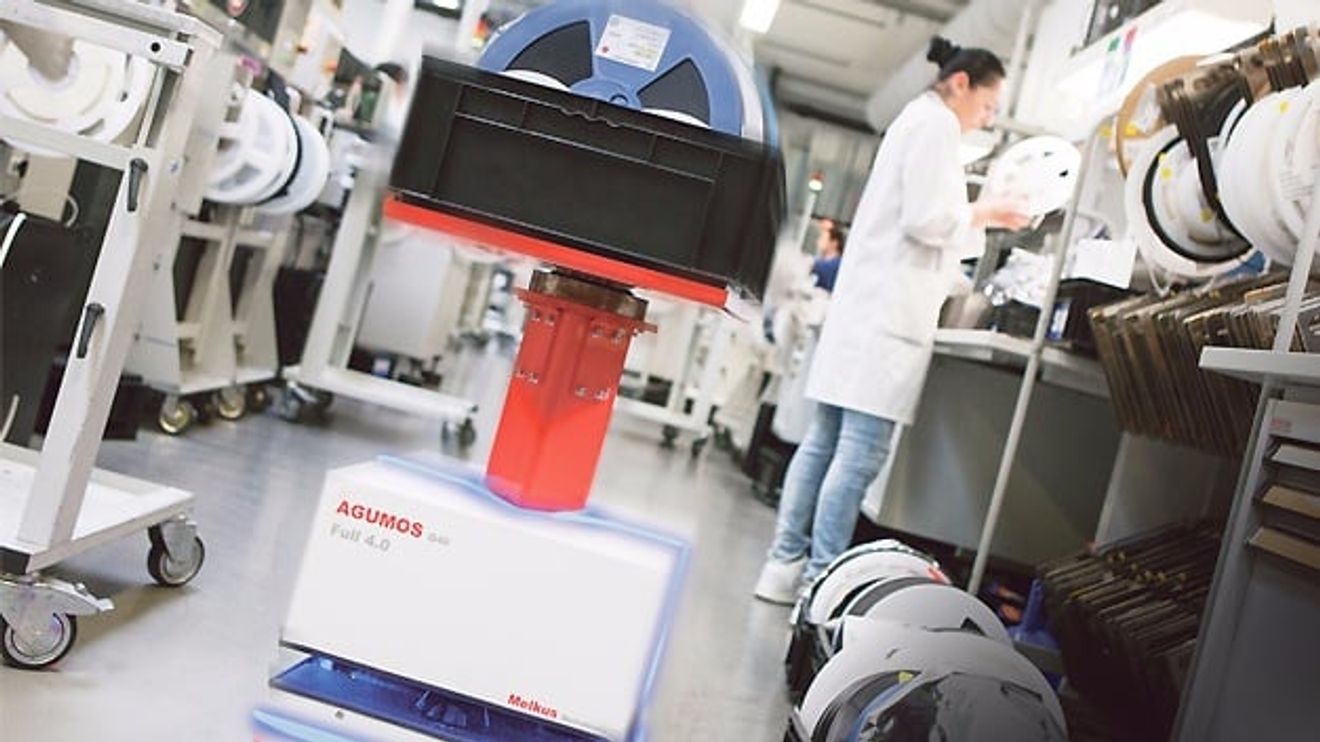
The production plants of the future are no longer homogeneous. Ever smaller functional units will be designed as independent modules and only switched on as required. As permanently installed handling and conveyor systems are not flexible enough, driverless transport systems (DTS) will increasingly take over internal transportation tasks in the future. They can react flexibly to changing requirements and close the gap in the chain of automated processes within a factory. In short: AGVs are an integral part of smart factories and must therefore be integrated into the overall automation system.
AGVs as an automation benchmark
The control and automation technology used in mobile plant components has to meet high requirements. In addition to sequence control, it often has to master mathematical tasks in order to implement the movement commands from the master control system. In the case of freely navigating systems, the course taken must also be constantly checked using magnetic points, laser reflectors or optical features of the surroundings.

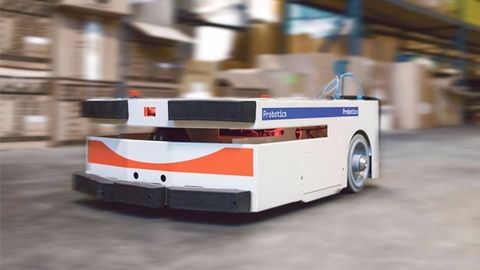
... the AGV (automated guided vehicle) from Directech will be on the move in increasing numbers in future, for example in rack aisles or on assembly lines.
© DirectechThe drive technology, in turn, must not only control the drive motors, but also auxiliary drives, such as lifting, turning or pushing units for material transfer. In addition, visualization directly on the vehicle is often required, including intervention options for special operational cases and maintenance. Not forgetting the issue of functional safety, as it is particularly important to minimize the risk of accidents with freely moving systems.
Whether track-guided as mobile platform carriers in assembly lines or freely navigating for flexible material provision: Inside the mostly very compact driverless transport vehicles, there is usually extremely little space available, and even that is often not continuous, but divided into several small cavities. The permissible power consumption in battery-powered vehicles is also very limited. Not least because of their size and power consumption, series devices for industrial automation were not very suitable for such applications in the past.
Communication - a particular challenge
Another special challenge is communication - it can only take place wirelessly. Today, WLAN is usually used for this purpose. In the absence of cabling, safety-relevant signals must also be transmitted wirelessly. This is an issue wherever driverless transport vehicles dock onto machines or production cells for material transfer. For this purpose, the safety equipment of both the cell and the vehicle must allow exceptions to their rules. At the same time, however, protection against physical injury must be maintained. To explain: the safety control system of a production cell must stop the safe action when requested by the AGV, for example when a light grid is penetrated, so that the vehicle can drive in. Ideally, it knows the contour of the vehicle so that it 'allows' the safety violation after this request, provided that only the appropriate light barriers in the entire light grid are attenuated. If other elements are attenuated - for example because a person accidentally penetrates the light curtain at another point immediately after such a request but before the vehicle - the protective violation is still triggered. The possibility of such a situation occurring at all is prevented mechanically wherever possible, but can never be completely ruled out.
But that's not all: the floor of a factory building is never completely smooth or even. Therefore, the behavior of the travel drives is never as uniform and predictable as in a machine tool, for example. As a result, the control and visualization systems must be able to cope well with vibrations and shocks.
For all these reasons, in the past, AGV manufacturers usually developed and produced the control systems for their vehicles on a task-specific basis. In view of the relatively small quantities of the often system-specific vehicles, this is not only an enormous cost factor for new systems. It also makes the long-term stocking of spare parts more difficult and expensive and therefore has a negative impact on maintenance and the total cost of ownership. It also means that individually programmed interfaces are required, which ultimately makes it difficult to seamlessly integrate automated guided vehicles into overall solutions and also hinders the subsequent connection of AGVs to surrounding systems after they have been modernized.
Miniaturization makes it possible

A look inside the Packmann 200 shows the vibration-resistant S-Dias system with motion control and safety and two AKM low-voltage DC servomotors.
© Thorsten Sienk / KollmorgenAgainst this background, the demand from AGV manufacturers to move away from the previous special developments is more than understandable. In order to meet this demand, one thing is absolutely essential: the consistent miniaturization of series automation, as Sigmatek has implemented in the S-Dias I/O series, for example. With up to 20 I/Os on just 12.5 mm × 103.5 mm × 72 mm, the device family in pocket format is not only particularly space-saving; it also combines fast signal processing (bus cycle times under 100 µs) with convenient handling and high vibration resistance as a result of mechanical cross-locking and the use of robust connectors with a two-point contact principle.

With the S-Dias module series, Sigmatek has made classic industrial automation systems suitable for mobile plant components, including the necessary drive technology with integrated safety functions.
© SigmatekDepending on the application, various CPU modules with edge technology supplement the I/O system, which are also suitable for multi-CPU concepts. During their development, the focus was not only on performance but also on consumption data: for example, the CP 111 CPU DIN rail module with 800 MHz clock frequency and only 2 W power dissipation is predestined for use in battery-powered applications. And since open data exchange is an absolute must in 'Machine Concepts 4.0' - whether horizontally in a machine network or vertically with higher-level systems such as MES, ERP or cloud solutions - all CPUs and also the HMIs with Edge2 Technology processor from Sigmatek support OPC UA.
Finally, S-Dias communicates via the hard real-time Ethernet bus Varan at 100 Mbit/s. Ethernet and USB interfaces are also available, and a WLAN connection is available for the wireless connection of external system components.
Secure signals via WLAN
As already mentioned, functional safety is particularly important for mobile applications and has therefore been integrated into S-Dias right from the start. The corresponding safety components comply with SIL 3 or SIL CL 3 in accordance with EN ISO 13849-1/-2, category 4, PL e and IEC 62061. In addition to the safety controller, various safe input and output modules are available in compact I/O format. Particularly noteworthy are the SRO 021 with two safe relay outputs, the SSI 021 for safe evaluation of the signals from two SSI absolute encoders and the SNC 021, which enables the evaluation of two incremental encoder signals for safe monitoring of speed, position, direction of rotation and acceleration.
The integrated safety technology is designed in such a way that the signals can be transmitted securely via black channel over any communication path - even via WLAN. This enables developers to design parts of machines and production systems - such as driverless transport vehicles or wireless hand-held operating devices with emergency stop buttons such as the HGW 1033 from Sigmatek - regardless of location.
New servo output stage with STO
Finally, a wide range of I/O modules with different functionalities enables interaction with all types of sensors and actuators. For example, there are special modules for counters, position measuring systems and thermocouples, for axis positioning, current control and measurement technology. There are also corresponding modules for motion control, which are ideal for use in location-independent units thanks to their compact design and high functional density. The servo motor output stage with 'Safe Torque Off' function, the DC 061 with resolver and DC 062 with incremental encoder input, for example, is predestined for AGV traction motors. A new stepper motor module for controlling two-phase stepper motors (ST 151) will be added at SPS IPC Drives. This has an incremental encoder input for position feedback and STO. The SR 022 module for controlling DC motors is also equipped with an incremental encoder.
Finally, the compatibility of the automation solution for semi-autonomous system parts with the surrounding system begins with the software development: In the case of the Sigmatek solution, the complete sequence, motion and safety technology as well as the visualization are developed with the object-oriented development environment Lasal, which particularly supports a modular, mechatronic machine design. In addition, Lasal contains extensive libraries with tested technology modules that significantly reduce the programming and testing effort. Last but not least, options such as OPC UA, VNC repeaters or integrated web servers are available for connecting external systems or remote maintenance mechanisms via the Internet.
Author:
Franz Aschl is responsible for innovation management at Sigmatek.


You might also be interested in
The future of CANopen
Similar to the automotive industry, industrial automation also requires more and more bus bandwidth. In addition, the cloud is becoming increasingly important in terms of communication. How does the CAN protocol, which has long been established in...
 read more...
Unauthorized access fended off
Plant modernizations often require new safety precautions. This was also the case for a manufacturer of cleaning agents and disinfectants, who had to safeguard the material flow in the area of a roller shutter door, among other things.
read more...WLAN in the factory - the selection criteria
WLAN is suitable for various applications in the factory. However, due to the many influencing factors, it is not always obvious how a network based on the IEEE 802.11 standard can be optimized to meet the requirements of industrial use. - Here is...
read more...Simply integrate safety
Machine and system manufacturers are increasingly turning to mapping safety functions via the communication bus. How can integration on the component side be achieved with reasonable effort?
read more...Flexible buffering via software
The complete automation of manual or semi-automatic processes is a major challenge with very short cycle times. When it comes to workpiece carrier transport, the machine manufacturer Goldfuß relies on a system that allows the creation of flexible...
read more...Individual IoT systems
How big? How much power? How robust? Which housing? The requirements for IoT systems are extremely varied. By designing individual embedded applications, devices can be created that are perfectly tailored to the application.
read more...A digital image
The digital twin accompanies machines and systems throughout their life - from the initial idea to ongoing operation and a look into the future. The aim is to avoid errors, optimize systems and prevent failures.
read more...Stumbling blocks with direct current
The question "direct current or alternating current?" is becoming increasingly important - not least due to the increasing use of renewable energy sources that generate direct current. When switching and protecting with direct current, however,...
read more...Traceability optimized
Directly marked 2D data matrix codes ensure the traceability of engine and transmission parts at KIA Motors. Read rates of 99 % are the target.
read more...