
Cable routing
Hybrid cables under constant stress
What properties must single-cable solutions for servomotors have to ensure that communication via the integrated encoder cable functions reliably even under mechanical stress in highly dynamic drag chain applications? Shielding is particularly important here.
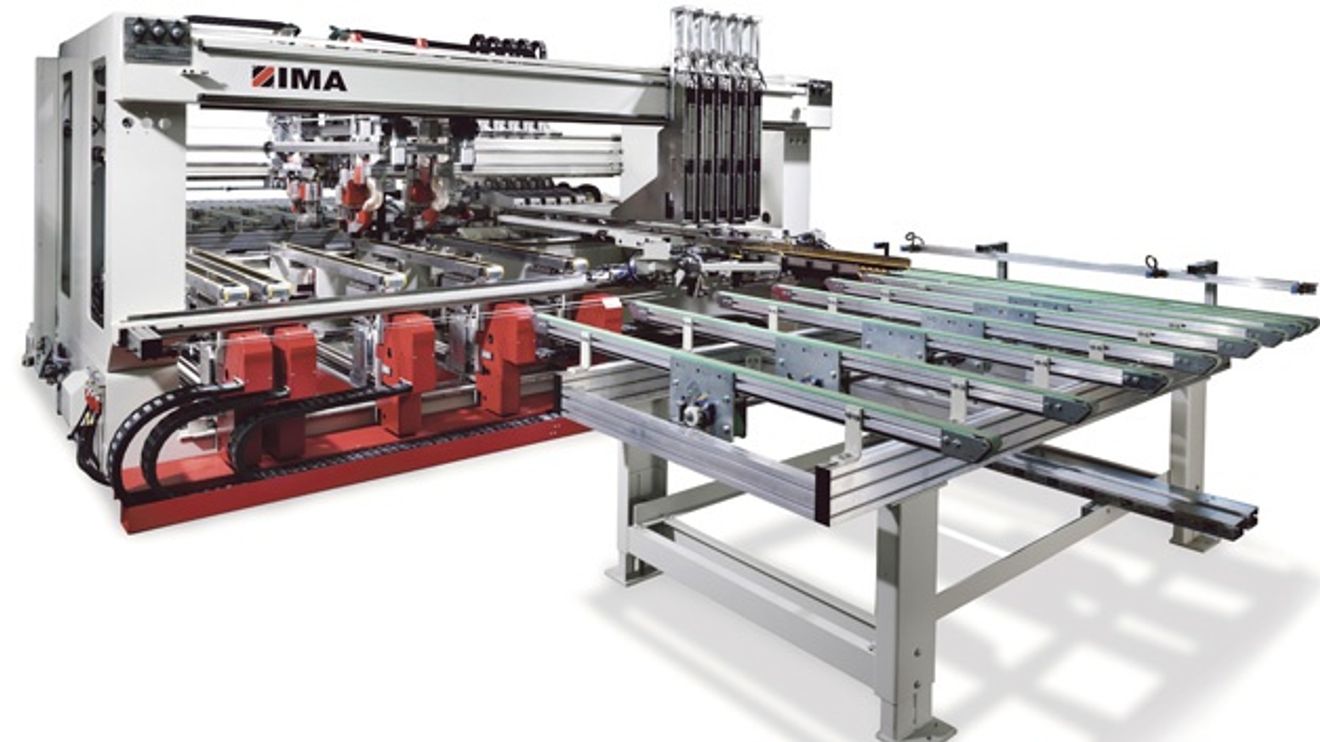
When introducing single-cable technology, the choice of the right special cables is crucial. This is shown by the example of IMA Klessmann, an internationally active manufacturer of machines and production lines for woodworking in the furniture industry. Since the beginning of 2015, the company has been using 'OCT' (One Cable Technology) single-cable technology from Beckhoff for its drilling systems and production machines for CNC processing. This includes the 'Topserv' hybrid cables for servomotors from Helukabel, which are suitable for highly dynamic drag chain applications. These cables are used, for example, in the 'Imagic' drilling systems, where they are exposed to continuous mechanical stress caused by tight bending radii and high bending cycles in the drag chains as well as abrasion caused by wood dust.

Drilling systems for woodworking from IMA place high demands on the cables in drag chains. The picture shows several drills preparing a piece of furniture for further processing.
© IMA KlessmannIMA drilling machines are used stationary or as throughfeed machines in the furniture industry. At throughfeed speeds of around 30 m/min, several drills simultaneously drill horizontal and vertical holes in the workpieces, which are later used to assemble living room, bedroom or office furniture, for example. Up to 90 axes can be involved in such an application.
Focus on shielding
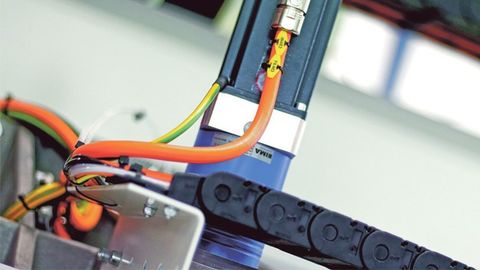
With the hybrid cable, the feedback wires are carried directly in the servo cable.
© Helukabel / Detlev Haake HZWEIAManufacturers of hybrid cables are now facing special challenges in order to provide machine builders with long-lasting cables. Helukabel, for example, presented a standard cable for single-cable technology in spring 2014 with the 'Topserv' servo cable series. At that time, drive manufacturers had no long-term experience with the technology in the field. However, thanks to realistic drag chain tests, Helukabel was able to confirm that the shielding of the encoder cable was still functional even after well over 5 million cycles and that encoder signals transmitted via Hiperface DSL could be read perfectly.
The quality of the signal arriving at the receiver is fundamentally relevant to the question of whether the motor turns: the less external interference penetrates the signal element, the cleaner the data arrives at the receiver. The shield of the data pair is responsible for protection against EMC emissions. The longer this remains intact in use, the longer the protective function is maintained.
While servomotors were connected to the controller with separate cables for the power supply and encoder signal in the traditional two-cable solution, the encoder cable for the motor feedback is integrated into the servo cable in the single-cable solution. However, this means that the power wires can more easily interfere with the transmission of data - at least if good and permanent mutual shielding of the cables is not ensured. In the worst case, a reduction in the shielding effect can lead to encoder signals becoming unreadable.
In static applications, cable shielding lasts virtually indefinitely. The situation is different in applications with moving axes and cables in drag chains, such as robots, machine tools or handling systems. Unfortunately, the choice of an unsuitable cable may only become apparent months after a machine has been commissioned. So how can permanent shielding be achieved for dynamic applications?
Braided shields made of bare or tinned copper wires can break due to mechanical tensile stress in the outer radius, which can reduce the shielding effect over time. To prevent this, the braiding angle and degree of coverage of the braided shields in hybrid cables must be optimally matched to the dynamics of the application and the required bending radii as well as speed and acceleration parameters. This ensures that the EMC shielding remains intact even after several million cycles. To ensure the most durable shielding possible, the braided wire should always be laid at an obtuse angle around the cores. In addition to a higher degree of coverage, this also results in better elasticity and thus a reduction in tensile forces. In addition to the braided shields, special metalized nonwovens are also used for hybrid cables.
Reduced installation effort
Overall, the installation effort for the drilling machines was reduced by around 20 to 30 % thanks to the single-cable solution, as cable assembly, installation and laying take less time. However, the space saved by the single-cable solution was less than originally expected when the number of cables was halved - this is due to the fact that the larger cable cross-sections in the drag chains also have to be taken into account.
IMA uses single-cable technology in applications up to 30 m away from the control cabinet. The first machines have been successfully in use at the customer for over a year.
Author:
Thomas Pikkemaat is Product Manager for Drive Technology at Helukabel and Commercial Operations Manager at the Windsbach plant.


You might also be interested in
The lubricant problem in food production
Lubricants for components used in food production machinery must be safe for human consumption. However, as these are very expensive, alternatives are in demand - for example in drive chains.
 read more...
IO-Link for the vacuum
To make electric vacuum generators, grippers or compact ejectors visible for the smart factory, they must supply digital energy and process data in real time. This works using interfaces such as IO-Link, Ethernet or NFC in the vacuum components.
read more...Integrated microchips
Whether medical devices, product tracking, vehicle systems or 5G communication - the demands on safety, performance, documentation and user-friendliness are increasing. What is the significance of microchips integrated into connectors or cable...
read more...RJ45 - fit for the IIoT
Industrial-grade RJ45 connectors are a good solution for applications without increased protection against dust, dirt or splash water. What must the data interface look like so that the 'dinosaur of data transmission' can serve industrial...
read more...Engineering with a digital twin
There is simply not enough time for time-consuming activities such as drawing up parts lists based on circuit diagrams in control cabinet construction. How can the process - from planning to installation to operation - be optimized?
read more...The effects of the F-Gas Regulation
Can refrigeration units and chillers still be used when the F-Gas Regulation on climate protection comes into force on January 1, 2020? What do the bans on the use of refrigeration and air conditioning systems and new regulations for their...
read more...Choosing the right heat sink
In order to equip a data center with high-speed modules for optical interfaces, AFCI was looking for a suitable solution for cooling the high-performance servers. Pin heat sinks were the solution.
read more...(Ethernet) cables put to the test
The dynamic requirements for cables and the associated energy chains are high. How must (Ethernet) cables be designed so that they can be safely routed in energy chains even under the highest bending stress?
read more...Predictive maintenance of cables subject to wear
A sophisticated concept is needed to be able to maintain cables subject to wear and tear in a predictive manner. Lapp is currently developing one for Ethernet cables that uses machine learning approaches, among other things.
read more...