
Automation
IO-Link for the vacuum
To make electric vacuum generators, grippers or compact ejectors visible for the smart factory, they must supply digital energy and process data in real time. This works using interfaces such as IO-Link, Ethernet or NFC in the vacuum components.
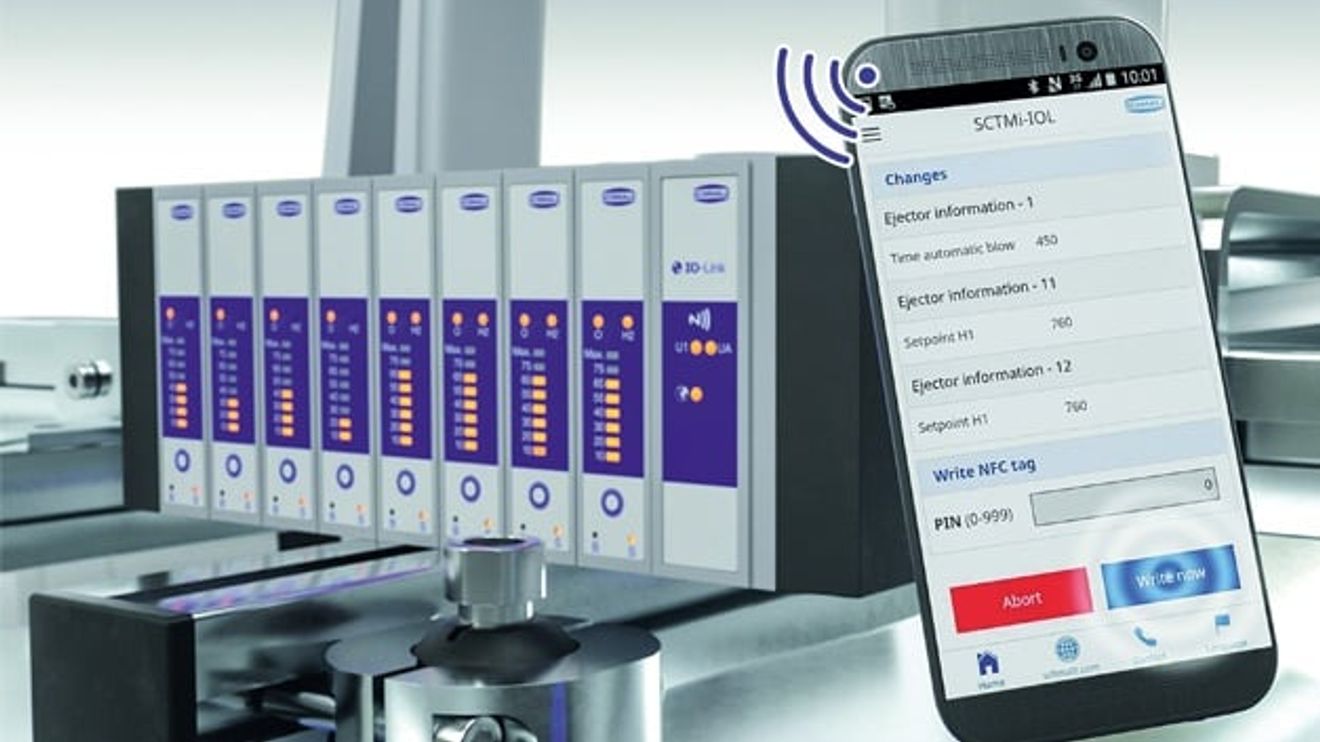
Cyber-physical systems link real objects with virtual objects, i.e. machines with information processing systems. Cross-system communication allows energy and process control as well as predictive maintenance to be realized - if the devices have the appropriate interfaces.
Schmalz develops vacuum components specifically for networking in vacuum automation that not only record energy and performance-relevant data and send it to the cloud, but also monitor and analyze it. Thanks to IO-Link or Industrial Ethernet interfaces, the smart field devices are able to communicate seamlessly from the sensor and actuator level to the higher-level controller (PLC) and on to the control level. Communication works in both directions: In addition to transmitting data on the status or energy consumption, parameters can be changed via the controller and transferred to the smart field device.
In addition to the IO-Link and Industrial Ethernet interface, Schmalz integrates an NFC (Near Field Communication) interface into the intelligent vacuum components. In order to exchange information wirelessly over short distances, a point-to-point connection is established between the smart field device and the user's NFC-enabled mobile end device. No separate energy source is required in the component for transmission. Instead, a coil is installed that is energized via the smartphone. The coil induces a voltage in a processor, which then transmits its information via an antenna. Users can therefore read process data as well as maintenance and service information directly on their smartphone. The device speaks to the user in plain language: if there is a standstill, it provides clear information about the source of the error instead of cryptic error codes. The component can also be parameterized via smartphone. The 'ControlRoom' app is available for this purpose: parameter changes made via NFC can be transferred directly to the device or copied from one device to another.
Another advantage of NFC is the direct assignment of product to smartphone. Two devices are only connected over a very short distance of a maximum of 2 cm. This means that the user can be sure that no neighbouring devices are parameterized unintentionally.
From the airflow to the data stream
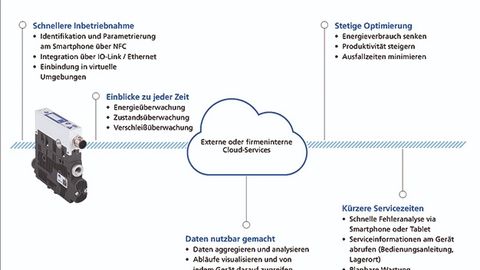
The vacuum components are quickly integrated into the application environment via interfaces such as IO-Link, Ethernet or NFC. They enable seamless process monitoring, early fault detection and timely, predictable maintenance.
© LardThe benefits of digitalization at component level for vacuum applications can be seen in the compact terminal 'SCTMi'. This bundles up to 16 individual vacuum generators into one unit, which only has one electrical and one compressed air connection. This allows different parts to be handled simultaneously and independently with just one system. The vacuum is generated by a Venturi nozzle and detected by a sensor. Users can read out the exact vacuum value via the IO-Link process data or on the display of the generator.
The ejectors are also controlled via the cyclical process data and current information is reported back by the ''SCTMi''. Users can also access setting values, parameters and measurement and analysis data via the IO-Link connection. In addition, the diagnostic and forecasting functions of the vacuum components derive information about the status of the system and identify trends in quality and performance. The data is transmitted to an internal or external cloud, where it is processed and analyzed: If the system detects values running out of tolerance or creeping changes, these can be displayed to the user quickly and clearly. For example, the system checks the leakage and dynamic pressure for predictive maintenance evaluations.
Condition monitoring events are triggered, for example, if the dynamic pressure values deviate, the evacuation times of the ejectors exceed their limit values or sensor voltages are outside the operating range. The energy monitoring function keeps an eye on the energy consumption of the connected vacuum systems. This monitoring is based on the measured air consumption, which is calculated taking into account the system pressure and nozzle size. Users can specify an externally recorded pressure value via the IO-Link process data. If this value is available, the ejector can measure the absolute air consumption in addition to the percentage.
Quickly integrated
IO-Link also simplifies the integration of the compact terminal into the system environment: Schmalz provides a comprehensive IO-Link configuration file IODD (IO Device Description), which contains information on identification, device parameters, process and diagnostic data and communication properties, among other things. The replacement of devices is also simplified, as the IO-Link protocol contains an automatic data transfer mechanism. When replacing a device with a new one of the same type, the setting parameters of the old device are automatically saved by the master in the new device.
Author:
Andreas Dölker is Head of Corporate Communications at Schmalz in Glatten.


You might also be interested in
The lubricant problem in food production
Lubricants for components used in food production machinery must be safe for human consumption. However, as these are very expensive, alternatives are in demand - for example in drive chains.
 read more...
Integrated microchips
Whether medical devices, product tracking, vehicle systems or 5G communication - the demands on safety, performance, documentation and user-friendliness are increasing. What is the significance of microchips integrated into connectors or cable...
read more...RJ45 - fit for the IIoT
Industrial-grade RJ45 connectors are a good solution for applications without increased protection against dust, dirt or splash water. What must the data interface look like so that the 'dinosaur of data transmission' can serve industrial...
read more...Engineering with a digital twin
There is simply not enough time for time-consuming activities such as drawing up parts lists based on circuit diagrams in control cabinet construction. How can the process - from planning to installation to operation - be optimized?
read more...The effects of the F-Gas Regulation
Can refrigeration units and chillers still be used when the F-Gas Regulation on climate protection comes into force on January 1, 2020? What do the bans on the use of refrigeration and air conditioning systems and new regulations for their...
read more...Choosing the right heat sink
In order to equip a data center with high-speed modules for optical interfaces, AFCI was looking for a suitable solution for cooling the high-performance servers. Pin heat sinks were the solution.
read more...(Ethernet) cables put to the test
The dynamic requirements for cables and the associated energy chains are high. How must (Ethernet) cables be designed so that they can be safely routed in energy chains even under the highest bending stress?
read more...Predictive maintenance of cables subject to wear
A sophisticated concept is needed to be able to maintain cables subject to wear and tear in a predictive manner. Lapp is currently developing one for Ethernet cables that uses machine learning approaches, among other things.
read more...Single Pair Ethernet - suitable for drag chains!
Single-pair Ethernet technology is one of the latest developments in the field of data cables in order to handle the constantly growing volumes of data in production. One of the challenges here is its use in the drag chain.
read more...