
What is behind the organization
The Edgecross Consortium
Decentralized data processing at the transition from production to the IT world - the Edgecross Consortium from Asia has been dedicated to this topic since the end of 2017. But what is behind this organization and what are its goals?
Edge computing is the term used to describe decentralized data processing at the transition from production to the IT enterprise world. And there have been solutions for this topic for years - proprietary solutions in particular quickly came to the fore, but they stand in the way of the interoperability of Industry 4.0.
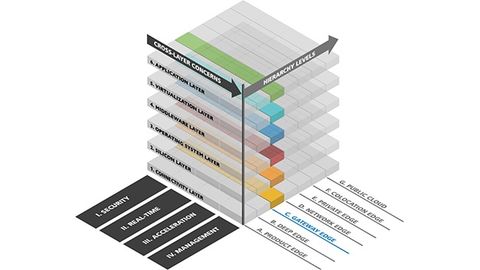
This is one of the reasons why, in addition to the Edgecross Consortium, several international companies, including some from China, joined forces at the end of 2019 to form the European Edge Computing Consortium (EECC). The Edge Computing Consortium Europe (ECCE) is another cooperation project between research and industry. Its aim is to define 'an' edge standard platform for Industry 4.0 and a reference architecture model for edge computing (ECCE RAMEC), similar to the RAMI model of Industry 4.0.
Various approaches in the area of the asset administration shell (AAS) were also initiated as part of the Industry 4.0 platform, the ZVEI and VDMA. Among other things, this led to the founding of the Industrial Digital Twin Association (IDTA) at the end of 2020.
A brief look back: The Edgecross Consortium (EC) was founded in Japan in November 2017. The board members are Hitachi, Advantech, OMRON, NEC, IBM Japan, Oracle Japan and Mitsubishi Electric. More than 350 companies worldwide are now members of this open platform. 'Edge' and 'Cross' stand for the basic principle of connecting factory automation (OT) with information technology (IT) and the transparent exchange of data along all value chains. In line with the Japanese tradition of 'Kaizen', the EC has built up an open platform in small steps with various connection options to the cloud and various automation devices. As the development of the concept rests on many shoulders, a large number of connectors have been developed for production. Some of these are based on proprietary drivers, but more and more on international standards such as OPC UA. Enterprise communication is also based on OPC UA(more news on OPC UA) and the MQTT standard. This means that the open platform is prepared for any type of cloud use.
Various functions can be implemented in the cloud. In particular, 'big data' and complex cross-system analyses can only be realized here. Real-time reactions to system statuses, on the other hand, can only be realized in the edge area. The members of the Edgecross Consortium have integrated applications into the platform for this purpose. These can implement a wide range of services - from real-time analyses and preventive maintenance to optimization programs.
Templates to support integration
To ensure that this interoperability works, the EC technical working groups have developed templates that support integration into the platform. Receiving and sending data to the platform and other applications is therefore child's play. For example, to implement communication with a sensor with a proprietary protocol, the template is simply supplemented with the protocol to read or write the data from the sensor. By using these templates, EC certification can be realized without great effort and interoperability is ensured.
If the tasks cannot be solved with the templates, a Software Development Kit (SDK), a Software Device Kit (SDK) and a Gateway Development Kit (GDK) are also available. These tools contain various sample integrations, including those based on .NET. They can be used to create edge applications, data collectors and enterprise gateways yourself.
For those who want to use the Edgecross Basic software as a data collector and distributor without programming themselves, many predefined applications are available on the Edgecross Marketplace.
The data is exchanged between production, the Edge applications and the enterprise world via Comma Separeted Files (CSV) or a database. CSV files may sound old-fashioned, but their simplicity and speed make them ideal for these applications and provide real-time capability.
The Edgecross Basic software
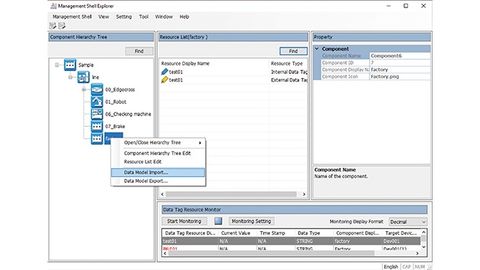
The Edgecross Basic software is a Windows application that runs on any PC or industrial PC) - with the restriction that the user is dependent on the 50 ms Windows interrupts for reading and receiving data. This results in response times that are greater than 100 ms. If the user requires real time (<10 ms), for example to detect good/bad parts in a production machine, Mitsubishi Electric offers the MELIPC industrial PC for this purpose. It is characterized by the fact that three of the four kernels run Windows and the fourth kernel runs a real-time operating system (RTOS), which can then also carry out analyses and reactions in real time. This also applies if Windows crashes. However, this is very unlikely due to the particularly hardened Windows 10 IoT. Should this occur, however, the Real Time OS will continue to function.
State-of-the-art hypervisor technology separates the production from the IT world and enables the user to separate the production level from the IT world. This significantly increases cyber security and protects valuable production data in particular from unauthorized access.
The Edgecross Basic software is the heart of the EC and is used for data collection and distribution. To ensure that the data can be used by all programs along the value chain, there is a data model that gives the pure data values a value. Similar to the OPC UA companion specifications. At the same time, it enables a secure 'fall-back' strategy (backup) in the event of an error or cyber attack. This is required by the European NIS Directive (NIS - Network and Information Security) and should be a matter of course for every system operator. This management shell offers even more tools to simplify the commissioning and operation of a complex system.
The Edgecross Consortium in Germany
Due to its foundation in Japan, the first references are located in Asia. This is where the Edgecross Consortium was first able to gain experience with this technology and is now gradually implementing it in Europe. Two examples.
Contact Software is one of the first companies in Europe to use the Edgecross platform in customer projects. For many years, the company has relied on open source technologies, standard interfaces to other systems, an open component architecture and cooperation with other solution providers when developing its products. The large number of coordinated specialist applications on the Contact Elements platform are used to create customer-specific solutions along the digital thread that support end-to-end processes from development and production through to the operation of technically complex products.
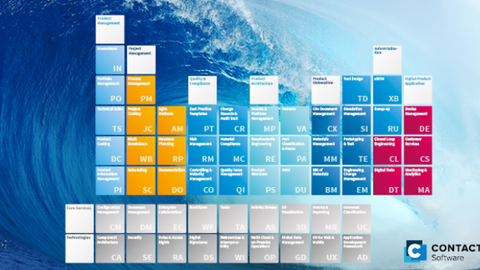
The Lego principle: The building blocks of the Contact Elements platform are flexibly configurable.
© Contact SoftwareContact Elements for IoT is a low-code platform that is configurable and easy to scale. The digital twin is at the heart of the applications. This is where the data - which is transferred from the Edgecross platform via a secure MQTT connection - is stored, visualized via a dashboard and translated into value chains. The data from operations can be used to simulate production processes and automatically initiate certain actions - process improvement, maintenance, ordering spare parts - via triggers. Contact supplies solutions from the edge to various clouds. "This rounds off Mitsubishi Electric's product portfolio upwards into the enterprise world and we can use the Edgecross concept to integrate production into the value chains," says Stefan Knauf, Division Manager Central Europe at Mitsubishi Electric.
Connection to SAP Digital Manufacturing Cloud

The showcase for the collaboration between robots and humans at the SAP Experience Center in Tokyo. The showcase uses the EC platform to demonstrate the vertical integration of OT and IT in accordance with Industry 4.0.
© SAPBased on the Edgecross platform, SAP and Mitsubishi Electric are bringing the Industry 4.0 approach to Japan. Together, they have set up a showcase for the collaboration between robots and humans at the SAP Experience Center in Tokyo. Here, the EC platform is used to demonstrate the vertical integration of OT and IT in accordance with Industry 4.0. For example, a valve that is manufactured using 3D printing is to be assembled by a robot and a human. There are several variants. The SAP ERP and MES transmit the order for the partially customized production to the robot via the Edgecross Gateway and the valve is manufactured according to the specifications. All production data, such as energy consumption, is recorded and reported back to the SAP system. Various analyses can then be carried out here, including for preventive maintenance. This also makes it easy to set up pay-per-use models.
The open platform approach of the Edgecross Consortium also makes it easy to bridge the gap between IT and OT in Europe. Thanks to the many connectors to production, both brownfield and greenfield systems can be connected. Modern interfaces such as OPC UA and MQTT allow connection to cloud systems. Real-time data analysis and pre-processing of data in the edge area are also possible.
AI and the Real Time Data Monitor

The Real Time Data Monitor is probably the most widely used Edgecross application. In this industrial APP, the data of a process is first read in. Artificial intelligence is then used to create a mathematical model offline, which then performs the production-related analysis online in the RTOS. This means that a faulty product can be ejected immediately and costly rework and production rejects can be avoided. In addition, various statistical methods enable the user to reduce data and easily implement further analysis procedures. This also applies in particular to preventive maintenance.
The data analyst - but also the specialist personnel on site - with their domain knowledge, can easily use everything from automatic 'waveform' detection, multi-regression (to predict the data that cannot be measured at all times) to the Mahalanobis-Taguchi method (to detect a deviation from normal operation). This reduces the total cost of ownership (TCO) and ensures production stability.
Digitization in small steps
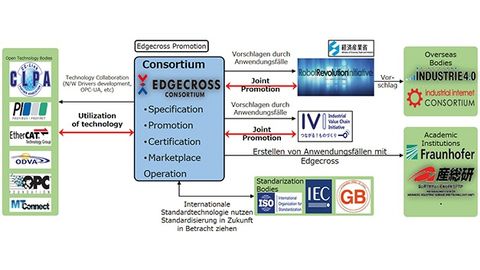
Dream big, but start small - according to this motto, the Edgecross Consortium enables its customers to start their journey towards digitalization with small steps. And this is coupled with the certainty of not being at a dead end. The 'open' approach, the multitude and the networking of the various providers in the different continental approaches do not offer a single solution. This is why the EC is cooperating with various international organizations to ensure the interoperability of the various digitalization approaches.
The Edgecross Consortium is open to the activities surrounding the Industry 4.0 platform, but also to the American Industrial Internet Consortium. It works together with the academic Fraunhofer Institute and many international standardization organizations. Even though the EC prefers the Ethernet-based TSN network, the consortium also works with all major fieldbus organizations and integrates the corresponding fieldbuses into the data collectors.


You might also be interested in
Partnership for manufacturing of the future
T-Systems and GFT are working together on the Industrial Internet of Things (IIoT). Together, they offer the manufacturing industry solutions for analyzing large-scale machine, production and planning data: End-to-end and directly on the production...
 read more...
Available in three versions
With the ME1-8MD series, ICP Germany is launching what it describes as three affordable embedded system variants onto the market.
read more...Insight into IT assets still inadequate
What is the state of global cloud usage among companies? Flexera has identified the key trends in a survey of 750 users.
read more...Real-time communication with TSN
The Fraunhofer Institute for Production Technology IPT is working with partners from the fields of mechanical engineering, network technology and robotics to develop an end-to-end real-time communication infrastructure based on 5G mobile technology...
read more..."Three questions for..." - in December
The company roadmap to TSN
Time Sensitive Networking - TSN for short - is in the process of establishing itself as a real-time Ethernet standard. What is the state of play in the industry? As part of the "3 questions for ..." series, we asked experts from companies about this.
read more...A digitalization push against the coronavirus crisis?
Sales are falling, IT investment budgets are shrinking. But under these circumstances, where are companies now focusing their efforts? And how does this affect investments in SAP infrastructure? DSAG asked its members.
read more...Compact PLC extended by safety modules
Mitsubishi Electric has added two modules to its Melsec iQ-F compact PLC. These form the basis of an integrated safety system.
read more...The e-paper of issue 08/2024
How can data centers be cooled for AI? How successful is malware programmed with WormGPT? And how can virtualized control systems be integrated into production using TSN? Computer&Automation issue 08/2024 provides answers to these questions and...
read more...Teaching box for faster robot deployment
Mitsubishi Electric has launched the 'R86TB', a new teaching box designed to help users, machine builders and system integrators to set up, program, retool, maintain and troubleshoot industrial and collaborative 'Melfa' robots.
read more...