
Production software
Reduced downtime - thanks to MES
In order to further increase productivity in production, the globally active automotive supplier Neumayer Tekfor decided to purchase an MES solution. The aim was to reduce machine downtimes.
We are a partner to the automotive industry and are part of the Amtek International Group, which employs over 10,000 people worldwide and has a total annual turnover of EUR 1.9 billion," explains Markus Misof, MES project manager at Neumayer Tekfor. At the Hausach site, the two companies Amtek Tekfor Holding and Neumayer Tekfor are the largest employers with around 650 employees and an annual turnover of EUR 141 million, according to Misof. "Our company is active in the design, development and production of solutions and assemblies for transmissions, engines, powertrains, chassis, special applications and safety nuts," says Misof, describing the automotive supplier's portfolio.
Expressed in figures, this means a steel consumption of around 100 tons per day and an annual production of 290 million parts. The many presses with a pressing force of 80 to 450 tons and weight-dependent stroke rates of 80 to 180 parts per minute ensure this, among other things.
"With the aim of further increasing productivity in production, we decided to purchase the 'Cronetwork' manufacturing execution system from Industrie Informatik," says Misof. Until then, the company had only been using PDA software - with manual entry of quantities and logging in/out of all orders at shift changes.
Automatic piece count recording
With the help of the browser-based MES solution, a reduction in machine downtimes was to be achieved. "We therefore also wanted to implement the changeover from manual booking to automatic quantity recording as a first step with the acquisition of the MES." The challenge was that many different machines and departments had to be connected to the MES and still have to be connected. "This includes machines from the hot and cold stamping shop, for heat and surface treatment, for thread cutting, for machining and for facing," says Misof. This also included work preparation, maintenance, logistics, the IT department and controlling as well as special machine construction.
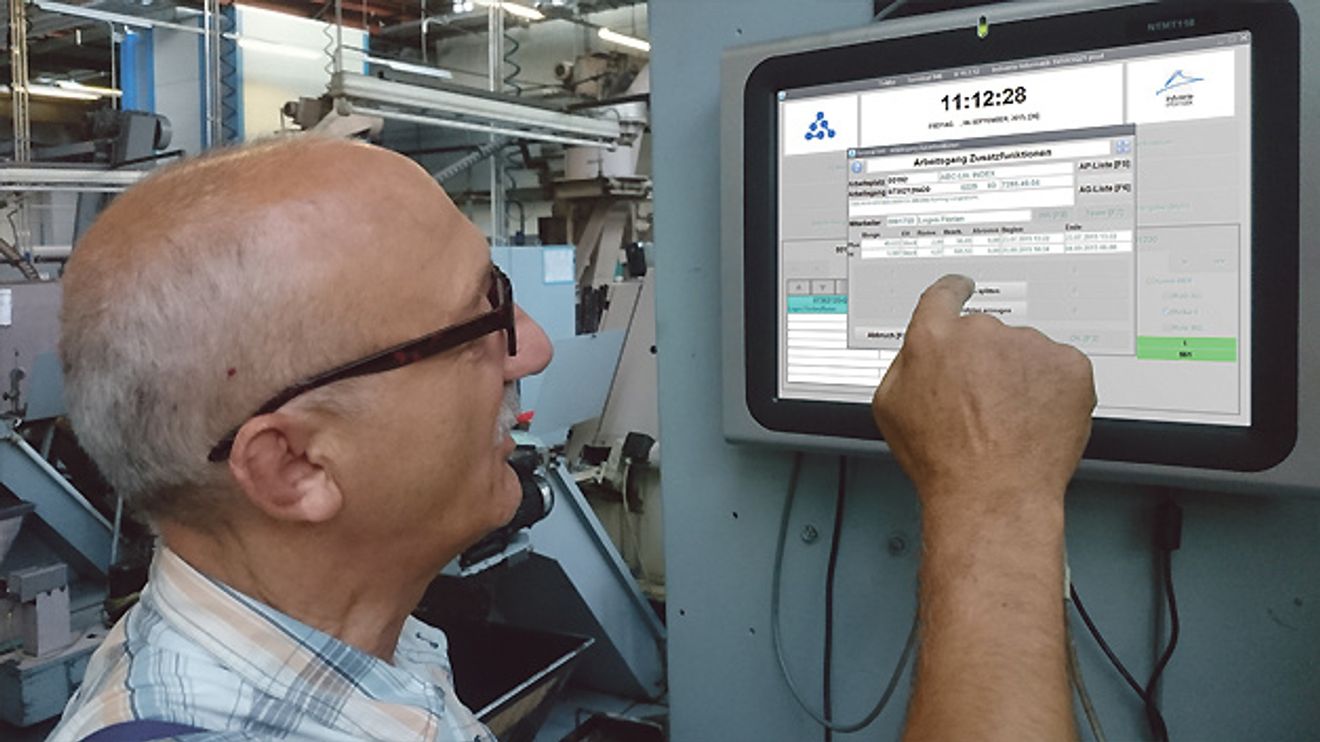
The MES should therefore automatically supply all production-relevant data from this combination. "Above all, however, we wanted to know and see as quickly as possible what is scrap, what is not and what the causes of faults are that result in machine downtime. This information was not available in the legacy PDA system." The 'Cronetwork' modules BDE, MDE with fault reason tracking, KPI (e.g. OEE) and BI (dashboards) were installed in stages. The project started in pilot operation for machining production. As more than 200 machines need to be connected to the MES, the roll-out has been running for three years. To connect simple machines to the MES, an Adam module is installed as additional hardware to process the signals. Each machine is also equipped with an additional touchscreen to record the reasons for faults. More complex systems/machines are connected via OPC servers or interfaces for file transfers.
150 machines connected

The machines for thread cutting, machining and facing are also connected to the MES.
© Neumayer TekforAs of today, around 150 machines are recorded in the system, with a further 60 to follow. The automotive supplier currently covers 95% of its requirements with the standard features of the MES solution, with the remaining 5% being adaptations. For example, in so-called optimization phases, shift changes were to be made faster. Individual adaptations were then made by IT service provider Industrie Informatik. "With the MES, it was also important to us that the feedback from machines not yet connected to the ERP system could be imported into the MES," reports Markus Misof. In order to create data consistency in both databases (ERP and MES), the PDA data of non-connected machines is imported from the ERP system.
This means that day-to-day production is now supported by a range of features that would be unthinkable without MES: In addition to live data - such as machine statuses, quantities, current cycle times with online visualization and hall monitoring on large displays - this also includes detailed reporting for the management as well as successful bottleneck management - i.e. live quantity tracking or automatic report dispatch for meeting preparation at defined times. #
"These functions are also used the most by employees," says Misof, assessing the improvements across all departments. The flexibility of the MES solution to determine meaningful key figures from very different data sources is also a great advantage. Overall, "machine downtimes have been reduced by 20% thanks to MES," emphasizes Misof.
In production, all evaluations are now displayed on the dashboard. "You can see the current status directly on the system or machine, but thanks to hall monitoring or the dashboard, you also have an overview of the entire department," says Misof. In addition, there is the clear planning board for the entire production, which hangs on the wall in the foreman's or shift supervisor's office and is a good source of information.
According to Misof, the greatest benefits resulting from daily work with the MES solution can be summarized as follows:
- Reduction of machine downtimes by 20%.
- Prompt and location-independent availability of production data.
- Automatic collection of piece data.
- Very high data accuracy.
- Low manual correction effort.
- Functioning bottleneck management.
But the project doesn't end there: "We keep setting ourselves new goals and priorities for every new department we connect. Nobody does this full-time anymore. That was only necessary at the beginning of the MES introduction. Now all the tasks are spread across several employees. I still do the project planning, but the tasks are very specific and person-related," says Misof.
Integrate BI solution
Currently, for example, tempering systems and electroplating are being connected. The automotive supplier wants to take a further step and enter the next major project with the BI solution 'Pido' (production info data objects) integrated in CronetworkC. The BI solution accesses the same database - it is simply another new tool for displaying the data. As an operational BI tool, Pido enables a view of short time horizons. The new solution is therefore also an essential source of context-oriented information in the Industry 4.0 environment for employees in production. "We have already licensed the solution and are about to start training. In addition to the real-time data with detailed planning data from the Cronetwork module 'Detailed Planning APS' (Advanced Planning and Scheduling), we also want to set up the option of a preview of our production. This will enable us to create a sequence plan later on, taking machine and personnel capacities into account. Together with the recording of personnel time and process data, this will be the next phase that we will tackle," says Misof, looking optimistically to the future. But even today, the MES solution makes it possible to quickly see what is scrap, what is not and what the causes of faults are that result in machine downtime, for example.
Author:
Tino Böhler is a freelance journalist in Dresden.


You might also be interested in
The future of CANopen
Similar to the automotive industry, industrial automation also requires more and more bus bandwidth. In addition, the cloud is becoming increasingly important in terms of communication. How does the CAN protocol, which has long been established in...
 read more...
Unauthorized access fended off
Plant modernizations often require new safety precautions. This was also the case for a manufacturer of cleaning agents and disinfectants, who had to safeguard the material flow in the area of a roller shutter door, among other things.
read more...WLAN in the factory - the selection criteria
WLAN is suitable for various applications in the factory. However, due to the many influencing factors, it is not always obvious how a network based on the IEEE 802.11 standard can be optimized to meet the requirements of industrial use. - Here is...
read more...Compact controls and drives a must
Smart factories promise operators a high degree of flexibility - for example through the use of driverless transport systems or mobile robot solutions. The automation of these subsystems in turn requires extremely compact control and drive concepts.
read more...Simply integrate safety
Machine and system manufacturers are increasingly turning to mapping safety functions via the communication bus. How can integration on the component side be achieved with reasonable effort?
read more...Flexible buffering via software
The complete automation of manual or semi-automatic processes is a major challenge with very short cycle times. When it comes to workpiece carrier transport, the machine manufacturer Goldfuß relies on a system that allows the creation of flexible...
read more...Individual IoT systems
How big? How much power? How robust? Which housing? The requirements for IoT systems are extremely varied. By designing individual embedded applications, devices can be created that are perfectly tailored to the application.
read more...A digital image
The digital twin accompanies machines and systems throughout their life - from the initial idea to ongoing operation and a look into the future. The aim is to avoid errors, optimize systems and prevent failures.
read more...Stumbling blocks with direct current
The question "direct current or alternating current?" is becoming increasingly important - not least due to the increasing use of renewable energy sources that generate direct current. When switching and protecting with direct current, however,...
read more...