
Business process optimization
Preparing data for AI
With the optimization of business processes, the use of AI is moving into the focus of many companies. Processes that do not require those responsible to have any AI-specific expertise and yet systematically recognize existing content in the data can leverage great potential.

All artificial intelligence first requires labeled or processed data that has already been assigned a meaning before the learning process. A suitable AI process can then use this data with the aim of creating a model of this data in order to automatically recognize similar data patterns in future data. Labeled data represents the bridge between data patterns and their meaning in the real world, so to speak.
In classic applications such as image classification or speech recognition, the labeling of data is usually pre-classified empirically and often even carried out manually. In these applications, this is only possible because once the data patterns have been labeled, they do not change substantially over time and the labeled data material remains valid in the long term. AI-based speech recognition, for example, can assume that the speech and word patterns of a language, once trained, retain their meaning unchanged in principle. What is spoken will last for months or even years.
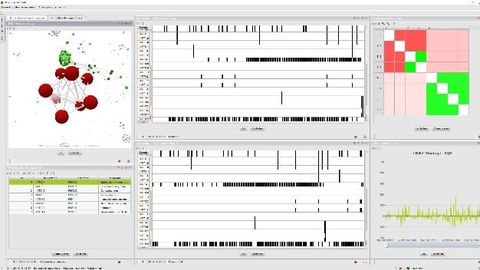
Business process data analysis with Deep Qualicision AI in the sequencing of production orders.
© PSI FLS Fuzzy Logic & Neuro SystemsIn the case of business process data, the continuous emergence of new data patterns means that automated labelling of the data is essential as soon as the AI applications are working in the area of process optimization and real-time decision support. Particularly in production processes with a higher number of variants, the ordering behavior of customers and the resource situation of the production process are different every day. AI-suitable data preparation must be able to automatically recognize and visualize correlations from historical and current data in the form of qualified, less volatile classes of data patterns and thus automatically label the raw data. Only in this way can 'raw' business process data be used by self-adapting and self-learning AI algorithms. The effort required to provide input information for this type of data labeling must also be economically viable in relation to the benefits.
To this end, algorithms for so-called qualitative labeling were developed in conjunction with the AI software. Put simply, qualitative labeling makes use of the measurement data already collected in the business processes. We are talking here about so-called micro and macro KPIs (key performance indicators), which the customer classifies as key figures with regard to satisfaction from their perspective or from the perspective of the process. Data time series can be derived from this quality-oriented minimum information and the qualitative labels for the relevant business process can be calculated without further input knowledge.
Put simply, key performance indicator systems, which companies use to evaluate and control their own processes, form the initial input information for qualitative labeling. Raw data from the business processes is labeled in a KPI-oriented manner and fed to the AI systems. This ensures the availability of labelled business process data as a basic prerequisite for the targeted, value-adding use of AI methods for process optimization, without which neural networks, for example, could not be used.
Sequence optimization in production
Qualitative labeling is already being used in a number of industrial applications - for example in AI autopilots for the automatic control of production processes or for learning system settings in the automotive industry and in the energy sector. Among other things, this involves processes in connection with the self-diagnosis of complex machines for predictive maintenance. Further applications such as the forecasting of energy load profiles in micro grids or in the area of predictive quality are in preparation.

Classification of relevant criteria using qualitative labels and resulting recommendations for action.
© PSI FLS Fuzzy Logic & Neuro SystemsA concrete example of an industrial application in which the qualitative labelling process is used is the optimization of sequences in automotive production based on planned times. The KPIs defined here are derived from the working times of activities and processes in each of the work stations along an assembly line. The vehicles to be produced are to be sequenced in such a way that none of the working time KPIs exceed their upper capacity limits. If an overrun cannot be avoided at certain points, working time relief must be ensured immediately afterwards by following vehicles with complex activities in the sequence with vehicles with less complex work content.
In addition to the highly combinatorial nature of the possible sequences, sequencing - like almost all production processes - is subject to immense dynamics with regard to the diversity of variants and the composition of order quantities, which results from the fact that each customer orders an individually assembled and therefore different vehicle. From the factory's perspective, the composition of order variants is astronomically complex, but order processing should be orderly and planned. Qualitative labeling, which is automatically derived from KPIs, helps to prepare the raw order data in an AI-ready manner so that the learning ability of the sequencing software and the required process stability are ensured despite the high degree of combinatorics.
Predictive maintenance
When planning maintenance and servicing, there are also a variety of daily challenges that can be reconciled in industrial applications using qualitative labeling. These challenges often lead to the following questions: How can the availability of machines be increased while minimizing maintenance and repair costs? How can maintenance orders and any operational changes to them be taken into account cost-effectively when scheduling and classifying capacity peaks?

Data records are qualitatively labeled by previously defined KPI evaluation functions and correlated by a conflict and compatibility analysis, which leads to recommendations for action.
© PSI FLS Fuzzy Logic & Neuro SystemsIn predictive maintenance with the automatic classification of intelligent AI software, a distinction is first made between the selection of relevant criteria such as temperature, pressure, working hours, date of last maintenance, power consumption or criticality of the machine failure and between their negative, normal and positive effects on machine maintenance. Based on standard machine parameters agreed with the manufacturer, micro-KPIs are defined in advance and qualified using evaluation functions based on advanced fuzzy logic. These qualified micro-KPIs are then used to recognize correlations on the micro-KPIs and to process the machine data using the algorithm - in other words, to label it qualitatively.
Aggregated macro-KPIs are then learned on the basis of the labeled machine data, which can be used as criteria for recognizing machine conditions and for classifying maintenance requirements. The classification can be made, for example, according to the categories 'urgent (acute) maintenance requirement', 'medium-term maintenance requirement' or 'no maintenance requirement'. The exact gradations are determined by the machine manufacturer himself by using Deep Qualicision to readjust the self-diagnosis of the machines - but he does not have to.
This results in automatic detection of maintenance and servicing requirements based on sensor data. The criteria can be readjusted by assigning different relevance rankings to the labeled data, either manually or in combination with new machine learning of the relevance of the criteria.
Value-adding data usage with machine learning and thus optimization of business processes through AI is primarily made possible by learning correlations from historicized data using qualitative labelling and the flexible combination of an AI technology stack that is suitable for the respective business process. Experience shows that employees who are familiar with the business process are able to use AI techniques quickly and intuitively without having to be AI experts themselves. This last aspect in particular will play an important role in the use of artificial intelligence in industry in the future.
The corresponding business processes will continue to become more complex and dynamic, not least due to the networking of existing solutions into overarching scenarios. The top priority here is to ensure that the new complexity remains manageable in terms of users and processes. The labeling of data must therefore be comprehensible and manageable, not only by AI experts and data scientists, but also by the users themselves with their process knowledge. This is the only way that users themselves can bring artificial intelligence to the industrial level. Although this will not happen overnight, it is possible with the appropriate software support and becomes more efficient and comprehensible with every AI application.
Author: Dr. Rudolf Felix is Managing Director of PSI FLS Fuzzy Logik & Neuro Systeme.


You might also be interested in
The first steps towards digitization
Real-time transparency in the material flow: this was the goal set by Miba when it set out to digitalize its internal logistics processes. But how successful was the close link between ERP and MES in the end? - A field report.
 read more...
How will the IoT change companies in 2020?
How will network technology in companies change in 2020? Axel Simon, Chief Technologist at HPE Aruba, takes a look into the crystal ball
read more...Digital twin revolutionizes maintenance
As virtual representatives of real machines, digital twins open up new possibilities for maintaining and servicing complex industrial plants and systems. A project report.
read more...You can't do without Edge and Swarm
The IoT has changed the requirements for processing data provided by machine sensors and actuators. This needs to happen as quickly as possible - preferably where the data is generated. Edge nodes and swarm computing systems take on this task.
read more...Online machine data under control
Turning huge amounts of data into valuable information - how can this smart industry approach be implemented? Linking PC-based controllers with Matlab and a cloud-based IoT analytics service can be a viable approach.
read more...From modeling directly into the PLC
Despite digitalization and I4.0, the technical functions in a process plant do not become simpler if you break them down to the smallest detail. Nevertheless, the high level of difficulty can be overcome by combining the right tools in the right way.
read more...Where are the new business models?
The necessary new business models are repeatedly cited as the hallmark of an Industry 4.0 environment. But to date, very few companies have seen any of this. Schneider Electric now has a few models up and running.
read more...Why predictive maintenance?
Investments in predictive maintenance systems are worthwhile in order to proactively detect damage. Not only does this increase the service life of a machine, it also opens up new business models for machine manufacturers.
read more...First customer projects via BaSys 4.0
The BMBF project 'Basissystem Industrie 4.0' expired at the end of June 2019. Together with NetApp and Objective Partner, Fraunhofer IESE now offers Industry 4.0 solutions with support and adaptation to customer systems on the basis of this project....
read more...