
Technical documentation
How content can be shared transparently
Digitalized, semi-autonomous production in networks using cyber physical systems (CPS) not only requires the use of 'smart' (automation) components and services - there is also a need for action when it comes to technical documentation.

Throughout the entire product life cycle, machines are already embedded in a loose, heterogeneous 'network' of people as specialized know-how carriers. In such networks, developers, technical writers, suppliers, operators, service technicians and users exchange information on machines or systems and advance corrections, improvements or further developments.
What has been missing until now, however, are digital services that link and bundle this knowledge independently of platform and device. Industry 4.0 also requires the consistent digitalization of technical documentation and the interfaces to the various players involved in the development, operation and further development of a machine or system. In product development, for example, this means that developers increasingly rely on information that is collected about a machine or system during its product life cycle - for example in the form of technical documents, FAQs, error reports or digital machine diaries.
Device independence in particular is playing an increasingly important role in this context: while access at the desk is still traditionally via a desktop PC, use on site at the machine is increasingly shifting to mobile devices and tablets. This calls for a seamless transition from desk to 'field work', which also supports everyday offline situations via appropriate synchronization functions: Whether on a train/plane or in the basement of a building - the Internet is often nearby, but not available at the place of work, or not at a sufficient speed.
In short, the digitalization of production is leading to a further upgrading of the immaterial components of an application, such as process data, program code or technical documents. This general trend is not new: as we know, the intelligence of an application has increasingly shifted to software in recent years. Even today, the software component of a machine tool, for example, is so dominant that machines can differentiate themselves from the competition mainly through their software.
Modular software solutions, which are constantly being developed further, therefore create the basis for flexible 'changeable automation' and thus ultimately for the changeability of machines and systems as well as the entire production process. Big data or smart data, in which experts have high expectations, are also an expression of this change. The decisive factor will therefore be how all this data, information and software releases for complex applications and high-tech products that require explanation can be effectively collected, provided and exchanged.
The 'digital transformation' in practice
In the following, Eckelmann's Engineering Documentation Platform E°EDP will be used as an example to show how a company can adapt to this digital transformation of the industry. This solution, developed in close cooperation with the Wiesbaden-based company Makrolog Content Management, has been used throughout the company since 2014.
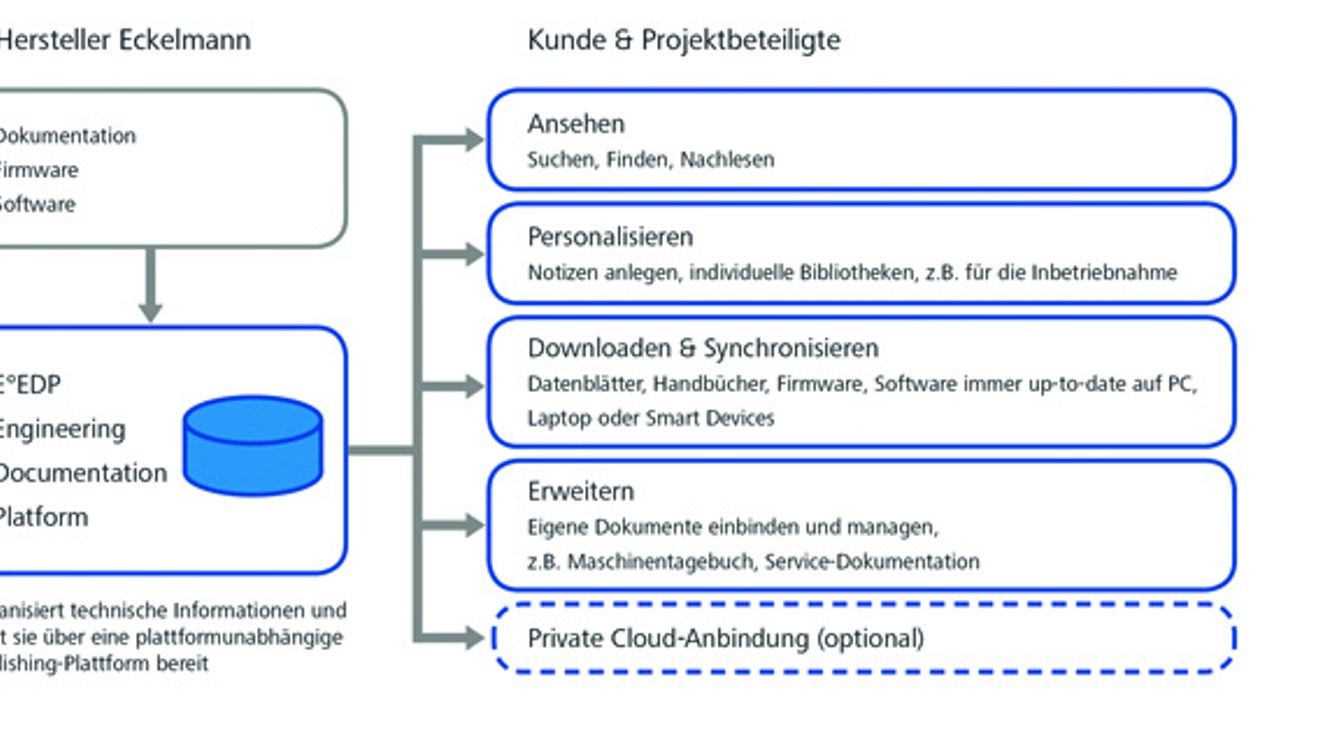
Eckelmann provides the technical documentation, software and firmware updates for the control and drive technology of machines and for the control system for refrigeration systems via E°EDP.
© EckelmannSpecifically, E°EDP is a platform-independent content delivery and publishing portal that can be used to provide and share technical documents and software for products and solutions both online and offline - on a PC, tablet or smartphone. It can also be used to organize transparent project-related communication with customers. As a flexibly adaptable information resource, the EDP can accompany all phases of the product life cycle of a machine or system (concept, design, engineering, commissioning, production & operation, modernization). All relevant technical information is collected there and made available via various media, whether for smart support via app or other smart services such as product optimization or predictive maintenance.
In addition to the content delivery and publishing functionalities, the concept offers extensive backchannel connectivity. It not only provides backchannel functionalities for users (comments, feedback, notes), but also as a web service for devices. Digital data (images, videos, but also measured values and events) can be stored directly in the EDP via the Connect API as a basis for later analysis. Information and parameters directly from the machine and the production process itself are thus collected together with engineering information and user comments in one place. However, EDP is not a proprietary Eckelmann platform, but is designed as an open system. It is available both as a cloud-based SaaS solution (Shared EDP) and as an on-premise solution, for example for applications with increased security requirements. This means that machine manufacturers can also use EDP independently of Eckelmann, for example to organize their machine documentation and optimize the flow of information between developers, manufacturers, clients and machine operators.

Exemplary overview of controllers for machine automation with comment function including file attachments. The page history, personal favorites collections and related components appear on the right.
© EckelmannAfter a personal login, users can personalize the solution for their purposes, for example by compiling frequently used documents in favorites collections or individually configuring the e-mail information service for updates and new documents. A machine builder can create a separate collection of favorites for each machine type, for example, so that all documents are always 'at hand' - whether for commissioning or service work.
Notes and comments can also be added to individual documents, which is used as a direct feedback channel. Errors or suggestions discovered by users can thus be incorporated into the documentation more quickly. All users benefit from this up-to-dateness. With the help of the share function, individual content or an entire collection of favorites can be conveniently shared with other registered EDP users, who also receive an e-mail notification.
More than just a publishing solution
In general, EDP is a versatile multi-user system and a publishing platform for any technical documents and software for devices, applications and projects. Thanks to the differentiated rights concept, the platform can also be used for bidirectional communication with customers or partners in order to share or comment on any information about products and applications in small groups. And even the machines themselves can be included as information suppliers; this is a significant advantage over pure publishing solutions for technical documentation.
Eckelmann therefore uses EDP for project-related communication and joint information management with individual customers in addition to classic technical documentation. Specific application scenarios here include the documentation of development services, the provision of software releases and use as a feedback channel that can be accessed by everyone involved in the project at any time. This facilitates transparent collaboration across company boundaries and relieves the burden on e-mail communication. As a result, coordination processes become much leaner and agile development projects are accelerated.
The HMI as an interface

With the control system for refrigeration systems from Eckelmann, the user can call up the page with the desired operating instructions, data sheets, FAQs and other information directly via QR code on the user interface of the system control center.
© Eckelmann, Fotolia / Denis PrykhodovAn important component of Industry 4.0 environments are more intelligent HMI concepts that enable people to gain an overview of complex situations with the help of assistance systems and at the same time contribute their experience in the form of planning and control ideas. One concrete approach, for example, is an app for service support for individual components through to concrete action support during commissioning, diagnostics and troubleshooting. The graphical user interface can display an error message with a specific QR code, for example, which the service technician scans in order to be shown a specific solution to a known problem - ideally directly.
In this way, the latest error information and solutions can always be called up on the machine via EDP without the machine itself having to be online, which is also an advantage that can hardly be overestimated from an IT security perspective.
Another interesting service concept with EDP as a future 'switchboard' is the direct initiation of a support process with the manufacturer. To do this, the service technician can use an app to read out basic information about the control system, such as parameters and parameters, via a video QR code - similar to the transmission of transaction data to a TAN generator in online banking - and send it directly to support, where a ticket is automatically created for the service process. Because the service employee has all the essential data in a structured form without having to ask for it individually, they can provide specific assistance more quickly. Such innovative, user-oriented and security-conscious support models, in which the machine itself is not accessible via the internet, are also an important aspect of Industry 4.0.
'Digital biotopes' in the making
As already mentioned, the upgrading of intangible components of a solution will also increase the need for suitable communication platforms in order to jointly support and optimize machines and applications with several partners over the entire product life cycle and, if necessary, offer supplementary smart services. Such models of cooperation between specialized partners can also be implemented with the platform described. Information that is to be shared with other partners is fed into the EDP via imports, for example from project management tools. The software also has a powerful machine interface that can be used to import data directly from Eckelmann controllers. This also opens up potential application scenarios in the innovative field of smart data analytics.
In such digital biotopes, in which specialized partners exchange information and cooperate with each other in this way, Eckelmann can actively contribute its expertise and process knowledge on certain technologies to customer projects - from rolling mill technology and CNC cutting to refrigeration systems for supermarkets, to name just a few key applications.
Authors:
Felix Berthold is an employee of the Schwitzgebel press office;
Dr. Frank-Thomas Mellert is a member of the Eckelmann Management Board.


You might also be interested in
The future of CANopen
Similar to the automotive industry, industrial automation also requires more and more bus bandwidth. In addition, the cloud is becoming increasingly important in terms of communication. How does the CAN protocol, which has long been established in...
 read more...
Unauthorized access fended off
Plant modernizations often require new safety precautions. This was also the case for a manufacturer of cleaning agents and disinfectants, who had to safeguard the material flow in the area of a roller shutter door, among other things.
read more...WLAN in the factory - the selection criteria
WLAN is suitable for various applications in the factory. However, due to the many influencing factors, it is not always obvious how a network based on the IEEE 802.11 standard can be optimized to meet the requirements of industrial use. - Here is...
read more...Compact controls and drives a must
Smart factories promise operators a high degree of flexibility - for example through the use of driverless transport systems or mobile robot solutions. The automation of these subsystems in turn requires extremely compact control and drive concepts.
read more...Simply integrate safety
Machine and system manufacturers are increasingly turning to mapping safety functions via the communication bus. How can integration on the component side be achieved with reasonable effort?
read more...Flexible buffering via software
The complete automation of manual or semi-automatic processes is a major challenge with very short cycle times. When it comes to workpiece carrier transport, the machine manufacturer Goldfuß relies on a system that allows the creation of flexible...
read more...Individual IoT systems
How big? How much power? How robust? Which housing? The requirements for IoT systems are extremely varied. By designing individual embedded applications, devices can be created that are perfectly tailored to the application.
read more...A digital image
The digital twin accompanies machines and systems throughout their life - from the initial idea to ongoing operation and a look into the future. The aim is to avoid errors, optimize systems and prevent failures.
read more...Stumbling blocks with direct current
The question "direct current or alternating current?" is becoming increasingly important - not least due to the increasing use of renewable energy sources that generate direct current. When switching and protecting with direct current, however,...
read more...