
Product development
A central approach
Developing products uniformly - across all three disciplines of mechanics, electrics and software: the household appliance manufacturer V-Zug has risen to this challenge. A field report.

The Swiss household appliance manufacturer V-ZUG was founded more than 100 years ago and is now known for its innovative products and inventions - for example the 'Vibration Absorbing System', an active unbalance compensation system. It ensures that the washing machine no longer vibrates during the spin cycle. "As a medium-sized company, we cover the entire product life cycle, from customer requirements to product development, production and after-sales services," says Ernst Dober, Head of Development and Services at V-ZUG.
In order to better manage the increased product complexity - caused by increasing customer requirements, new markets and legal regulations - the company wanted to create a standardized development environment. It opted for Dassault Systèmes' '3DExperience platform' to manage the product development process in a single environment and ensure data consistency from specification to production.
The implementation
"We replaced two legacy systems with the '3DExperience platform' in order to be able to map PDM and CAD information in a single environment. We also have the option of adding new functions on a modular basis as required and necessary," says Dober.
A Dassault Systèmes business partner assessed the company's existing business processes and highlighted the potential benefits of a unified IT environment. The partner also advised that the solution used was largely based on standard processes and ultimately implemented them. "The platform's standard functions cover our processes as far as possible, so that the effort required for individual customizations could be reduced. This also helps us to minimize the costs for maintenance and future software updates. The platform is used by around 440 users in development, production and management," says Dober. The '3DExperience platform' with the products 'Catia' (CAD program) and 'Enovia' (PLM solution) has been in use at V-ZUG since 2015. It offers an integrated solution for the various disciplines in product development. All engineers involved in a product - from the areas of mechanics, electrics, electronics, software and processes - can access the current data of a product, so that developers can exchange ideas quickly and easily. The models can only be accessed via 'Catia'. Working with revisions or versions is a basic principle when working with the '3DExperience platform' and applies across all managed objects.
The connection of suppliers who develop parts with V-ZUG is also guaranteed. The platform enables the company to grant suppliers access via a secure Internet connection. For this purpose, the suppliers deliver the data either in 3dxml or STEP. This data is imported as required. The '3DExperience platform' offers the possibility of connecting a large number of products and linking the data with each other.
'Catia' in the center
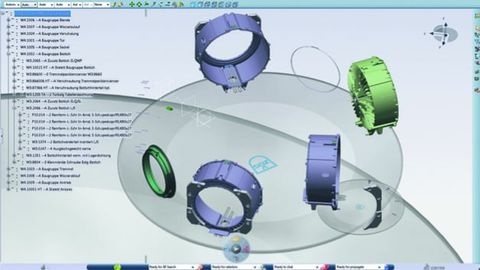
The design engineers develop the various components and assemblies in 'Catia'. The production-related bills of materials (BOM) for the various components are then created using the PLM solution 'Enovia Engineering Central'. Thanks to the platform character of the solution, engineers can create components in Catia and then synchronize them with 'Enovia Engineering Central'. As soon as it is available there, the component is saved and does not have to be created again. The product knowledge and history is thus available for reuse. Construction or design changes can be managed in the central platform using engineering change orders (ECOs).
"Customers are demanding more variety and our products are becoming increasingly complex. It is therefore important to have powerful change management options so that necessary changes can be made in as little time as possible," says Blaise Metzker, Head of CAD/PDM at V-ZUG. With the new solution, all components are available on one platform. If a design change is necessary, for example to make the locking mechanism on a control panel more stable, the developers create the change request in Enovia and this modification is automatically forwarded to all downstream processes in the company - thanks to the integrated function for change requests. The redesign of the digital workflow has accelerated processes by 50%, particularly in the release change management process.
Employee training for the release change from 'Catia V5' to version 6 was supported by the eLearning platform '3DS Companion' from Dassault Systèmes. However, employees without special CAD knowledge can also work with the platform and use the 3D live application, for example, to view new 3D designs. No training or expert knowledge is required for this, as navigation through the products is simple and intuitive thanks to the tree-like structure.
Even if product development and production are located on the same site, clear production instructions are required. To do this, the developers use 'Catia Composer' and create the work instructions from the latest 3D model. The elimination of 2D assembly drawings should save time and costs and the transparency ensures fewer assembly errors during production.
The product information created via the platform (drawings, parts and parts lists) is transferred to the ERP via an interface and taken over by production planning for production. Assembly and tool design use 3D master models. This means that drawings are no longer necessary.
The associated information flow is supported by engineering change orders (ECOs), which are used to manage construction and design changes. At V-ZUG, the ECO runs from development to purchasing and production planning through all the relevant departments in the company. This is the case both for the release of new parts and for changes to existing parts. The ECOs are mapped in the '3DExperience platform' as separate objects, which hold together all the objects affected by the change. The ECO is routed via a workflow (routes with specific tasks) depending on the status through the company to the affected locations. It is also used to monitor the change and the associated releases.
Virtual simulation under consideration
The household appliance manufacturer is planning to expand the platform and further develop the area of simulation in order to reduce development costs and lead times. Simulation at an early stage of the development process is intended to define the product as precisely as possible in order to reduce modification costs and reduce the number of prototypes by optimizing the digital product. With solutions from Dassault Systèmes, users can now not only create a product that is optimized in terms of mechanical properties, but also optimize the design.
In many areas, the number of prototypes can be minimized with virtual product testing. This means that the process of simulation, interpretation of results and improvement of the design is automatically repeated several times until the target specifications are achieved. Only then does the company build a prototype - if necessary at all. In this way, some industries can even dispense with prototypes altogether.
Author:
Jutta Treutlein is Corporate Publishing Project Manager at Dassault Systèmes.


You might also be interested in
The future of CANopen
Similar to the automotive industry, industrial automation also requires more and more bus bandwidth. In addition, the cloud is becoming increasingly important in terms of communication. How does the CAN protocol, which has long been established in...
 read more...
Unauthorized access fended off
Plant modernizations often require new safety precautions. This was also the case for a manufacturer of cleaning agents and disinfectants, who had to safeguard the material flow in the area of a roller shutter door, among other things.
read more...WLAN in the factory - the selection criteria
WLAN is suitable for various applications in the factory. However, due to the many influencing factors, it is not always obvious how a network based on the IEEE 802.11 standard can be optimized to meet the requirements of industrial use. - Here is...
read more...Compact controls and drives a must
Smart factories promise operators a high degree of flexibility - for example through the use of driverless transport systems or mobile robot solutions. The automation of these subsystems in turn requires extremely compact control and drive concepts.
read more...Simply integrate safety
Machine and system manufacturers are increasingly turning to mapping safety functions via the communication bus. How can integration on the component side be achieved with reasonable effort?
read more...Flexible buffering via software
The complete automation of manual or semi-automatic processes is a major challenge with very short cycle times. When it comes to workpiece carrier transport, the machine manufacturer Goldfuß relies on a system that allows the creation of flexible...
read more...Individual IoT systems
How big? How much power? How robust? Which housing? The requirements for IoT systems are extremely varied. By designing individual embedded applications, devices can be created that are perfectly tailored to the application.
read more...A digital image
The digital twin accompanies machines and systems throughout their life - from the initial idea to ongoing operation and a look into the future. The aim is to avoid errors, optimize systems and prevent failures.
read more...Stumbling blocks with direct current
The question "direct current or alternating current?" is becoming increasingly important - not least due to the increasing use of renewable energy sources that generate direct current. When switching and protecting with direct current, however,...
read more...