

SSV Software Systems
The tricky question of authentication
In electronic transactions, users and applications are automatically identified on a daily basis using various security factors. In many IoT applications, however, there is a gap between what is technically possible and what is actually used in practice.
If you want to use a service in the digital world, you first have to authenticate yourself to the service provider using suitable factors. This means that you have to provide the clearest possible proof so that the user identity can be authenticated. There are various server-side methods for this, which depend on the respective factors - they can be divided into three categories:
- Knowledge (knowledge factors): This involves proving knowledge of a very specific piece of information, such as knowing a password, a Personal Identification Number (PIN) or the answer to a specific question.
- Possession (Ownership Factors): The service user is in possession of a specific object, such as an ID card, a smartphone with a specific hardware feature or special software, or a security token in the form of a USB stick. An RFID-based microchip implant or digital certificates also fall into this category.
- Physical characteristic/biometrics (inherence factors): This category includes various physical characteristics or biometric features that are evaluated as proof of identity. Measurement and evaluation methods for fingerprint, iris and retina structure as well as facial recognition data can be used for this purpose.
Identity verification methods can be used individually (single-factor authentication) or in combination (multi-factor authentication). For example, a password can be combined with an ID card. On closer inspection, however, the first two categories only enable implicit identity verification by the service provider. The password as a secret that was assigned to a specific person when the user account was created can ultimately fall into the possession of third parties accidentally or through a cyber attack; a smartphone with a SIM card, telephone number and app can be stolen. Only biometrics provides more or less unambiguous proof of identity under reasonably normal circumstances.
Secure practice: e-banking
Two-factor authentication (2FA) is currently the state of the art in the IT world. The first identity verification factor is the user name/password or a PIN, i.e. a classic proof of secret knowledge. The second factor is often formed by possession of a smartphone with or without an app. In the first case, a text message is sent with a one-time password that must be entered within a specified period of time during a login procedure. Alternatively, it is also possible to manually enter a time-based one-time password via an app or even scan a QR code, which is displayed as an image object in the web browser of a second device and becomes invalid after just a few seconds.
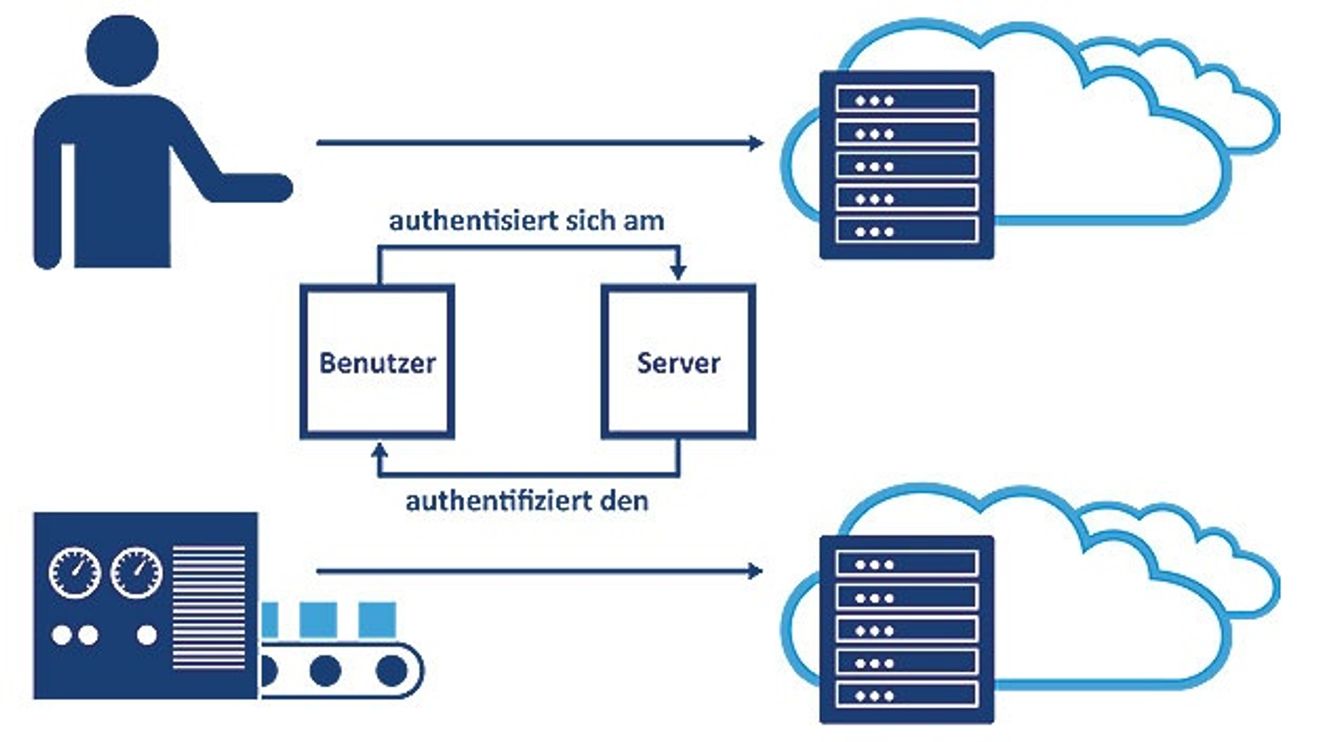
As 2FA has been mandatory within the European banking system since 2018, many banks now use the "password plus authenticator app" variant for customer access: For example, the user logs on to a service provider's website from a PC via a web browser using a username/password as the first factor and must then provide the second factor via a smartphone app within a certain period of time. Particularly important: 2FA smartphone apps use a different transmission channel than the web-based login via password. This means that both factors are transmitted to the server via different connections. This is why the app is also referred to as out-of-band authentication (OoBA). OoBA-based 2FA procedures offer additional protection against man-in-the-middle attacks.
Insecure innovation: e-charging stations
With the exception of sending a one-time password via SMS, the 2FA-OoBA combination is considered a relatively secure procedure overall. It should therefore be used at least for applications that involve cashless payments or other money transfers. From a security perspective, it must therefore be assumed that relatively new technologies and processes will also use these functions - especially if the market launch and penetration are also coordinated by government authorities and the users are predominantly private individuals.
A practical example of validating current authentication procedures in a high-growth IoT application is the public charging infrastructure for electromobility. There are currently around 50,000 to 55,000 public charging points in Germany. According to political targets, there should be one million by 2030. Over time, tens of millions of people will authenticate themselves at these infrastructure points to draw electricity and pay for it, in order to charge their vehicles after successful authentication. At the moment, simple one-factor authentication via RFID customer card or smartphone app, i.e. ownership factors, still dominate the currently available e-charging stations. Many charging service providers have simply transferred the high risk of these highly insecure procedures to the user via the general terms and conditions. On the other hand, the charging process is very convenient: simply hold the correct RFID card in front of the reader or scan a QR code at the charging point using a smartphone app and the charging current flows into the vehicle battery. Days, weeks or even months later, the costs are then debited from the user's account.
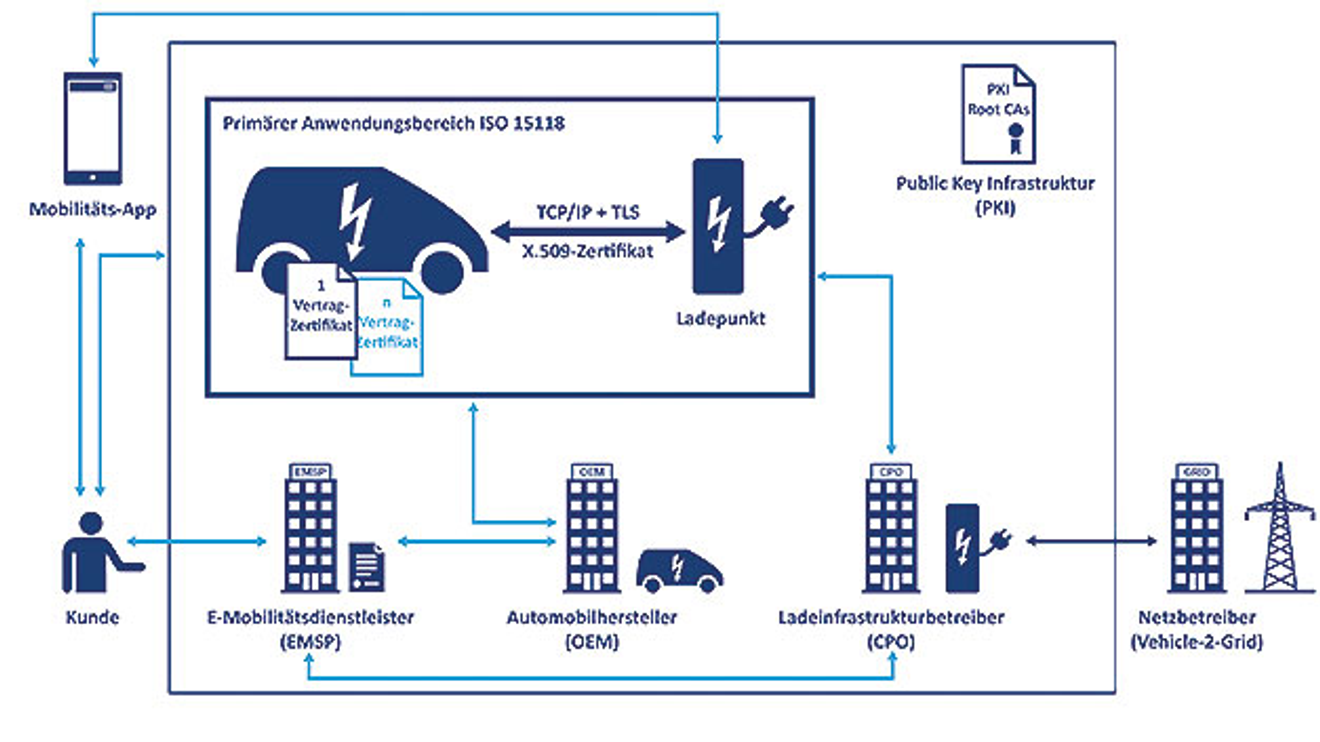
The public charging infrastructure for electric cars is a highly complex IoT application due to the large number of parties involved. Among other things, sensitive billing-relevant data is exchanged between various participants. The new ISO 15118 series of standards is intended to authenticate a vehicle at the charging point using public key infrastructure (PKI) and X.509 certificates.
© SSVAnother negative example is provided by the e-charging stations of a telecommunications company with regard to payment by credit card for ad-hoc charging, i.e. spontaneous charging without registering for an RFID card or app. Here, the user is shown a QR code that takes them to a website where they enter their full credit card details in a form. The problem: Due to the acute risk of fraud, you should never make payments via websites accessed via a QR code. It could be a fake website.
The reasons why billing and e-mobility service providers and charging infrastructure operators have opted for predominantly insecure authentication procedures for billing charging processes may have something to do with the fact that e-mobility as a whole is still in a pioneering phase. On the other hand, there are numerous stakeholders involved from completely different sectors and economic areas who want to capture market share as quickly as possible - in other words, not exactly ideal conditions for user-friendly and secure solutions with a high level of international acceptance.
From an IoT perspective, however, the conditions for the use of modern communication methods are ideal. After all, two devices with relatively modern hardware and software are connected to each other by cable for a charging process. One of the two devices can even be clearly assigned to a natural or legal person through the approval of a road traffic authority and therefore already has at least a relatively forgery-proof analog identity.
Do standards help?
The standardization organizations recognized this fact very early on and began developing the ISO 15118 series of standards for a standardized "communication interface between vehicle and charging station" just over twelve years ago. It includes a so-called Plug'n Charge (PnC) function. The charging process is automatically started and ended by connecting or disconnecting the charging cable. PnC data communication for billing takes place via TCP/IP over the charging cable. A public key infrastructure (PKI) with X.509 certificates is used for authentication, whereby the first certificate is already installed in the vehicle by the manufacturer.

The author: Klaus-Dieter Walter is a member of the management board at SSV Software Systems.
© SSV Software SystemsHowever, you should not expect one hundred percent authentication security even with an ISO 15118-based TLS handshake between two devices. There are still numerous possibilities for errors and attacks. In addition to faulty TLS protocol implementations and configuration problems, various man-in-the-middle attack scenarios are conceivable, for example with forged certificates. Manipulative attacks are conceivable, particularly in the case of charging stations that are standing around unobserved and freely accessible somewhere in the landscape, in order to collect access data for payments unnoticed. In this respect, a 2FA smartphone app with out-of-band communication makes sense in addition to the PKI and certificate.


You might also be interested in
Bluetooth sensors in the 5G campus network
Until now, the relatively short radio range of Bluetooth has been a hindrance for sensor applications with Bluetooth Low Energy (BLE) in industrial environments. SSV meets this challenge with the help of local 5G mobile networks.
 read more...
The Corona Warn app - a source of ideas?
Digitalization is permeating all areas of daily life. Some of these applications also provide innovative approaches for automation tasks. One example: the Corona Warn app.
read more...Foundation of open app stores
Open app stores require virtualization technologies such as Docker containers to achieve the desired data consistency. But there is more behind these technologies. What potential could these technologies actually open up for automation?
read more...An edge app store for the industry
At the end of April, the OWL Mechanical Engineering Initiative presented the Industrial APP Marketplace: an online platform for Docker containers. What is behind the Marketplace and what opportunities does it offer users?
read more...The trend is moving towards edge AI
The focus of IoT application development is shifting away from the cloud and towards sensor technology. The associated use of machine learning algorithms directly in the sensor or its environment enables completely new approaches for the Internet of...
read more...The dilemma of IoT security vulnerabilities
It should be a matter of course that identified and published security vulnerabilities in IoT products are immediately closed with updates. Due to a lack of technical possibilities, this is rarely the case. This option is unacceptable for industrial...
read more...Sovereign edge-to-cloud platform for the industry
Hilscher Gesellschaft für Systemautomation and Schwarz Digits have announced a cooperation to provide sovereign European edge-to-cloud solutions for the industry.
read more...Marco Geiser becomes new Vice President Secure Power DACH
Marco Geiser has held the position of Vice President of Secure Power DACH since April 1, 2026. In this role, he will strategically develop the Secure Power business in Germany, Austria and Switzerland, strengthen it operationally and focus it on...
read more...Cloud security often inadequate
According to Red Hat's "State of Cloud-native Security" Report 2026, 97% of the companies surveyed with hybrid cloud environments reported security incidents within a year. This is based on data from around 600 IT specialists.
read more...