
SSV Software Systems
An edge app store for the industry
At the end of April, the OWL Mechanical Engineering Initiative presented the Industrial APP Marketplace: an online platform for Docker containers. What is behind the Marketplace and what opportunities does it offer users?

The Industrial APP Marketplace is implemented as a web store. Suppliers and customers each need their own account to access the store via a browser. The individual products are subdivided into functional groups and described in detail. Each individual offer is available as a Docker and can be downloaded from the web store to your own PC as part of a purchasing process and transferred from there directly to an edge gateway or a Docker-capable controller, for example.
© SSV Software SystemsThe idea behind the OWL platform: with the help of Docker container technology, which has become the de facto standard in the IT world, software applications can be operated as 'APPs' on a wide variety of edge modules - such as controllers or gateways - regardless of the provider. This means that in future, the hardware and software supplier would no longer automatically be one and the same. This in turn could enable new business models in industrial digitalization, but could also pose some problems that still need to be solved.
The Industrial APP Marketplace is intended as a connecting element between machine operators, control cabinet manufacturers and developers of industrial software. It is functionally based on app stores as we know and use them for smartphones. However, from the perspective of the OWL mechanical engineering initiative, the special requirements and conditions of Industry 4.0 applications should be taken into account.
Information instead of measured values
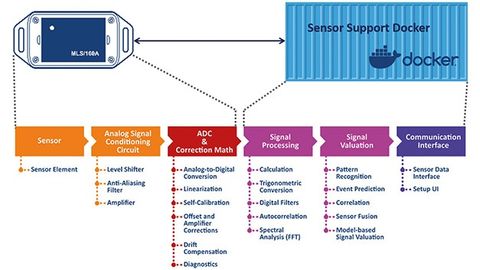
Docker technology enables innovative MSR sensor solutions that consist of two coordinated components. The six functional units of an intelligent sensor system are distributed between the actual sensor element and the Docker. Application-specific software modules, such as sensor fusion, sensor data pre-processing or data evaluation using machine learning, are implemented within the Docker. Updates and further developments are available as DevOps.
© SSV Software SystemsDocker app stores for automation technology, such as the Industrial APP Marketplace, create many new opportunities for providers and users. An example from sensor technology: until now, there has been a very large product range of highly developed industrial sensors in this area, but they only provide relatively simple measured values at the output. Although this requires very complex technology in the sensor itself, the measured output value is only a single problem-solving module for the user. The user also needs software components plus a suitable runtime environment for processing the measurement data in order to solve the respective task. The relevant software components usually have to be developed individually. Both control modules with IEC 61131 programming and PCs plus measurement data software (Matlab & Co.) can be used for this. However, this sometimes results in an undesirable vendor lock-in plus relatively high additional costs. This situation can now be improved using Docker containers.
With the help of Docker technology and independent marketplaces, standardized MSR sensor solutions are possible that consist of the two components 'sensor plus Docker app'. Independent experts and software providers could focus on specific problem solutions that match different sensor data images on the input side (such as vibration or current sensors) and can be used as Docker on completely different edge assemblies from different manufacturers. In combination with AI functions such as machine learning (ML), a Docker-based app can then provide high-quality information on the output side, which can be used to directly derive the next maintenance date for a predictive maintenance application, for example.
Just one Docker is not enough
High-quality sensor data plus machine learning enable completely new insights into the interrelationships of machine and system operation. The sensor technology required for this is available from countless providers. The necessary ML algorithms in the form of artificial neural networks (deep learning) have also been state of the art for almost a decade - albeit predominantly in the IT world and less so in the automation and I&C world. A few years ago, the Internet of Things gave rise to cloud-centric hub-and-spoke systems, such as sensor-to-cloud solutions with centralized sensor data processing. Thanks to the ever-increasing performance of smartphone hardware and software, deep learning applications can now also be used on the move without a cloud connection. Using appropriate apps, a smartphone can perform an ML inference - a conclusion from a data analysis using a set of rules - locally, for example to recognize objects in the image data from the camera sensor. Such a sensor-plus-app combination will also be possible in automation technology in the future thanks to Docker app stores.
However, such applications also show that just one Docker will not be enough for edge use. As deep learning is classified as supervised machine learning, a machine learning pipeline is also required for model generation in order to create a suitable ML model for inference operation. Although these function modules can also be implemented as Docker, they must then be provided for use in the cloud or on-premises on IT systems with appropriate performance.
The safety aspects
However, dockers that are downloaded from public app stores on the Internet and installed on edge gateways also create new IT security problems, for which solutions should be available before the app store market launch if possible.
As the human factor plays a very large role in all security problems in operational technology, the app store operator should ensure that only offers with state-of-the-art IT security are included in the store. OT specialists are primarily responsible for keeping machines running. They have to guarantee the required availability and reliability. This is a complex task. A high level of IT security awareness is not required for this. For this reason, industrial app stores must provide appropriate security guidelines as standard and demand compliance from the respective providers.
The test operation is running

Klaus-Dieter Walter is a member of the management board at SSV Software Systems.
© SSV Software SystemsThe web-based online platform of the Industrial APP Marketplace has been running in test mode for several months. Various companies and organizations from the OWL mechanical engineering initiative have developed their first Docker apps and are testing their use on different edge hardware. Docker federated operation, i.e. the interaction of several Dockers from different providers in a single application, is also currently being tested (you can read an example from the companies Knowtion, PerFact, Phoenix Contact and SSV Software Systems from the field of condition monitoring in Computer&AUTOMATION 2021, issue 5, page 16 et seq.) However, some development work is still required in terms of the simplest possible use for AI or ML applications and with regard to IT security. Ease of use, genuine vendor independence and state-of-the-art cybersecurity are ambitious goals. However, entering the market as quickly as possible is also very important today. Hopefully those responsible behind the Industrial APP Marketplace will find the right balance here.


You might also be interested in
The foundation of open app stores
Open app stores require virtualization technologies such as Docker containers to achieve the desired data consistency. But there is more behind these technologies. What potential could these technologies actually open up for automation?
 read more...
Working group for software-defined vehicles
The open source organization Eclipse is now actively addressing interested companies with a manufacturer-neutral working group for the development of next-generation vehicles based on open source.
read more...New Industry Clouds
At Mendix World 2021, one of the largest virtual gatherings for low-code developers, Siemens subsidiary Mendix announced its new, expanded digital ecosystem on September 7.
read more...Apps as microservices
Msg Plaut is now presenting an IT marketplace called Smart Factory Platform. Companies will be able to use it to purchase agile individual solutions and thus keep their production processes up to date.
read more...Edge AI applications simplified
Aetina's DeviceEdge Mini edge AI-enabled computer extends the company's 'DeviceEdge' platform range.
read more...MQTT-based test adapter for industrial protocols
One approach to testing control systems uses an API test technology that sends MQTT-based messages directly to components that support industrial protocols such as ModBus, OPC UA. The resulting framework communicates directly with IIoT and backend...
read more...Non-destructive testing
With the solutions for non-destructive testing (NDT) in the image processing software 'EyeVision 4' from EVT, the extended command set for NDT is available. According to the provider, this simplifies the detection of cavities or other structures...
read more...Software for switch cabinet construction
The engineering software clipx Engineer from Phoenix Contact makes it possible to plan and order terminal strips, assembled mounting plates and terminal boxes and seamlessly transfer the data to production.
read more...Generating added value from machine data
iTAC.SMT.Edge from iTAC Software enables the standardization and centralization of machine data, especially in SMT production.
read more...