

Machine tool 4.0
Preview of the EMO 2017
After a four-year break, the Hannover Exhibition Centre will once again be dedicated to metalworking from September 18 to 23, 2017. The 'central theme' of EMO 2017 will be a digital one.
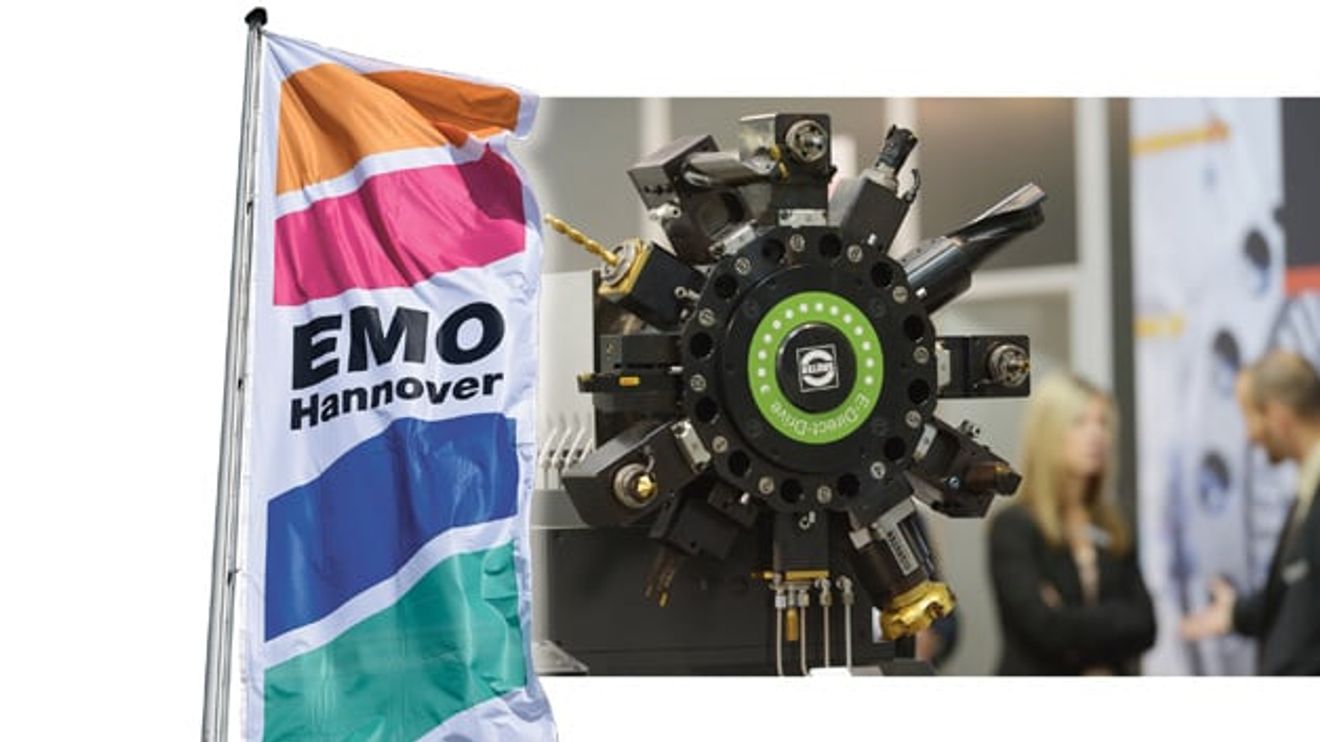
The most important task for manufacturers and users of machine tools is digitalization. This year's EMO Hannover addresses precisely this topic," says EMO General Commissioner and VDMA President Carl Martin Welcker. According to him, the trade fair is intended to help overcome hurdles on the path to digital transformation. His company, Alfred H. Schütte GmbH & Co. KG, is also already active in the field of digital transformation. The Cologne-based company started working on the topic of Industry 4.0 over two years ago. At EMO, the company will be demonstrating, among other things, how machines can be networked via open interfaces in accordance with the OPC-UA standard (Hall 17, Stand D10). Welcker explains: "For example, we will be demonstrating how machine data can be pushed into the network and then retrieved remotely using an app. This offers our customers the opportunity to visualize and monitor statuses and analyse operating data, which can be used as a basis for initiating maintenance measures, for example."
Industry 4.0 is also a topic in Mindelheim at Grob-Werke (Hall 12, Stand B04). Products already developed, such as Grob4Analyze or Grob4Pilot, serve to increase production and availability. The next projects, which will deal with machine learning, virtual worlds, energy efficiency and resource conservation, are already being planned. In addition, the company has developed its own software called Grob-Net4Industry with ten individual modules that digitize and network production systems, not only for itself but also for customers and other partners. Last but not least, Grob will also be represented at EMO with a new HMI operating concept called Grob4Pilot: a multifunctional user interface designed to enable paperless production as well as ergonomic and intuitive machine operation.

The intelligent information system developed jointly by Mitsubishi and Fraunhofer provides machine operators with information tailored to their individual tasks directly from the machine control system.
© Mitsubishi Electric / Fraunhofer IPTThe aim of Mitsubishi and the Fraunhofer Institute for Production Technology IPT (Hall 25, Stand B94) is to provide machine operators with an intelligent solution that provides them with information tailored to their individual tasks directly from the machine control system. In a joint project, a new system has been developed that collects and displays all important information on mobile devices such as tablets or smart glasses.
The smart devices and the Mitsubishi Electric machine control system communicate directly with each other. This allows employees to see in real time if faults occur, if a machine door is not closed properly or if maintenance is due soon. The system informs the machine operator directly via a message in a pop-up window on the end device and offers help. Step-by-step instructions on how to change a tool, for example, are shown in various formats such as video or text.
The system also enables the machine operator to monitor individual components of the machine tool in real time: the smart devices display current motor current data for different drives or 3D models of components in the real machine environment in the employee's field of vision. This allows the condition of the component to be monitored continuously and at any time. This allows the employee to intervene before a malfunction occurs or to use the data to find out that a component is wearing out more slowly than expected and to extend the planned maintenance intervals independently.
Data analytics creates transparency
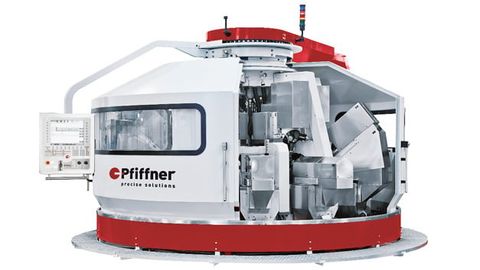
The I40 showcase from Bosch Rexroth: This rotary transfer machine will be connected to the Bosch cloud via an IoT gateway - where the collected 'big data' will then be analyzed.
© Bosch RexrothHow can machine manufacturers increase their overall equipment effectiveness (OEE) and make targeted use of data analyses for development, sales and service? Bosch Rexroth wants to answer this question in Hanover using a new 'i4.0 Showcase', which, among other things, networks two trade fair machines and a production system from rotary transfer machine manufacturer Pfiffner - from the electrical components to the hydraulics and linear technology. The key software for condition-based monitoring and maintenance is the Data Analytics Server (DAS) and an IoT gateway with a secure connection to the Bosch IoT Cloud.
Visitors can experience live demonstrations of machine status, condition and performance monitoring both at Bosch Rexroth (hall 25, stand D94) and at the Fair Friend Group (FFG), of which Pfiffner is a member (hall 14, stand G02). The OEM partner's three networked rotary transfer machines are controlled by the scalable IndraMotion MTX advanced CNC system. The data analytics server installed on a standard industrial PC collects informative data such as operating mode, cycle time, piece counter or motor temperature in real time. The data analytics server uses the OPC UA protocol to communicate with the machines and the higher-level IT systems.
Based on all the data collected, the DAS calculates, analyses and visualizes the status and usage of the machines as part of the live demo. If required, the locally stored data is available to the machine manufacturer remotely for further development and targeted troubleshooting, in particular to ensure the productivity contractually agreed with the end user.
For cross-location performance monitoring, the DAS streams pre-processed data via a secure connection to the Bosch IoT Cloud - for subsequent evaluation by the Production Performance Manager from Bosch Software Innovations.
At EMO 2017, Siemens (Hall 25, Stand D60) plans to connect not just three, but around 200 machines distributed throughout the trade fair to the open IoT operating system Mindsphere via the new 'Manage MyMachines' app. Machine operators, for example, can also use this cloud-based approach to obtain an overview of important data and the operating status of their machines.
The digital twin
In terms of data transparency, Industry 4.0 stands and falls with the digital image of the real tool. This so-called 'digital twin' with all relevant data helps with the simulation of machining, the loading of a virtual machine tool or the digitalization of the value chain in the factory (supply chain). With this in mind, the Aachen-based company Cimsource has developed the 'ToolsUnited' platform as a kind of Machining Google, the latest functions of which will be presented at EMO (Hall 5, Stand B48). These include, for example, the option for tool manufacturers to operate their own portal via which they can communicate directly with their suppliers. NC programmers, for example, can use the tool to find application recommendations for process design and 3D data for simulation, while tool managers can find suitable tool holders for given cutting bodies and vice versa.
Together with the Fraunhofer Institute for Microelectronic Circuits and Systems (IMS) in Duisburg and the Heinz Nixdorf Institute in Paderborn, the Aachen-based company now wants to go one step further with the digital twin by recording the characteristic values of the machining processes even more reliably in future. Cimsource Managing Director Dr. Götz Marczinskien explains how this is to be achieved: "The data from the machine control system is entered and can be assigned to the respective tools via an identification number. However, this data must always be available directly in connection with the tool, i.e. even after the tool has been reconditioned, for example after regrinding. In turn, the data must not be stored in the tool; instead, a reference to a corresponding life cycle file must be set up in the cloud."
In order to achieve this, the Aachen-based company is now developing a solution based on high-frequency radio identification (RFID). The idea is a tiny chip with a radio antenna that transmits and receives usage and tool data. The solution stands and falls with a technology that integrates the chip into the tool during production in such a way that it continues to function even after reconditioning. Marczinski: "In this way, a large number of data-collecting tools could be realized that generate big data for the 'ToolsUnited' platform, in which solutions for machining tasks are then created with the help of data mining algorithms. However, we are still primarily looking for a method to apply machine-readable identification numbers to the tools."


You might also be interested in
Data security solutions no longer sufficient
According to a recent study, a majority of companies believe that their current data security solutions will not be sufficient for the future. Action is needed now, as data loss costs companies almost 900,000 euros per year.
 read more...
International Federation of Robotics
The three top trends in industrial robotics
According to the IFR, two million new robots will be installed in production facilities worldwide by 2022. Three trends stand out in particular.
read more...Grid operators under pressure to act
The high investment costs for the expansion of the 5G network are causing problems for network operators. The technology consultancy BearingPoint assumes that network operators therefore need to reposition themselves - now!
read more...New series: Three questions for ...
What will 2020 bring?
Under the title "Three questions for ...", computer-automation.de is publishing short interviews with the leading figures in the automation industry on a monthly basis this year.
read more...Smart maintenance still a dream of the future
Maintenance is given too low a priority - this is the conclusion reached by Acatech and Fraunhofer IML in their survey on smart maintenance. Where do companies stand? And what should they tackle as a matter of urgency?
read more...The GAIA-X project
GAIA-X has been launched! That was the message at the digital summit in Dortmund on October 29. The aim of the large-scale digital project is to establish a European cloud for the secure digitalization and networking of industry.
read more...Campus offers for the industry
Deutsche Telekom is now announcing two campus network offers for companies. What's new is that SMEs will also benefit from the offers. And: there are edge cloud solutions for real-time data processing.
read more...SmartFactory-KL presents production of the future
Under the slogan 'Production Level 4', the SmartFactory-KL technology initiative has defined a new stage in Industry 4.0 - with people at the center! A corresponding demonstrator is already under construction. It is to be presented at the Hannover...
read more...Two million euros for Industry 4.0 start-up
The Munich-based start-up Remberg has developed software that enables manufacturers, service providers and operators of industrial machinery to map all relevant service processes on a single platform.
read more...