
Building automation
Modernization via SCADA
Adding a SCADA system to an existing building automation system - that was the approach taken by the operators of the Stockwerk office center to modernize the building management system. A standardized interface between the control system and control technology simplified the project planning.

The Stockwerk office center is operated in Gröbenzell - with offices for over 80 companies and an integrated hotel. The premises also host around 100 events a year, including cabaret and concerts. The properties with three large building complexes are integrated into a fully IT-supported building management system. Almost all technical processes and procedures in the office complex are recorded and controlled via server and system technologies. The range of functions extends from control processes for electricity, ventilation, lighting, electromechanical windows and door systems to temperature and humidity measurements that are carried out and recorded, as well as signal, monitoring, warning and alarm systems in the building. The building automation system is based on components from Beckhoff - including control units and panels. As part of a modernization project, these elements have now been supplemented by a SCADA solution from GTI-Control.
The modernization

In 2015, CBS was commissioned to review the functions of the technical building equipment, the measurement, control and regulation technology systems and their hydraulic implementation and to replace them with new software and standards for control and automation technology. Together with GTI-Control, the company then developed libraries for all common systems programmed with IEC61131-3. This created a standardized interface from the control systems to the control technology. A simplified and consistent operating and monitoring function based on the web-based SCADA solution Procon-Web was also created for the end user.
There were several reasons for the modernization: The graphical capabilities of the old building management system (BMS) were very limited and operation via tablets was not possible, which was a knock-out requirement for Stockwerk. It was also important to enable the new interface to be used not only via specially installed panels, but also via any operating device, including tablets and smartphones.
For the fixed panels, a switch was made to the CP22XX, CP27XX and CP37XX generation of panels from Beckhoff for the use of modern web interfaces with gesture support in order to also enable multi-touch operation.
Accelerated project planning
As part of the project, the manufacturer-independent building automation library from CBS and the BMS library from GTI-Control were expanded and harmonized. The aim was to reduce the project planning effort by using the so-called 'automation objects' technique. With this technology, the data structure of the automation module in the controller is assigned directly to a complex display element in the visualization. Only instance names need to be assigned instead of, for example, 20 individual variables.
During configuration, all elements of the data structure of a function block that controls a valve, for example, and requires setpoint/actual value, error states and other states as variables, are assigned directly to the display properties - for example, color change, flashing or actual value display. The data structures of all objects for all instances can then be imported into the BMS configuration via data import from the IEC 61131 environment. A BMS object (e.g. a pump) is then dragged from the library into the screen and only linked to the associated instance of the data structure (e.g. with the system identifier as the name).
This speeds up project planning and avoids assignment errors. The link to the control systems is established via the TCP/IP-based ADS protocol from Beckhoff. This connection not only enables data points to be tapped from the sensors or actuators. It is also possible to use the functionality of the Twincat software and retrieve the status of individual inputs or network participants, including the temperature of the controller, and pass it on to the visualization via ADS (Automation Device Specification).
The visualization precisely reproduces the I&C diagrams and CAD plans of the floors and the actuators and sensors installed there. The user can control and parameterize all sensors, actuators, curves and control parameters from the interface.
In addition, the technician can call up the control cabinet and CAD plans, occupancy and cable pull lists or the function description stored in the BMS from his mobile device on site. This extends the range of use of the control room, as all important data is always available and can be used where it is needed.
The integrated OPC UA server can also be used to transfer internal BMS information to higher-level systems, which is configured by simply releasing all the required data points.
The 'Resma' energy management system from GTI-Control was installed in the building for testing purposes in order to collect, archive and evaluate energy data and system statuses on the basis of the Beckhoff controllers. The additional benefits are to be demonstrated as part of a free trial operation. If this is successful, the system will be permanently installed.
Security was a priority for both the building management system and the energy management system: A user administration system manages interpretable rights and does not allow any critical interventions to be made without logging in. These rights are also verified again on the server side via the session context, which rules out unauthorized manipulation even if hackers were able to gain unauthorized access to the HTML interface.
The implementation of the surfaces
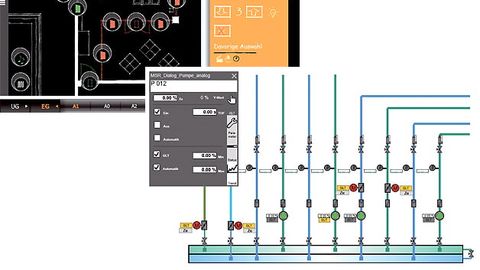
The user area in the lounge view for the building's guests (top left) compared with the graphic implementation for the technician with faceplate (bottom right)
© GTI-ControlFor the user interface, a distinction was to be made between two user groups: the technically experienced building technician who carries out system maintenance and rectifies faults, and guests or users of the building who want to influence the lighting control of the lounge, for example. For this reason, GTI Control designed and implemented a user interface that matches the style of the interior design and a technically sober expert view in accordance with Stockwerk's design requirements. Dynamic user interfaces were implemented, as is familiar from web applications. GTI-Control placed great emphasis on clear navigation in order to quickly reach any operating menu.
Authors:
David Baier is a usability engineer at GTI-Control;
Reinhard Eichschmid is Software Project Manager at CBS.


You might also be interested in
News about operating and monitoring
What is the optimum operating unit for industrial users? What is happening on the market? Computer&AUTOMATION presents a selection of new products from the operating & monitoring sector as a series of pictures.
 read more...
Runs on simple hardware
With Procon-WEB-IoT, GTI provides a variant of the Procon-WEB HMI/SCADA system that can be installed on compact and cost-effective hardware with different operating systems.
read more...Weidmüller acquires majority stake in GTI
The Weidmüller Group has acquired the majority of shares in GTI-Control mbH and GTI-Process AG. In future, both companies will operate under the name 'Weidmüller GTI Software GmbH'.
read more...New products at embedded world 2018
From February 27 to March 1, 2018, the Nuremberg exhibition halls made room for everything to do with embedded systems technology. Computer&AUTOMATION presents a selection of new products that were on show at the stands of the 16th embedded...
read more...Scalable in the range of applications
Procon-Web from GTI is a web HMI that can run on different platforms - from embedded systems to virtualized Windows servers - and also scales in the range of applications from simple HMIs to complex control systems.
read more...Flexible HMIs
New operating concepts are placing increasing demands on HMI systems - including for packaging machines. Christ Packing Systems relies on HTML5 technology with responsive design and gesture support.
read more...Networking embedded devices
GTI-Control is supplementing its HTML5-based HMI/SCADA solution with a higher-level and cloud-capable platform. The aim: simple networking of embedded devices.
read more...News about operating and monitoring
What is the optimum operating unit for industrial users? What is happening on the market? Computer&AUTOMATION presents a selection of new products from the operating & monitoring sector as a series of pictures.
read more...Designer with new interface
With version 6.1, the HMI software Procon-Web has been given a new interface for the designer function - more closely based on solutions such as Microsoft Visual Studio.
read more...