
Interview with Tobias Thiesmann
A question of safety
When it comes to safety certification, there is often uncertainty on the part of users. Tobias Thiesmann, System and Solution Manager at the Schmersal Group, comments on current issues.

Mr. Thiesmann, the supply bottlenecks are leading to reengineering and alternative solutions. What impact does this have on safety certification in accordance with the safety standards? How can re-certification be prevented?
Tobias Thiesmann: There is little that can be done to prevent this. If the alternative components are within the given specification and have the same design, we evaluate it internally and report the change to the responsible notified body. If a significant change has to be made to the alternative component, such as a change to the layout, circuitry or software, these changes must be re-examined by the notified body - up to and including recertification.
More and more safety functions are being mapped in software. What should the user pay attention to when implementing them?
In principle, mapping safety functions in software is not a problem. However, this software should run on hardware that is suitable for use in the area of functional safety. This can usually be recognized by the fact that the manufacturer specifies the corresponding characteristic values - i.e. safety integrity level, performance level or safety category. However, the software itself must also meet certain requirements. The ISO 13849-1 and 13849-2 standards provide a starting point here. In most cases, programmable hardware that allows safety functions to be mapped in software is supplied by the manufacturer with a suitable programming environment. Once the software has been created, validation must also be carried out to ensure that the implementation of the software meets the requirements of the risk assessment, for example.
User software is also used on safety control systems. What does this mean in terms of compliance with safety certification?
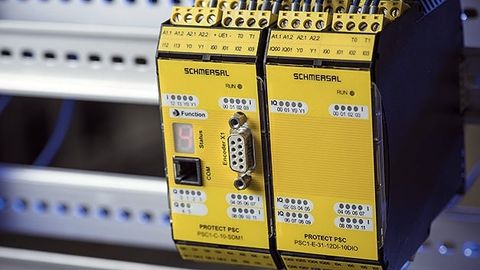
The Protect PSC1 programmable safety controllers form the basis of many safety solutions - with customer-specific software on request.
© SchmersalThe safety parameters specified by the manufacturer generally only apply to the hardware and firmware of the safety controller. As the name suggests, the user software is the responsibility of the creator, i.e. the user. Although software errors in the narrower sense are often intercepted via the programming environment, the actual program logic is not included in this check. This means that not everything that is compiled is also functionally secure.
In addition to using safe hardware and a suitable programming environment, the user must document the suitability of the software through validation. In addition to the suitability of the control system, questions relating to the specific application also play a role in achieving certain safety parameters - for example, protection against unexpected restart or the integration of feedback loops.
Schmersal is on hand to advise users. What questions keep coming up? Where do you see the greatest need for action?
The first question is often the selection of the right hardware for a specific task. This is often followed by advising the customer on how to integrate the security solution into the application. What often falls by the wayside, however, is the use of synergy effects. Modern, programmable safety logic often offers the opportunity to standardize safety solutions as well as other functions such as interfaces for documentation, diagnostics and communication. This potential is often wasted because it does not immediately generate new revenue for the user and people therefore want to 'leave everything as it is'. Unfortunately, the long-term increase in productivity often falls by the wayside.


You might also be interested in
The machine safety expert
Tec.nicum - the service division of the Schmersal Group - is presenting an "immaterial" product at SPS: a new qualification. Tobias Keller, Global Safety Consulting Coordinator at Tec.nicum, reveals what it's all about.
 read more...
Machine safety made easy
The 'System Engineering Tool' can be used to design complex cable installations for safety switchgear on machines and systems. Users can put together distributors and safety switches using drag & drop. Product Manager Udo Weber explains the...
read more...Solenoid interlock functionally extended
Schmersal has equipped the electronic solenoid interlock 'AZM40' with new accessories and new features.
read more...Subsidiary founded in Vietnam
The Schmersal Group has founded a new subsidiary in Ho Chi Minh City, Schmersal Vietnam Co. Ltd.
read more...Motto "Sustainable!"
The EU Commission has presented a proposal for a new Ecodesign Regulation for Sustainable Products (ESPR), which is to become a central component of the European Green Deal. Schmersal is also already on the road to sustainability.
read more...K.A. Schmersal at the Hannover Messe
Door handle system with seven colors
The 'DHS' door handle system from Schmersal combines the functions of a robust door handle with the display of various machine statuses via the illumination of the handle.
read more...These are your winners!
We put 96 products in twelve categories to your vote in December, and now the winners have been chosen! The trophies were presented at a 'Winner's Dinner' at the Seehaus in Munich. These are your "Products of the Year 2024"!
read more...Services division restructured
The Schmersal Group is restructuring its service business: tec.nicum's range of safety services is being significantly expanded - particularly with regard to digitalization and complete solutions for machine safety.
read more...Image processing - The winners
The winning products in the 'Image processing' category enable the monitoring of 3D zones and logistics processes and allow mobile robots to navigate freely in production.
read more...