
Industrial PCs
It's all about the cooling
The computing power in embedded systems and industrial computers is constantly increasing - and with it the power loss. Effective thermal management is therefore required. A simulation helps to select the right heat sinks and housings.
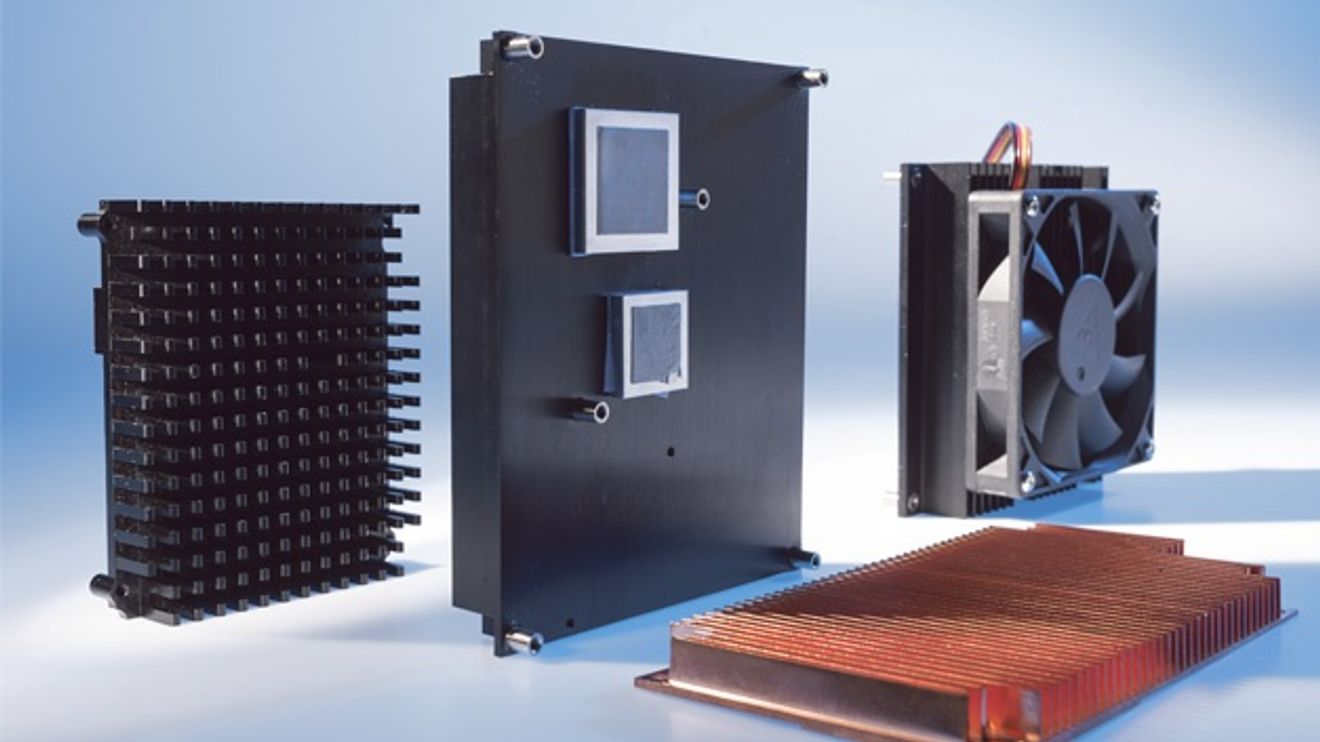
The increasing degree of networking and digitalization of machines and systems is constantly demanding smaller end devices while at the same time increasing computer power and power loss. To ensure reliable operation and a long service life for the powerful electronics, compact and efficient cooling solutions are therefore required to dissipate the processor heat. Special CNC-manufactured heat sinks for active or passive cooling ensure the rapid dissipation of system power losses. These include heatspreader solutions with integrated heatpipes as well as heat sinks with copper inlays and cooling housing solutions. The heat sinks are usually mounted directly at the hotspot, i.e. where the heat development is greatest. This means that excessive heat, which weakens the performance of the system, cannot occur in the first place.
Heatpipes for powerful cooling
Cooling solutions with integrated heat pipes are particularly suitable for embedded systems and industrial PCs. The liquid-flowing pipes significantly increase the efficiency of the heat sink, as they dissipate the heat from the hot base plate into the cooler fins. Further advantages of heat sinks with heatpipes, in addition to better heat dissipation, are the completely position-independent installation thanks to the capillary effect of the fins, the lower thermal resistance than with pure metal heat sinks and the manageable space requirement of the cooling solution.
Another solution is heat sinks with copper inlays. This is because copper is not only an excellent conductor of electricity, but also an outstanding heat conductor. At 395 W/(m-K), the metal has the highest thermal conductivity of all metals and therefore cools even better than the typical heat sink material aluminum. CTX makes use of this property in heat sink technology, particularly in the design of high-performance heat sinks for cooling embedded systems. However, as copper, with a density of 8.92 g/cm³, is also significantly heavier than aluminum (2.71 g/cm³), the material is often combined with aluminum in heat sinks. Examples of this are aluminum heat sinks with a copper inlay for direct installation at the hotspot or liquid heat sinks consisting of an aluminum plate with inserted copper tubes through which the cooling liquid flows. In this case, the component to be cooled sits directly on the heat sink and ensures rapid heat dissipation.
Cooling housing
Another important aspect is the housing of the systems. Electronic components such as power supply units or circuit boards require housings that can do more than just protect them against dust and contact.
In order not to impair the function of the device, the housings must also be able to dissipate the power loss that occurs in the form of heat. The material of the enclosure plays a major role in the effective dissipation of power loss from processors or power supply units of an embedded system. CTX therefore offers project-specific enclosures made of particularly thermally conductive materials such as sheet steel, aluminium, galvanized sheet steel or stainless steel. An additional advantage is that they generally ensure good electromagnetic shielding to protect the electronics from electrical and/or magnetic fields and to protect the surroundings from radiation from the device. However, metal enclosures are not only available in profile and stamped-bent technology, but also technical aluminum parts in project-specific designs.
Thermal simulation
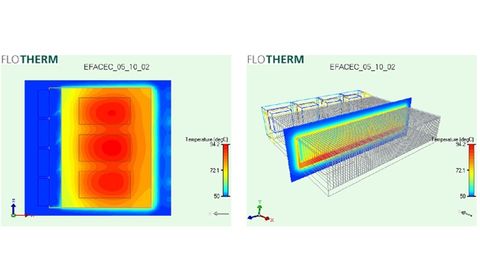
Thermal simulation can be used to detect hotspots in systems and develop appropriate cooling solutions.
© CTX Thermal SolutionsA suitable cooling solution is selected on the basis of customer data in consultation with the heat sink manufacturer and using a software-based thermal simulation. This allows the temperature state of an electronic component to be calculated in advance. For this purpose, thermodynamic framework conditions must be taken into account, such as the design and the expected power loss of the respective component - such as the module or the chip - with determination of the hotspot where the power loss occurs. The size of the available installation space and the maximum permissible surface temperature of the component for safe operation are also included as parameters in the simulation calculations. This not only allows problems to be identified or prevented at an early stage during product development, but may also save costs and materials when designing the heat sink.
Individual solutions

The PCB cooling solutions can be attached to the component using clips, rivets, soldering pins or screws.
© CTX Thermal SolutionsCTX has hundreds of heat sink models in its range for thermal management on printed circuit boards alone, with thermal resistances covering a spectrum from 6 to 72 °C/W. These include punched finger, clip-on and small heat sinks for cooling components designed for through-hole mounting (IMD = Insert Mount Device). They can be quickly and easily attached to the electronic component using clips, rivets, soldering pins or screws.
The company also offers low-profile heat sinks for the demanding cooling of surface-mounted components (SMD = Surface Mount Device). Like the SMD components, the heat sinks with their splayed wing surfaces are soldered or screwed onto the PCB and provide indirect cooling. They are available either as bulk material or taped and on reels (tape+reel) for automatic assembly.
CTX offers custom-fit components to meet the needs of different applications. On request, the company also offers complete solutions packed in blister packs consisting of the respective project-specific heat sink and insulation, mounting studs and screws. With its wide range of products and comprehensive advice, the company develops customized cooling concepts, as these can guarantee a long service life and optimal functioning of embedded systems and IPCs in the long term.
Author:
Thomas Windeck works in technical sales at CTX Thermal Solutions.


You might also be interested in
The knowledge hub of the embedded community
The embedded systems industry will meet from March 11 to 13. In seven exhibition halls, exhibitors in Nuremberg will provide information on hardware, software, services and tools. Two accompanying conferences, expert panels and exhibitor forums will...
 read more...
Customized Single Board Computer
Helbling has developed a flexible embedded vision platform based on an ARM processor that can be used as a reference design for the development of customized single board computers (SBC).
read more...Secure embedded PC for industrial applications
According to the manufacturer, the 'ReliaCOR 54-13' embedded PC from Inonet is one of the first embedded computers made in Germany to be certified for AI applications in accordance with IEC 62443-4-2. It therefore meets the requirements of...
read more...Operation via touch, glove, pen or digitizer
Getac launches the next generation of 'F110' and 'K120' tablets: The new F110 is suitable for use in a variety of harsh outdoor and indoor scenarios.
read more...IPC for IIoT gateway
The compact and energy-efficient industrial PC 'DA-1200' from Cincoze is suitable for IIoT gateways in modern industrial applications.
read more...Two new surface-mounted keyboards
Wöhr is expanding its 'Surta' industrial keyboards with versions 15 and 16, which have been specially developed for environments such as medical and dental areas, the pharmaceutical, clean room and food industries, as well as general industry and...
read more...New threat to industrial control systems
FrostyGoop is the name of a new malware variant that specializes in industrial control systems (ICS). It poses a threat to critical infrastructures worldwide. OT cyber security expert Dragos has identified FrostyGoop.
read more...Edge rack server in robust
The trend towards hyper-convergent infrastructures is not stopping at the manufacturing and automation industry. Siemens has now launched the first edge rack server in robust industrial PC quality. How is the inner workings of the server designed?
read more...Available in four sizes
KEB Automation has launched the 'Web HMI C6 X1'. The panel can be flexibly attached anywhere on the machine thanks to various mounting options.
read more...