
Advantech
Develop edge servers efficiently
The design of industrial servers is demanding. Industrial server manufacturers have therefore created an ecosystem for OEMs and system integrators that covers the range from robust standard configurations at board and system level through to individual server designs.
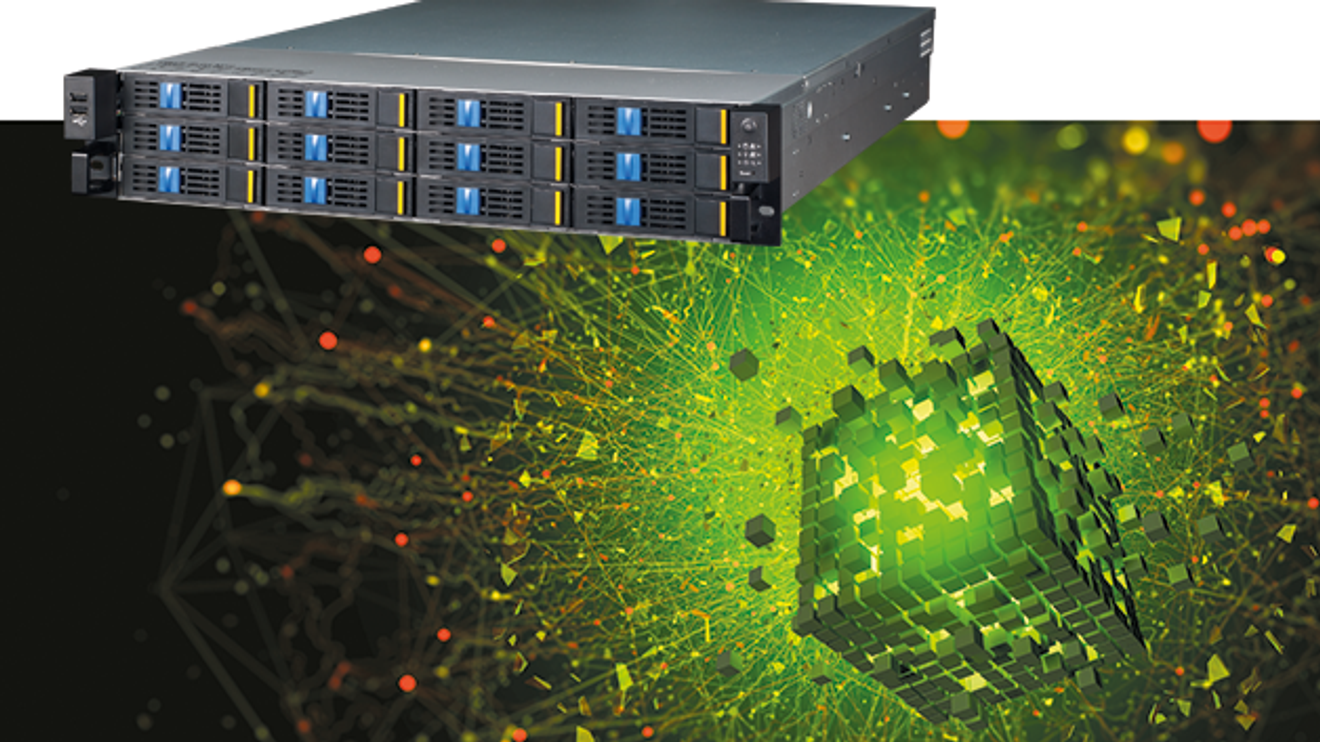
Digitalization demands more and more computing power at the edge. There is an immense amount of data from sensors, devices, machines and systems that needs to be processed and analyzed in order to make decisions in real time. Computing-intensive AI inferences or even machine learning for the continuous optimization of artificial intelligence are increasingly being used for this purpose. Enormously high I/O agility and massively parallel computing power are required for this if findings from image data are to be incorporated into control processes in real time. Sometimes several discrete control systems are consolidated on edge servers and cross-machine processes are automated, which requires additional resources.
Edge servers are also important whenever historical data needs to be stored locally. For example, if a continuous connection to central servers is not guaranteed. Added to this are network infrastructure and network segment tasks, such as security and firewall functions and fog services for horizontal and vertical integration, meaning that a great deal of data has to be processed at the edge and in industrial network infrastructures. This demand for more and more performance is also constantly increasing.
High-Performance Benchmarks
The new AMD EPYC embedded processors of the 7003 and 9004 series are currently opening up new worlds in terms of edge server performance. The processors of the 7003 series already provide 8 to 64 cores and up to 128 threads, which are clearly superior to the competition in numerous benchmarks. They are also superior in terms of cost: as single-socket servers, they deliver precisely scalable computing power for applications where alternative configurations have to scale towards dual-socket servers in order to achieve comparable performance. This minimizes software license costs and power consumption.
Thanks to support for PCIe Gen5 and the further developed Zen4 architecture, the 9004 series offers up to 90% increased performance compared to the AMD EPYC Embedded 7003 processors with an even better ratio of computing power to TDP. With individual processor types offering between 16 and 96 cores, an improvement in performance efficiency of up to a factor of 2 is possible. This also allows even better scaling down in order to sustainably reduce the energy consumption of server farms. Numerous new security features have also been integrated.
Long-term support

At board level, Advantech offers AMD EPYC Embedded 7003 processors on COM-HPC modules and Micro-ATX motherboards. Variants with AMD EPYC Embedded 9004 processors will follow shortly.
© AdvantechWith seven years of planned long-term embedded support, industrial OEMs and system integrators prefer EPYC embedded processors for new edge server applications, whether they are installing campus networking, security, storage or industrial applications, or developing virtualization, containerization, hybrid fogs or software-defined infrastructure solutions. The robustness of the enterprise-class embedded processor variants also ensures maximum availability in 24/7/365 operation. They can also be used outside of climate chambers directly at the point of use in harsh edge or industrial environments.
State-of-the-art cloud performance has thus arrived at the industrial edge and enables new possibilities and higher performance at lower overall costs thanks to low-latency operation directly on site.
The challenges
However, there are some challenges that OEMs at the edge have to face. They must implement these server processors, which have between 200 and 400 W TDP (Thermal Design Power), in an industrial-grade manner. Their systems must be able to withstand industrial temperature ranges. They must also be designed to be more robust against shock, vibrations and higher electromagnetic interference. Consequently, classic server designs for the well-tempered server room cannot be used here. However, industrially hardened systems are already available off-the-shelf, such as the SKY industrial server family from Advantech, which support AMD EPYC Embedded 7003 processors in numerous processor variants and are already available as ready-made rack servers for numerous applications.
Application-ready edge and infrastructure servers
The 2U rackmount server SKY-7260S for server racks, for example, is equipped with hot-swappable hard disks on the front for up to 200 TB of storage space and offers 2 TB of memory as well as slots for GPGPU and FPGA accelerators. Target applications include smart city and retail applications as well as medical technology. The SKY-8260S has a shallower installation depth of 20.4 inches for carrier applications, which is also recommended for space-constrained industrial racks. Numerous variants for a mix of PCIe x16 and x8 slots expansion slots already offer flexibility in the design for industrial expansion cards. The SWA-6080 server focuses on industrial networking applications. It offers numerous switches and connectivity up to 100 GbE on the front. An IPSec gateway is integrated and DPDK L2/L3 forwarding is supported. Open SSL is provided by the integration of the Advantech PCIe QAT card; an in-house diagnostics manager offers comprehensive support for OEMs, system integrators and operators.
As a result, a lot of basic work has already gone into application-ready solution platforms, which OEM customers can also obtain in customized housing designs. However, when it comes to tailoring a server precisely, extensive customization options are also required, which not every industrial server provider has in its portfolio. After all, this requires full responsibility for the entire system. The board, system-integrated mechanics and housing should ideally come from a single source. Only in this way is it ultimately possible to obtain a truly custom-fit design from a single source.
Individual interpretations
As one of the few providers of design & manufacturing services for industrial servers, Advantech has dedicated itself to precisely this task. The advantage for OEM customers is that the systems are already available as fully certified products, which drastically reduces the NRE costs for an OEM's own system design. Based on this offer, the optimum way for OEMs to ultimately achieve their product, which is then produced and delivered to them ready for immediate use, can then be defined as part of the requirement engineering process.
By omitting external and internal interfaces, the integrated motherboards - which are also available without a housing - can be adapted precisely to customer requirements with comparatively little effort. This reduces costs in series production and also increases system security, as unused interfaces cannot be misused for data theft. On the AIMB-592 Micro-ATX motherboard with IMPI 2.0 support, for example, the four USB interfaces designed for rear I/Os could be omitted. If the management console on the OEM product is only to be accessed via GbE, even more front-side USBs can be removed. Unused PCIe slots could also be omitted, as could VGA and RS-232. Such variants can be implemented from quantities of just a few hundred.
Individual motherboard or COM design with carrier board?
It becomes a little more complex when the PCB design has to be touched. Depending on the required intervention and ultimately the required quantities, it is necessary to evaluate whether a new Micro-ATX board should be used exactly for the customer's requirements or whether a design with computer modules is recommended as an alternative. Based on the new COM-HPC server-on-modules standard, there are already solutions such as the SOM-E780, which offers a total of 79 PCIe Gen4 lanes for customer-specific peripherals and interfaces. The carrier boards can often be designed to be less complex than motherboards, as they require fewer layers.
Which solution fits best must therefore be evaluated as part of requirement engineering. It is good if a manufacturer offers both options and can submit comparable offers, but simply adapting boards is not enough for a finished system. System expertise is also required, for example to enable designs that implement robust M12 connectors for mobile off-road servers.
All of this is feasible and is offered in Europe, for example, by Advantech's Design & Manufacturing Services (DMS). The DMS team focuses on developing customized embedded computing solutions for European customers. The range of services includes custom designs not only in the areas of board and system design, but also BIOS, firmware and customer-specific OS images. Software programming for AMD-based Linux servers is also carried out there.
Are off-the-shelf products a must?
OEM server designs are best placed where providers cover the entire value chain from the development of boards and systems through to production. If a broad standard product range with modules as well as boards and systems is added, this reduces NRE costs to a minimum, as the hardware-related software in particular is already used in series products and is therefore comprehensively functionally validated. In addition, only modifications are required. The variety of products also makes it easier to evaluate whether it should be a functionally stripped or modified motherboard or a server-on-module-based design. Of course, full-custom designs can also be implemented very efficiently on the basis of finished products. For example, if a circuit board for a mobile radio microstation is to be mounted on a lamppost and the PCB is therefore to have a round cut-out. If AMD EPYC embedded processors are to be integrated individually, this can be implemented particularly efficiently by companies such as Advantech.
The authors
Claus Giebert is Business Development Manager at Advantech.
Knud Hartung is Product Marketing Manager Design & Manufacturing Services at Advantech.
Antonio Tsetsos is Product Sales Manager for Industrial Grade Motherboards at Advantech.


You might also be interested in
Industrial routers and gateways
Hy-Line Technology is expanding its portfolio of 5G-capable industrial routers and gateways.
 read more...
Edge rack server in robust
The trend towards hyper-convergent infrastructures is not stopping at the manufacturing and automation industry. Siemens has now launched the first edge rack server in robust industrial PC quality. How is the inner workings of the server designed?
read more...Embedded PC for AI applications
Compmall has a new embedded PC in its range for AI applications in the industrial sector with limited space requirements, for example for on the edge at the machine.
read more...Compact and intelligent edge computers
With the 'ARK-1125' series, Advantech is launching a range of palm-sized fanless box PCs with Intel's N200 and X7211E processors.
read more...Edge Device with NVDIA Orin NX
The 'AIE-KN41' edge device from Spectra combines NVIDIA's 'Jetson' series, a compact design and AI performance in one system. It is based on the Orin NX platform.
read more...Rittal, Eplan, Cideon, German Edge Cloud
In partnership for more added value
At Hannover Messe, Rittal, Eplan, Cideon and German Edge Cloud demonstrated the opportunities that arise from combining software and hardware solutions across entire ecosystems. They wanted to show that more value creation can be achieved through...
read more...Edge computers for complex applications
To enable complex applications with higher requirements, Wago is expanding its portfolio with two powerful edge computers with 16 Gbyte RAM and 32 Gbyte RAM.
read more...Linux Foundation Launches Margo
At Hannover Messe the Linux Foundation will launch Margo, a new open standard initiative for interoperability at the edge of industrial automation ecosystems.
read more...Advantech and Qualcomm agree on cooperation
Advantech has announced a strategic collaboration with Qualcomm Technologies. The goal is to drive the continued innovation and expansion of edge AI solutions for the IoT.
read more...