
Congatec
3D vision benefits from COM-HPC
3D vision is a must, especially for guided robotics and automated guided vehicles (AGV). The new COM-HPC modules can offer a decisive performance boost in these fields of application and also drive the trend towards hardware consolidation in both areas.

Three-dimensional machine vision is admittedly not the simplest technology for recognizing things. However, as it comes closest to the human eye, 3D vision is very versatile and is increasingly being used in combination with machine learning. A large field of application in industrial production can be found in the areas of vision-guided robotics and automated guided vehicles (AGVs). In both fields of application, 3D vision is currently creating completely new solutions for Industry 4.0 applications.
The 3D machine vision market is currently developing very dynamically, with an annual growth rate of almost 15%. Among other things, the ageing world population is seen as an important driver. This aspect has two dimensions: On the one hand, it is assumed that the working-age population is decreasing. On the other hand, the number of people in need of care is increasing. In both areas, there will be a shortage of workers, making more robotics necessary. Robots are therefore being developed for industrial manufacturing to produce all kinds of things more efficiently. For the healthcare sector, robots are being developed to facilitate care and maintain autonomy and mobility. As a result, many things are to be made easier.
3D vision with a great future
However, before a large number of two-legged humanoid robots can actually
work around us, there is still a lot of development work to be done. Most inspection systems, for example, are usually still statically fixed in one place. Although there is already a lot of movement in the field of vision-guided robotics, there is still comparatively little mobility, although this market is also developing very dynamically. However, robots that are fixed in place must first and foremost look very closely, and increasingly in 3D. 3D camera technology helps them to identify any object from all three axes (X, Y and Z axis), estimate the distance and understand the resulting task. The main market driver for growth in the sector is currently the demand for increased flexibility in discrete manufacturing, which is playing an increasingly significant role due to the Industry 4.0 trend towards batch size 1.
Automated Guided Vehicles (AGVs) are important partners of vision-guided robotic systems, for example as supply and removal systems in discrete manufacturing, whose demand is also expected to grow dynamically at an annual rate of 14.1% until 2027. Such AGVs move and transport products in production facilities, warehouses and distribution centers, meaning that no or hardly any permanent conveyor systems such as belt or roller conveyors are required. They follow configurable paths to optimize storage, picking and transport functions and are primarily used on routes that, as central supply arteries of factories, must not be supplied with conveyor belts. Ultimately, they can also converge with vision-guided robotics if they are further developed into mobile pick & place robots.
When looking at very elaborate mobile robotic systems, it can be seen that they sometimes work with several subsystems. For example, there are mobile four-legged robots that use three Computer-on-Modules, firstly to find their way around the environment, secondly to move and thirdly to perform tasks.
Modularity is the trump card
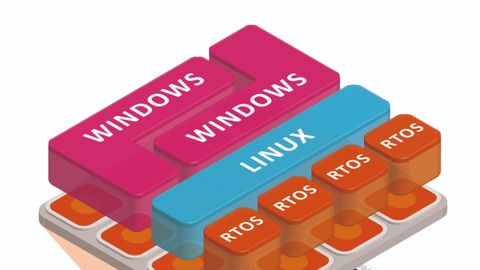
To consolidate multiple edge applications on one system, the Server-on-Modules support real-time hypervisor technology from Real-Time Systems. To consolidate multiple edge applications on one system, the Server-on-Modules support real-time hypervisor technology from Real-Time Systems.
© CongatecThis approach is also perfect because it allows the manufacturer to scale the computer-on-module for each of these tasks as required. In production cells, too, it has been common up to now for each robot to have its own controller. However, it is also conceivable that the robot controllers of a production cell could all be consolidated on one system and that this could communicate directly with the actuators/frequency inverters of the drives via real-time-capable two-wire Ethernet, for example. However, such consolidation requires a sophisticated platform strategy based on significantly more powerful modules, which have not yet been available in an industrial design. Incidentally, the four-legged robot mentioned above uses ten processor cores in the first expansion stage to ensure the required computing power and real-time capability. However, such processors are not yet available for particularly energy-saving mobile embedded systems.
Multi-purpose boost through more cores

With the adoption of the 'COM-HPC Computer-on-Modules Specification' by the PICMG standardization committee, an immense increase in performance is now available that will be far superior to COM Express modules, especially in the server category. COM-HPC server modules will make the upcoming solderable entry-class server processors available in a robust and scalable module format. This will enable multi-purpose embedded edge computing solutions on which even the most performance-hungry, decentralized real-time controllers can be consolidated.
However, this requires the use of hypervisor technology for real-time-capable virtual machines, such as those from Real-Time Systems. Only with such real-time-capable hypervisor solutions can real-time controllers continue to be operated deterministically, even if the HMI of the production cell is rebooting on the same processor or the integrated IoT gateway has to convert and evaluate a large amount of machine data and also process requests in parallel. But even without this high level of integration of different sub-systems on one module, COM-HPC is basically a must, because 3D image processing is a complex task that generates point clouds in the time-of-flight (ToF) process, for example, which produce immense amounts of data.
The need for performance is increasing

The Kit for Education, which was developed in the Intel Labs China, Autonomous System Lab, offers three expansion stages and is based on Computer-on-Modules from Congatec.
© CongatecSpatial coordinates of 32 bits are generated for each pixel. At a resolution of 640 x 480 pixels with 30 frames per second (fps), 35 MBytes of 3D data are generated per second. Added to this is the color information of a classic 2D camera, whose resolution should generally be 4 times higher. At 1.2 megapixels (1280 x 1024 pixels) and 8-bit color depth per channel, this results in an additional 112.5 MBytes per second. This total raw data of around 150 MByte per second must first be processed. The workload is also high for stereo vision with two cameras and optional structured light. The requirements for data throughput and heterogeneous computing power with CPU and GPGPU are correspondingly high.
The first generation of available COM-HPC modules based on 11th generation Intel Core processor technology (codenamed Tiger Lake) on COM-HPC is currently recommended here. Although they exist in COM-HPC client format, they offer attractive features that other module standards do not have. Firstly, the full bandwidth of PCIe Gen4 interface technology, so that twice as much bandwidth is available between cameras and processor as well as between discrete GPUs - which are used for massively parallel image data processing and AI algorithms - as with PCIe Gen3. This is paired with native support for MIPI CSI cameras, which reduces the cost of camera technology and increases performance. Added to this is the support of powerful and Ethernet-based configuration options, ranging from 8x 1GbE switching options and 2x 2.5GbE including TSN support up to dual 10GbE connectivity based on the congatec starter set for COM-HPC and can also be extended towards two-wire Ethernet support for the efficient real-time connection of the smallest peripheral devices such as sensors and actuators
The ecosystem for AI is crucial
AI support for MIPI-CSI-connected cameras - as offered by Congatec, for example - also makes IIoT and Industry 4.0-networked embedded systems even more application-friendly: AI and inference acceleration can be implemented on the CPU using Intel DL Boost-based vector neural network instructions (VNNI) and on the GPU using 8-bit integer instructions (Int8). Another attractive feature in this context is the support of the Intel Open Vino ecosystem for AI, which contains a function library and optimized calls for OpenCV and OpenCL kernels to accelerate deep neural network workloads across platforms and thus achieve faster and more accurate results for AI inferences. A suitable platform for training purposes has already been presented by Intel Labs China, Autonomous System Lab based on COM Express. In addition, there is already an Intel-certified 'ready for production' kit for workload consolidation. With the availability of COM-HPC modules, it is now possible to evaluate this OpenVINO ecosystem with its software libraries up to Adaptive Human-Robot Interaction (AHRI) or Simultaneous Localization & Navigation (SLAM) on COM-HPC.
ATX-compatible carrier board
The ATX-compliant conga-HPC/EVAL-Client carrier board offers everything required for evaluating smart vision robotics and autonomous logistics vehicles. It has two high-performance PCIe Gen4x16 interfaces as well as a variety of LAN options in terms of data bandwidths, transmission methods and connectors - including 2x 10 GbE as well as 2.5 GbE and 1 GbE support. The carrier can operate even more powerful interfaces up to 2x 25 GbE via mezzanine cards, making this evaluation platform a candidate for comprehensively networked edge devices. The heart of the presented starter set for COM-HPC client designs is the Computer-on-Module conga-HPC/cTLU, which is available in various processor configurations.
3D solutions from Basler

The deep learning-based vision system consists of a Basler Blaze Time-of-Flight camera that can be easily combined with embedded systems from Congatec. The camera provides high-resolution 3D images with almost millimeter precision. It not only generates a grayscale image as an intensity image, but also takes distance measurements for each individual pixel using time-of-flight measurements of light pulses in the near infrared range. The resulting image is then available as a 3D point cloud and thus provides further information about the depicted scene.

Compared to 2D RGB images, the color information is replaced by shape information, which not only has advantages for the simultaneous detection of red and green apples, but also enables additional applications such as the precise positioning and measurement of the detected objects. The camera's platform-independent programming interface allows easy integration of the Data Spree software 'Deep Learning DS'. This software solution based on deep neural networks is very user-friendly and allows the development of deep learning models without prior knowledge. With the help of the application software, the individual work steps for setting up the system, such as data acquisition, annotation, training, provision and application of the trained network on the target hardware, can be significantly simplified.


You might also be interested in
"Edge computing conserves network resources"
What hardware performance requirements need to be considered for edge computing? What role does security play and which areas need to be secured? Martin Danzer from Congatec provides the answers.
 read more...
IT and OT converge at the edge
The demand for computing power at the edge is increasing enormously. However, critical infrastructures are often subject to harsh environmental conditions. Embedded and server technologies must therefore converge at the edge.
read more...For AI-accelerated embedded vision
Congatec expands the 'i.MX 8' ecosystem with a starter set for AI-accelerated embedded vision applications.
read more...AI platform for machine vision
Basler has announced a new AI platform for machine vision based on the artificial intelligence and machine learning (AI/ML) services from Amazon Web Services (AWS). It enables customers to seamlessly deploy AI-based applications.
read more...SMARC modules with up to eight cores
Congatec is launching robust SMARC modules based on the Intel Atom x7000RE processor series (codenamed Amston Lake) and Intel Core i3 processor, which have been specially developed for industrial requirements.
read more...Next-generation AI computing for the edge
Congatec introduces COM Express Compact modules based on Intel Core Ultra processors. The new modules combine heterogeneous computing units such as CPU, GPU and NPU and are therefore particularly suitable for executing demanding AI workloads at the...
read more...New man in the management team
Congatec, a provider of embedded and edge computing technology, has appointed Dominik Reßing as its new CEO.
read more...The decisive factor is the performance class
It is not easy for developers to correctly evaluate the different form factors of the standardization bodies. Depending on the performance class, only a single standard is usually recommended for new system designs. However, there are also...
read more...Choose your cover photo favorite of the year 2022
Which cover picture did you like best this year? Take part in a short survey and optionally in the prize draw for great prizes.
read more...