
embedded award 2022
These are the winners
55 companies applied for the embedded award 2022. The jury nominated 16 of them. Today at 12:00 noon, Prof. Dr. Axel Sikora, Head of Jury, announced and awarded the winners in the six categories.
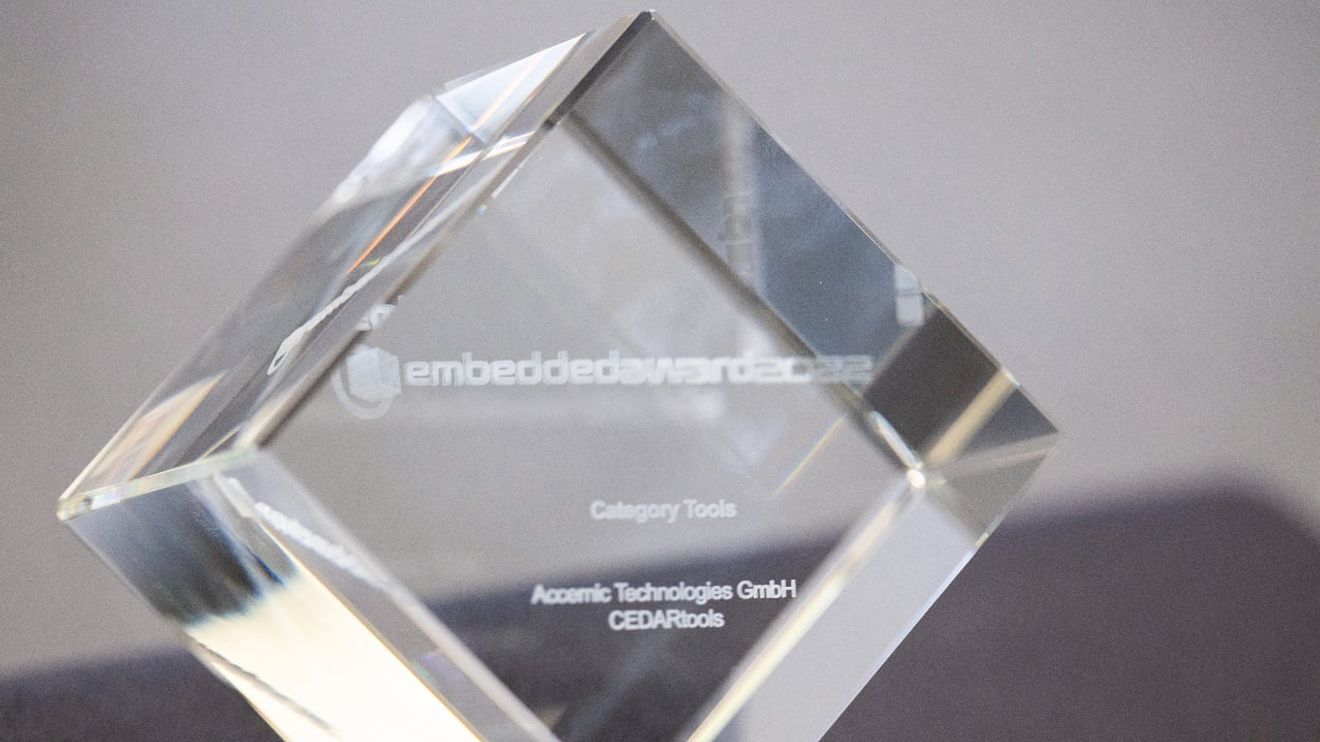
The coveted embedded awards were presented for the 18th time on June 21 at 12:00 noon at Embedded World. The jury had selected 16 of the 55 applications received in advance and nominated them for the award.
We present the winners in the six categories on the following pages:
The winners in the 'Embedded Vision' category

Beaming winners in the Embedded Vision category: Christian Verbrugge (left) and Paschalis Pelitaris (right), both GrAI Matter Labs, are delighted to have won the embedded award 2022. The trophy and certificate were presented to them by Yasmine Blair (right), moderator of NürnbergMesse, and Prof. Dr.-Ing. Axel Sikora (left), Head of Jury.
© Uwe NiklasGrAI Matter Labs with the Life-Ready AI Chip
GrAI Matter Labs (GML) has developed a new type of data flow computing architecture that combines the principles of biological systems, near-storage computing power and massively parallel cores. They call it NeuronFlow. The calculations within the NeuronFlow architecture are event-based, whereby a neuron operation is only executed when new data arrives at this neuron. New data or events only arrive at the neuron if there have been significant changes compared to the previous point in time.
GML's approach to the NeuronFlow technique makes it possible to avoid unnecessary calculations and only execute the most important aspects of a deep neural network. GML's unique neuromorphic computing paradigm provides massively parallel and fully programmable sensor analytics and machine learning with significantly reduced power consumption. GML's programmable application processors provide AI with machine learning for the Internet of Things.
The new generation processor, GrAI VIP, Life-Ready AI Chip, has been increased in capacity compared to its predecessor, making it capable of running larger networks such as ResNet-50, and it has been built on a more advanced processor node. In addition, numerous optimizations have been made to the architecture.
The winners in the 'Hardware' category

Brian Carlson (2nd from left) accepted the embedded award 2022 in the hardware category on behalf of NXP Semiconductor, presented by Peter Ottmann (left), NürnbergMesse, Yasmine Blair (2nd from right), moderator of the award ceremony from NürnbergMesse and Prof. Dr.-Ing. Axel Sikora (right), Head of Jury.
© Uwe NiklasNXP Semiconductors with the S32 RT Real-Time Processors
NXP's S32 RT real-time processors, based on 16nm FinFET process technology, offer a new class of automotive processing that delivers the benefits of microcontroller behavior but with significantly higher performance, integration and memory expansion. They fill a key processing space between the S32K microcontrollers and the S32G vehicle network processors in the S32 platform to provide the high computing power required for vehicle control, domain control, zonal gateways and safety processing applications.
The S32 RT real-time processor product line offers Automitive developers a scalable price/performance ratio with the S32Z2 and S32E2 series available now.
The winners in the 'Safety & Security' category

Three of CodeClinic attended the award ceremony for the embedded award 2022: (from left to right) Tom Keeble, Isaac Langmead and Neil Langmead, all from CodeClinic, received the award with trophy and certificate in the Safety & Security category from Yasmine Blair (right), moderator from NürnbergMesse, and Prof. Dr.-Ing.
© Uwe NiklasCodeClinic with the Traci Traceability Solution
CodeClinic's Traci is an innovative traceability matrix that identifies gaps in the development and verification of requirements as required by most traditional and emerging standards such as ISO 22839 and 21434. Traci's traceability engine includes a unique multi-domain visualization of gaps, impact analysis, metrics and reports. The analysis shows the impact of code changes across all domains. The tool provides a unique analysis of the software architecture and its implementation to show how the requirements are connected. Gaps are clearly visible as empty cells in the traceability matrix and are reported as compliance violations.
Traci can be integrated into a CI DevOps pipeline to assess traceability and automatically generate a report demonstrating consistency and completeness for compliance.
The winners in the 'Software' category

STMicroelectronics accepted the award for the embedded award 2022 in the Software category with a team of four: (from left to right) Tarik Souibes, Edouard Dulau, Corinna Babin and Vianney Taufour, surrounded by Yasmine Blair (right), moderator from NürnbergMesse, and Prof. Dr.-Ing.
© Uwe NiklasSTMicroelectronics with the NanoEdge AI Studio
NanoEdge AI Studio from STMicroelectronics is a machine learning library generator that enables any developer to benefit from AI capabilities previously reserved for experts. With this state-of-the-art all-in-one software tool, developers can easily develop an ML-based application for tiny devices based on an STM32 microcontroller. The tool provides an integrated workflow, from data acquisition to inference at the edge, including on-device learning.
In its latest version, NanoEdge AI Studio expands its scope and becomes more universal by integrating support for ISPU MEMS sensors, including the latest ISM330ISN smart sensors with embedded processing unit. AI training and inference can now be distributed across multiple devices, including an MCU and a sensor with an ISPU. This significantly reduces the power consumption of the application. The always-on sensor manages an initial detection phase where AI is performed with very low power consumption and only wakes up the microcontroller when certain events are detected to perform further AI analysis.
The winners in the 'Tools' category
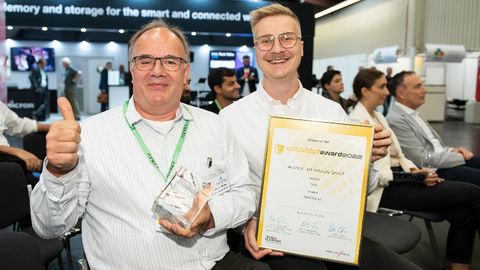
Accemic Technologies received the embedded award 2022 in the Tools category. Dr. Alexander Weiss (left), CEO of Accemic Technologies, and Albert Schulz (right) are delighted to receive the award with trophy and certificate.
© Uwe NiklasAccemic Technologies with CEDARtools
CEDARtools from Accemic Technologies is the first non-intrusive, continuous live observation tool for embedded systems. The tool runs with released code without influencing it and measures code coverage without instrumentation even at high functional test levels. It can be used to measure complex timing behavior without affecting the system. CEDARtools can process the multi-gigabit trace data stream generated by most industry standard processors such as ARM Cortex-A, Infineon Aurix, NXP QorIQ / Layerscape and Intel Atom via high-speed serial trace interfaces.
It consists of two components:
- the real-time observation of processors based on FPGA-based live trace data processing and
- non-intrusive, continuous live analysis applications when code is released without any instrumentation.
The winners in the 'Startup' category
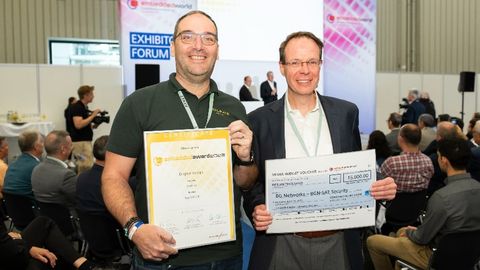
Vincent Huard (left), CTO of Dolphin Design, and Colin Duggan (right), CEO of BG Networks, are delighted with the award in the Startup category and the associated media budget. No representative from the third award winner, A-China Semiconductor, came to Nuremberg.
© Uwe NiklasIn the Startup category, all three nominees were awarded media packages donated by WEKA Fachmedien:
- Media package worth 20,000 euros: Dolphin Design with the Edge AI/ML accelerator (NPU) TinyRAPTOR.
Tiny RAPTOR from Dolphin Design is an energy-efficient NPU-IP (Neural Processing Unit) for TinyML applications. The computing power of the Tiny RAPTOR is based on Processing Elements (PE) with a special instruction set that enables unique near-memory computing. This approach has two direct advantages:
- Both pre-processing and post-processing of neural networks can be managed directly in the accelerator without the need for an external core, providing software flexibility compared to the MAC array approach.
- Data reuse is maximized as almost no data movement (near-memory) from/to L2 memory is required in TinyML applications, saving a lot of energy at the system level.
- Media package worth 15,000 euros: BG Networks with the Security Automation Tool (BGN-SAT).
The BGN-SAT Security Automation Tool from BG Networks helps embedded software engineers to quickly improve security, reduce development time and take advantage of in-silicon security features in their IoT developments. With the intuitive, GUI-based software tool, a security profile can be defined to match the cybersecurity requirements of an embedded device. BGN-SAT, complemented by BG Networks' open source security architecture (BGN-ESSA), provides embedded engineers with a low-code software platform to easily develop security controls. They can form the basis for the security of an IoT development, such as secure boot, encryption, authentication and secure software updates.
- Media package worth 10,000 euros: A-China Semiconductor with the MCU007, a 32 bit microcontroller with PUF security function.
The MCU007 from A-China Semiconductor is a 32-bit microcontroller with PUF security function. The Physical Unclonable Function (PUF) utilizes small differences in the semiconductor manufacturing process that occur naturally and are unpredictable, non-clonable, truly random and highly reliable. A concept comparable to the human fingerprint. The technology is suitable for firmware protection, car keys, IoT authentication, brand protection, licensing, blockchain technology and many other applications with high security requirements such as NFT (Non-Fungible Token) or cryptocurrencies. Device manufacturers can use the MCU007 for new product development and use the PUF ID to protect their firmware. In this way, they can prevent their development from being copied.


You might also be interested in
embedded world live again in Nuremberg
After a two-year break, embedded world is back in Nuremberg. In parallel, the embedded world Conference and the electronic displays Conference invite visitors to exchange ideas.
 read more...
The conference program: Off to Nuremberg!
With almost 200 presentations, the embedded world Conference offers an incomparably wide range of topics. Here is the overview. And a discount code!
read more...'Forum Safety & Security 2019'
The two sides of security
A total of 228 participants, speakers and exhibitors came together from July 8 to 10 in the Sindelfingen Stadthalle for an intensive exchange of information on the two sides of the "security coin" - as part of the 'Forum Safety & Security 2019'.
read more...Records broken again
The 17th edition of embedded world set new records in terms of exhibitors and exhibition space. At around 31,000, there were slightly fewer visitors than in 2018 - but this is the second-best visitor result in the event's history. The hype topic of...
read more...Review of embedded world 2019
More exhibitors, more space and the second-best visitor result: this is how embedded world 2019 can be summarized in figures. WEKA Fachmedien has collected impressions of the trade fair in a series of pictures.
read more...Focus on edge computing
Kontron is increasingly pushing the topic of edge computing. The company underlined this at embedded world with a cooperation with NXP and a new software platform.
read more...Kontron and NXP Semiconductors cooperate
Kontron and NXP Semiconductors want to work together on the development of Industry 4.0 solutions. To this end, NXP's ARM-based i.MX and Layerscape processors will be combined with Kontron and S&T's expertise in hardware and software.
read more...The NFC alternative
NFC can be found in more than 1.5 billion smartphones and is primarily used in the consumer sector. The simple and intuitive communication over short distances also predestines the technology for industry.
read more...Parameterizing by smartphone
Significance already attaches to near-field communication (NFC) on the consumer market. Richard Schmidmaier, senior marketing manager of NXP, explains why this technology was justified in taking a place here at SPS IPC Drives.
read more...