
Hannover Messe 2022 opens
Scholz: Economic restructuring all the more urgent
In 2020, the Hannover Messe had to be canceled due to the coronavirus. The following year, there was only a scaled-down version of the world's largest industrial exhibition with online formats. In addition to fundamental topics, this year there is a lot of crisis management.
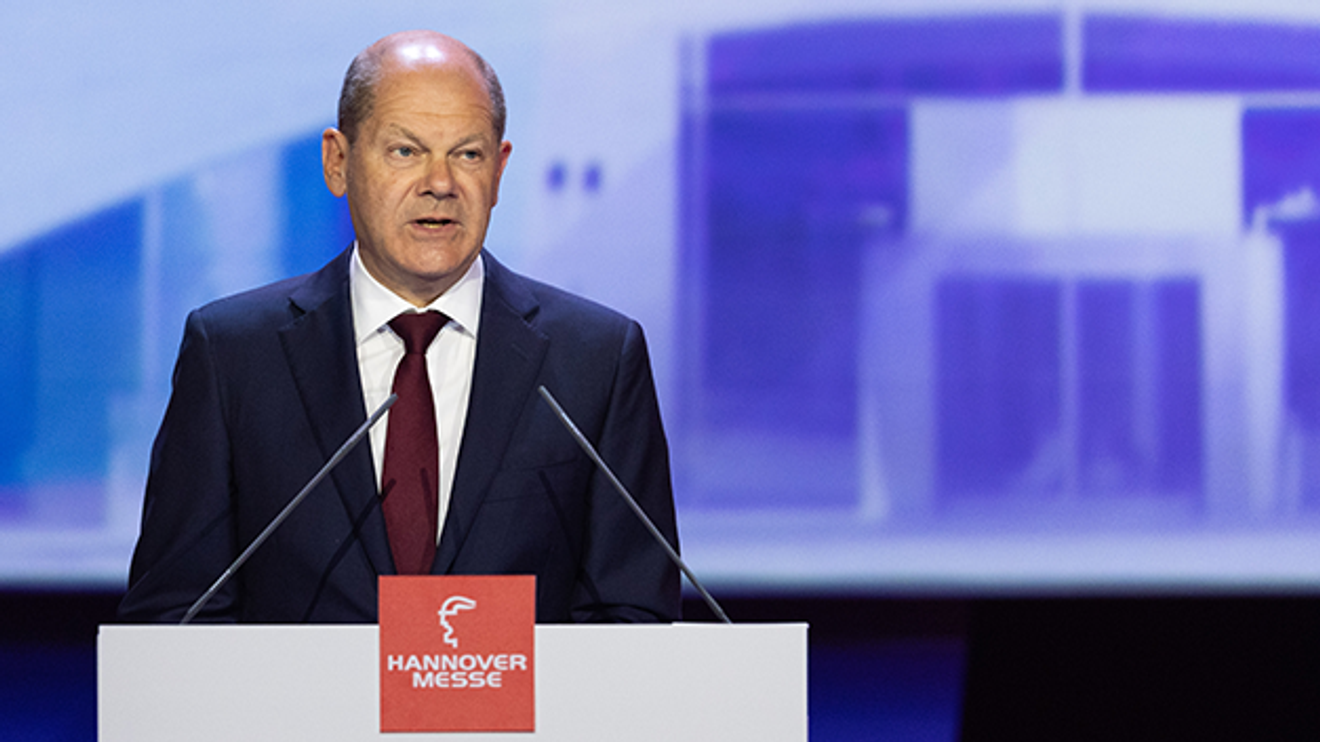
The war in Ukraine and the trade policy upheavals caused by the energy price and coronavirus crisis are dominating Hannover Messe for long stretches. At the opening on Sunday evening, it became clear that climate protection, energy efficiency and digital production are becoming topical issues at the most important industrial show - not least because of the search for alternative sources of raw materials outside Russia and new debates about economic isolation.
"One thing is very clear to me: the pandemic and the war have not diminished the urgency of the industrial transformation," said Chancellor Olaf Scholz (SPD). "On the contrary. Becoming independent of fossil fuels is not only sensible in terms of climate policy. In view of rising prices for gas, coal and oil, it also makes economic sense." Technologies for a low-carbon economy and "intelligent", energy-saving manufacturing processes are among the main topics at this year's exhibition.
Scholz expressed his relief that German industry stands behind the sanctions against Moscow. The consequences of the attack made it all the more clear that the economic transformation and a move away from fossil fuels must be driven forward. This would require many new procedures and processes. "This trade fair shows that this is possible and that we will achieve it at great speed."
However, there is no point in liberal societies and economies retreating into a policy of bloc formation. "We are now experiencing this with great severity: energy independence is also an imperative for our national security," emphasized the Chancellor. But: "At the same time, what we are experiencing today is a sign that we must work together." He considered a relapse into nationalism to be a dangerous mistake.
Economics Minister Robert Habeck expressed a similar view on globalization: "Let's hold on to it, but let's realign it. We must not fall into the rhetoric of a new nationalism. Then we will end up with Brexit and Donald Trump at some point."
The green restructuring of industry and its pitfalls
On Friday, the G7 climate, energy and environment ministers committed to the goal of phasing out coal-fired power production. However, since the start of the war in Ukraine, many countries have also been looking for alternatives to Russian gas supplies - and there are voices calling for a gas embargo. Habeck called for caution in general: "If we act rashly, a lot of capital will be lost. Many companies will not survive the difficult situation."
On the one hand, the "green" conversion could now gain more momentum through a faster switch to renewable energy sources. On the other hand, many countries are still relying, at least in part, on large quantities of fossil fuels such as liquefied natural gas (LNG) for the time being. And increased energy costs and the necessary investments in new technology are putting pressure on the budgets of companies and consumers.
"We are trying to cushion the biggest burdens," said Scholz - "with loans, subsidies and targeted relief packages, for example for energy-intensive companies. However, if Russia's President Vladimir Putin's policies were not resolutely opposed, "the price we would all pay together" would be even higher.
Scholz conceded that the need for modernization in the administration was now also becoming very apparent. Long procedures often slow down wind power, solar power or power line projects, for example. "We will speed up the times for administrative, planning and approval processes, at least halve them," he announced. The first floating LNG terminals should be ready by the end of the year. A number of environmentalists have criticized the shortened review routines.
German industry called for more efficient, faster and more digital administrative processes before the start of the trade fair. "There are many countries that are worse than us, but there are also countries that are better," said Siegfried Russwurm, President of the industry association BDI. "I've been talking about an electronic health card for 15 years now. I already feel like a zombie."
Despite the war in Ukraine, the BDI believes that export growth of 2.5 percent is possible in German industry in 2022. However, Russwurm told Redaktionsnetzwerk Deutschland that this would depend on the problems in the supply chains being alleviated and a gas embargo being lifted. It is clear that the leadership in Moscow bears responsibility for the situation. He had met many partners in the country. However, Russia is now "disqualified for a time that we cannot yet foresee".


You might also be interested in
Trade fair kicks off after the pandemic
According to Deutsche Messe AG, around 75,000 visitors made their way to Hannover Messe 2022. However, the trade fair was overshadowed by current crises. The next Hannover Messe is scheduled to take place again in April.
 read more...
Hermes Award goes to Sumitomo Cyclo Drive
The fully integrated Tuaka drive for robot applications from Sumitomo Cyclo Drive was honored with the Hermes Award 2022.
read more...Electrical industry expands exports despite Ukraine war
Important foreign markets offset the decline in business with Russia and Ukraine.
read more...Daniel Sahl-Corts becomes Managing Director
Daniel Sahl-Corts will become Managing Director of the VDMA Capital Office in Berlin on August 1, 2022.
read more...Kontron Begins Production of 5G Modules in Düsseldorf
Kontron has launched mass production of 5G communication modules in Düsseldorf. The modules, which were developed in Berlin, are used in a variety of sectors, including industry, transportation, and critical infrastructure.
read more...Weidmüller Builds Asian Headquarters in Suzhou
Weidmüller is investing in a new corporate headquarters in Suzhou. The facility will bring together development, manufacturing, and logistics, and production capacity is expected to more than triple.
read more...Expansion of the Sensor Portfolio
Infineon Completes Acquisition of ams Osram's Sensor Business
Infineon has completed the acquisition of ams Osram's non-optical analog/mixed-signal sensor portfolio. The business is expected to generate approximately 230 million euros in revenue in 2026.
read more...Production and Distribution Capacities
Yaskawa Opens Robotics Center in Slovenia
Yaskawa has opened a new robotics distribution center and an assembly hall in Kočevje. The 32-million-euro investment strengthens production and logistics for the EMEA region.
read more...Industrial AI and Manufacturing
Siemens and IFS Bridge the Gap Between Planning and Operations
Siemens and IFS are collaborating to use industrial AI to enable a closed-loop digital twin across the entire plant lifecycle. The goal is to more closely link design data with real-world operational information and optimize industrial processes.
read more...