

Fraunhofer IIS
Energy self-sufficient IoT communication in 5G networks
In the Internet of Things, sensors act as core components for data acquisition and communication. How can they be connected as wirelessly as possible and supplied autonomously in order to make installations cost-effective?

Output power of a piezoelectric generator as a function of frequency and load resistance.
© Fraunhofer IISPhysical objects, work processes and virtual services are networked with each other in the IoT. Sensors help with data acquisition and communication, and wireless technologies such as LPWAN (Low Power Wide Area Network) or NB-IoT network them together. As the sensors often cannot be connected to a power supply network, they are often powered by batteries, which in turn have to be recharged or replaced regularly. This limits their use considerably, causes additional maintenance costs, consumes an unnecessary amount of resources and thus increases the CO2 footprint. With energy harvesting and LPWAN/NB-IoT, however, many applications - such as condition monitoring, consumption data acquisition, tracking in industry and logistics - can receive an innovation boost in terms of sustainability, mobile use and retrofittability.
For mobile objects in industrial environments
Tracking in logistics, consumption data acquisition and environmental monitoring require continuous sensor data acquisition with real-time data transmission to a backend. A variety of wireless technologies with different performance characteristics are available for this purpose. However, users are spoiled for choice when it comes to which restrictions to accept: While technologies such as Bluetooth LE and Zigbee transmit data over short distances of a few meters in a very energy-efficient manner, LPWAN systems such as mioty or LoRa can cover several kilometers with a large number of participants within their network. As these LPWAN systems are not yet available worldwide, communication via the networks of mobile phone providers using NB-IoT or LTE-M also makes sense for sensor data in many regions. However, NB-IoT or LTE-M consume significantly more energy compared to other LPWAN systems due to the necessary protocol overhead.
Autonomous operation of sensors
The autonomous operation of networked sensor nodes with energy harvesting and the further optimization of standards and protocols with regard to energy efficiency are the subject of current research under the buzzwords 'Ambient IoT' and 'Zero Energy Communication'. They are also included in the discussions at IEEE and 3GPP. To ensure autonomous operation of sensor-based applications, energy harvesting, sensor technology, data processing and radio systems must be optimally coordinated. For current implementations, it is therefore advisable to consider the technologies NB-IoT for communication and energy harvesting for the self-sufficient supply of sensor nodes.
Narrow Band IoT for sensors
The term '5G' covers a large number of individual technologies and networking strategies that are standardized by 3GPP in releases 15, 16 and 17, for example. Very high data rates (eMBB Enhanced Mobile Broadband), the possibility of connecting up to 1 million end devices per km² (mMTC massive Machine Type Communication) and very reliable communication with low latency (URLLC Ultra-Reliable and Low-Latency Communication) are aimed at a large number of applications in industry, infrastructure, smart homes and the consumer sector that are still wired today. The public network of mobile network providers and additional private 5G networks, known as campus networks, are used for networking. The NB-IoT and LTE-MTC technologies were introduced in Release 13 of the standardization specifically for the connection of devices with low data rate and latency requirements, such as simple sensors, and were further developed in subsequent releases.
Energy requirements of sensor modules
In order to ensure the longest possible runtime with battery-powered sensor nodes, sensor data acquisition, data pre-processing and data transmission must be optimized in terms of energy consumption. This can already be influenced during development with regard to sensor technology and data processing.
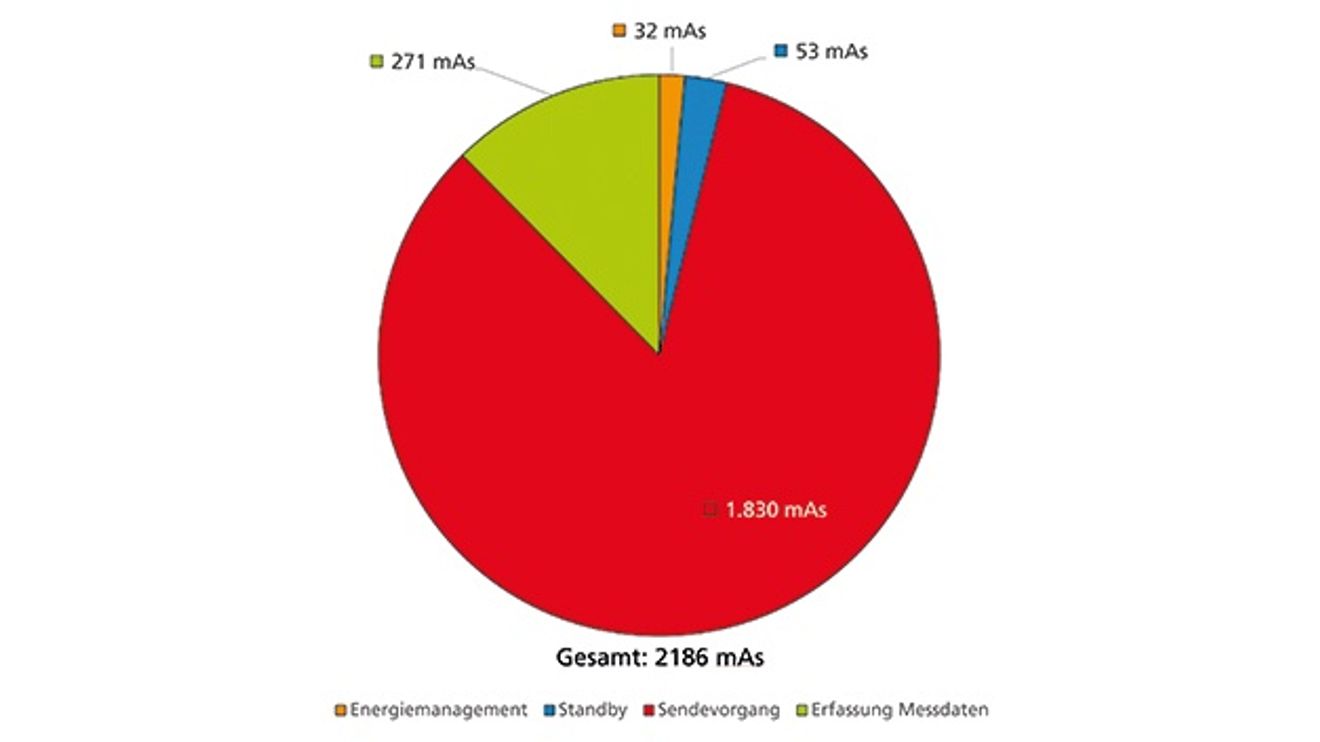
However, this is different for wireless data transmission: here, available modules, protocols and standards must be used. There are modules from several manufacturers for NB-IoT, each of which has its own mechanisms and methods for saving energy for data transmission that are specified by the standard and transmission protocol used. Nevertheless, measurements show that the energy requirement for wireless transmission can be significantly higher than for the other operating modes such as sensor data acquisition, processing, energy management and standby.
Optimizing wireless transmission or using other wireless solutions can be particularly worthwhile. For example, NB-IoT includes various options for reducing energy consumption. Parameters such as the Release Assistance Indicator (RAI flag), extended Discontinous Reception (DRX/eDRX) and Power Saving Mode (PSM) can significantly reduce energy consumption for the user equipment (UE). In contrast, other parameters are partly specified by the base station (eNB) and cannot be influenced directly at the sensor node. The network sets limits for the parameters of the base station and sensor node. For example, the RAI flag tells the base station of the UE what to expect after a message has been sent.
The flag signals in the overhead data in the uplink to the base station, for example, that:
- no further data is to be sent by the user equipment (RAI 0),
- no reception is expected and therefore the user equipment can be released directly after the uplink (RAI 1),
- or a downlink is planned after the uplink (RAI 2).
Unlimited energy from the environment

Exemplary illustration of the measured influence of the RAI flag on the energy consumption of an NB-IoT module when transmitting different payload lengths.
© Fraunhofer IISEnergy harvesting offers the possibility of using energy available from the direct environment of a device as electrical energy to supply electronics. Consumption optimization is essential to enable the permanent, self-sufficient operation of sensor nodes with the low electrical energy that can be generated by energy harvesting (EH). This makes it possible to recharge batteries during use or dispense with them completely, but which energy harvesting technologies are suitable for use?
Everyone knows the most widely used technology for energy harvesting: solar cells that convert ambient light into electrical energy. Typical power yields of a solar cell with an area of 1 cm2 for indoor operation, for example, are 12 µW/cm2 at an illuminance of 500 lux, which corresponds to typical office lighting. Outdoors, several milliwatts per square centimeter of solar cell can be expected, depending on the illuminance, about 2 mW/cm2 at 50,0000 lux, which corresponds to direct sunlight.
At present, thermoelectric converters - so-called thermogenerators that use temperature differences to generate electrical energy - are still not widely used when it comes to making sensors energy self-sufficient. However, they can be used very effectively for sensors on supply pipes, for example, which have a temperature difference to their surroundings due to the flowing medium. Motors, machines or gearbox bearings that become warm during operation, or even cooling units, are suitable for this energy generation. A temperature difference of just 3 to 4 Kelvin is sufficient to provide power in the range of 100 µW via Peltier elements and suitable voltage converters. One side of the generator is connected to the temperature source, for example a hot water pipe.
Utilizing vibrations and deformation

The NB-IoT sensor node developed at Fraunhofer IIS is supplied with energy via the heat of the thermogenerator and thus records the consumption data on a supply pipe of a heating system.
© Fraunhofer IISMechanical energy converters that use vibrations or deformation for this purpose are another option for the self-sufficient energy supply of sensors. Energy converters made of piezoelectric materials are used here, which react to deformation by generating electrical charges. If a coil is combined with a movably mounted magnet, vibrations and relative movements of motors, pumps or containers can be converted into electrical power. The typical yield is between a few 100 µW and a few milliwatts and scales strongly with the vibration amplitude used, the vibration frequency and the size and weight of the energy harvesting generator used.
Clever power management
A key component for energy harvesting is power management in the form of voltage converters and charging circuits. They adapt the voltages obtained to the system's energy storage and consumers. The circuits must be highly efficient in order to utilize as much of the harvested energy as possible. They must also be able to operate at very low currents and voltages in order to be able to work even with minimal amounts of energy. Current voltage converters work from as little as 20 mV in order to utilize the low voltages of a thermogenerator - perfectly suited for use with small temperature differences. Other converters can rectify and down-convert the amplitudes of up to 100 V of piezo converters at the lowest currents with high efficiency.
The future of self-sufficient sensors
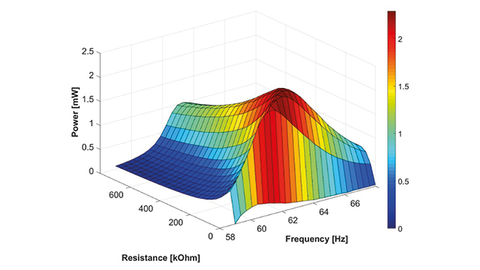
Output power of a piezoelectric generator as a function of frequency and load resistance.
© Fraunhofer IISPowering wireless systems from energy harvesting sources opens up a wide range of new areas of application and therefore data sources for Industry 4.0 applications and the Internet of Things. As the power loss of microelectronic circuits continues to be reduced, more and more use cases for wireless sensors can be operated permanently with energy harvesting. In addition to power management, system integration is also essential when implementing fully autonomous sensor systems. Here, the power supply, radio and sensor technology must be optimally coordinated and optimized according to the use case in order to achieve the desired performance with minimum size and low costs. Compared to other LPWAN systems, NB-IoT requires significantly more energy. A supply from energy harvesting sources is therefore much more difficult to implement and remains the subject of current research activities.
In this context, the supply of IoT devices from energy harvesting sources is currently also being considered in standardization at 3GPP and IEEE, for example, with regard to protocol optimizations under the keywords 'Zero Energy Communications' or 'Ambient IoT'. The supply from radio field energy using radio frequency energy harvesting, similar to RFID transponders, is also being discussed.
Regardless of the use case, the selection of the wireless system and its parameterization is also decisive for the energy consumption of the overall system. In the case of autonomous operation from energy harvesting sources, this is crucial for the reliable functioning of the system. The advantages and disadvantages of data preprocessing directly at the node and the event-dependent reduction of the amount of data to be transmitted must be considered and the overall system must be coordinated with regard to energy optimization.
At Fraunhofer IIS, energy self-sufficient IoT systems with energy harvesting and efficient wireless communication are current research topics and the subject of public projects as well as feasibility studies and developments for partners. Use cases for environmental monitoring and consumption data acquisition with solar, vibration and thermal harvesting have already been implemented.


You might also be interested in
Transforming analog industrial plants into cyber-physical systems
The digital transformation in manufacturing companies has also gained significant momentum during the Covid-19 pandemic. But many SMEs are still facing the same problem: what to do with an existing analog machine in an increasingly networked...
 read more...
Self-sufficient 5G networks for factory halls
At the Hannover Messe, Vodafone is presenting a solution that enables companies to set up a self-sufficient campus network based on 5G. The "Dedicated Multi-Access Edge Computing" service will be added to the offering so that sensitive data does not...
read more...Via REST to DataSpaces and Metaverse
In recent years, the OPC Foundation has positioned OPC UA over MQTT as a standardized implementation of edge/cloud communication up to IoT providers such as AWS and Azure. With a REST interface, it is now moving further into the IT world - all the...
read more...5G deployment under the microscope
In order to be able to manufacture products more efficiently, flexibly and autonomously in the future, many companies are hoping for 5G mobile technology. But when does the use of 5G really make sense? And what challenges does the technology pose?
read more...TSN-synchronized real-time via 5G
Congatec launches Computer-on-Modules for 5G-connected smart factories and industrial automation.
read more...With a focus on edge & cloud computing
The e-paper of issue 03/23
Sustainability is at the top of the embedded community's agenda. Prof. Dr. Peter Fromm from Darmstadt University of Applied Sciences explains in an interview why embedded technologies are becoming the key to a sustainable future - in cars, in...
read more...Sensor platform for AI testing in SMEs
KNIME is free software for analyzing large amounts of data. The KNIME2Edge platform is designed to enable companies to get started with AI technology without having to invest a large amount of resources and specialist staff at the outset.
read more...Intelligent monitoring using airborne sound monitoring
Structure-borne noise signals from corresponding system components are often evaluated for condition-based machine monitoring. A practical test compares the alternative approach of airborne noise monitoring in combination with AI algorithms with...
read more...The IoT-Bus - what's behind it?
Fraunhofer IIS presented the IoT-Bus with integrated security concept for the first time at embedded world 2017. Project manager Andreas Oeder explains the background.
read more...