
Native IPv6 support included
The IoT-Bus - what's behind it?
Fraunhofer IIS presented the IoT-Bus with integrated security concept for the first time at embedded world 2017. Project manager Andreas Oeder explains the background.

Andreas Oeder, group manager at Fraunhofer IIS: "We see the IoT-Bus as a general solution for systems in which IP capability up to the end node plays a role."
© Fraunhofer IISMr. Oeder, what exactly is behind the IoT-Bus?
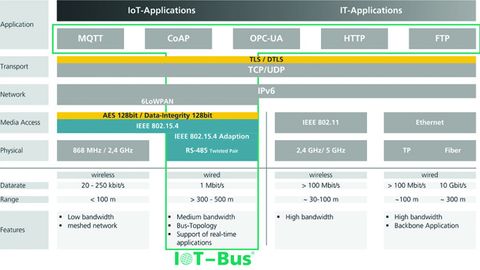
Oeder: In future, many IoT applications will require data rates that lie in the intermediate range of low data rates of up to 20 kbit/s for simple fieldbuses for building automation and high data rates of over 100 Mbit/s. Ifthe data rate is too low, IP capability and encryption cannot be implemented. If the data rate is too low, IP capability and encryption cannot be implemented. On the other hand, bandwidths that are too high unnecessarily increase the costs and energy consumption of communication. By combining a range of around 500 meters with a data rate of 1 Mbit/s, the IoT-Bus closes precisely this gap. It is the first 2-wire fieldbus with native IPv6 support. In the 4-wire version, the communication nodes are also supplied with power via the bus.
The IoT-Bus is being developed as part of a research project for energy management in industrial buildings. In this application, the focus is on a communication solution for networking the local operating resources for in-house power generation, storage and consumption - specifically: communication between the control center, photovoltaic systems, battery storage systems and consumers.
What does the technical implementation of the IoT-Bus actually look like?
Oeder: As already mentioned, the IoT-Bus from Fraunhofer IIS is the first fieldbus with direct IPv6 support and an integrated security concept. This means that the end nodes - i.e. each sensor or actuator - speak the IPv6 Internet protocol as well as UDP and TCP. This provides standardized interfaces for the actual applications, allowing protocols such as MQTT, OPC-UA as well as CoAP or REST to be used. This means that every IoT-Bus node is basically internet-enabled and can communicate directly with the cloud if required. An IP-capable end node offers clear advantages for direct access to the end nodes via the internet or for direct connection to the cloud. No protocol conversion is necessary and encryption on the transport layer can be carried out consistently. By integrating the IPv6 protocol in the IoT-Bus, each end node receives its own IP address and can therefore send and receive data. Status messages and warnings from machines can be sent to mobile end devices, for example, and responsible persons can react quickly to these messages and take appropriate countermeasures.
For the physical transmission layer, we use RS-485 using standard RS-485 transceivers. Based on this, we use the IEEE 802.15.4 and 6LoWPAN radio standards. This means that the advantages of 6LoWPAN header compression can now also be used for wired communication. A token-based access method is used for media access, making the IoT-Bus real-time capable. To make this possible, the IEEE 802.15.4 protocol has been adapted for wired communication.
Conformance to IEEE 802.15.4 also enables fast packet routing between the wired IoT-Bus and wireless networks without extensive protocol conversion. Imagine the following scenario, for example: You want to integrate an additional sensor, but laying a cable is difficult or even impossible because the object to be monitored moves quickly or is in a location that does not allow cabling. This is where the IoT-Bus will be able to connect wireless nodes that speak IEEE 802.15.4 very easily in future.
In the context of Industry 4.0 and the IoT, a number of new communication solutions are already being discussed in the factory environment alongside the established industrial Ethernet solutions - including Ethernet TSN + OPC UA + MQTT. Why do we need another new solution like the IoT-Bus?
Oeder: Developments such as Ethercat, Powerlink and now TSN have already brought about a change in classic fieldbuses. However, Ethernet-based technologies are not always the right solution for all areas of application. For classic machine control with its high requirements for very short response times - i.e. microseconds or a few milliseconds - we see TSN or other Ethernet-based solutions as an alternative to classic fieldbuses; however, these solutions also 'inherit' all the properties that Ethernet has in terms of topology, range for point-to-point connections and also in terms of costs. In contrast, the IoT-Bus offers a solution for applications where moderate data rates and response times are sufficient, but where the focus is on a reliable, cost-effective and IP-capable solution.
Unlike TSN, for example, the IoT-Bus enables communication via a 2-wire twisted pair cable based on RS-485 and therefore comes closer to classic fieldbuses. Nevertheless, protocols such as OPC-UA, MQTT and CoAP can be transmitted without the high energy consumption and costs of an Ethernet-based solution.
The idea for the IoT-Bus originated in the field of building automation. What specific role can it also play in factory automation in the future?
Oeder: Let me say one thing in advance: Where extremely low latency is required and the data is processed decentrally directly in the machine control system, we still see the domain of classic fieldbuses. The situation is different when it comes to monitoring production systems, predictive maintenance or even the implementation of business models such as 'machine as a service': connecting production systems to the internet will play an important role here in the future. It is precisely in these areas that the IoT-Bus can show its full potential: IP capability right down to the end node, standardized application protocols and encryption based on TLS. With the help of its data container concept, it can be used as a range extender for fieldbuses, for example, and transport CAN messages over a greater distance.
A bus system will only become established if it receives appropriate support from manufacturers and ultimately also from users. What is the situation in this respect?
Oeder: We are currently holding intensive talks with well-known manufacturers. The first interested parties already want to evaluate the technology. Inquiries from users are currently mainly coming from the areas of building automation, lighting control and the connection of various sensors in production plants.
When should the solution be ready for the market?
Oeder: The IoT-Bus is being developed as part of the SEEDs research project and is being funded by the Bavarian State Ministry of Economic Affairs and Media, Energy and Technology. The project ends in mid-2018. The IoT-Bus is already being used in a real field test in the demonstration and research platform at Fraunhofer IISB and is constantly being developed further. In the near future, the solution can also be licensed via Fraunhofer IIS. Last but not least, we can implement user-specific requirements directly as part of a development contract. To this end, we are already looking for partners to make the IoT-Bus even more interesting for the respective area of application.


You might also be interested in
Wago gears up for Time Sensitive Networking (TSN)
In the future, Ethernet TSN will enable continuous communication in machine and plant engineering without gateways and interruptions. Wago is launching two new automation systems on the market for the SPS, with which users can take advantage of all...
 read more...
Arrive in reality!
Time Sensitive Networking has firmly established itself in the vocabulary of the automation industry. All well-known suppliers have started activities to evaluate or even introduce TSN. But where exactly are the goals for the use of TSN and what is...
read more...OPC UA and DDS combined
To date, OPC UA and DDS have often been presented as competitors. Competitors that will both be based on the Ethernet standard TSN. - However, the key to successful automation in the future lies in a combination of the three standards DDS, OPC UA...
read more...The interaction of Ethernet TSN, OPC UA and 5G
Only the reliable and structured interaction of all units in an ant colony ensures its survival. Data communication in a modern industrial network works no differently in a figurative sense.
read more...Where there are still problems with 5G
5G in automation - a hot topic at the moment. How quickly can we actually expect 5G to be used in industry? What obstacles still need to be overcome? Thomas Schildknecht summarizes the key points in this interview.
read more...Data pipeline ASi-5
High data width, short cycle times, improved integration of intelligent sensors and actuators using IO-Link and cloud connectivity via OPC UA - ASi-5 makes AS-Interface fit for the requirements of digitalization.
read more...OPC UA - a must for the industry (Part 2)
OPC UA is regarded as the new communication standard for industrial automation. Part 1 explained why a new communication technology is needed in automation and described the OPC UA methods. Part 2 deals with the OPC UA pub/sub methods and the power...
read more...OPC UA, MQTT and co.
The Industrial Internet of Things (IIoT) covers very different areas of application. The available connectivity technologies and standards are just as diverse as the application areas. How can the right technology be filtered out in each case?
read more...The question of licenses
Will OPC UA in combination with TSN become 'the' standard for industrial communication? What role do licenses play in this question and what part does OSADL play?
read more...