

Analog Devices
Development of isolated, software-configurable I/O channels
When developing isolated I/O systems for industrial applications, some key data such as power dissipation, data isolation and form factor must be taken into account. A software-configurable input/output module can help with this.
With the help of a software configurable input/output device and its associated isolated power management and data solution, industrial applications can be easily developed at system level. This article explains the advantages of the system-level approach to the development of a single IC and the possibility of optimizing the power consumption of the solution presented.
Figure 1 shows a system solution built with the AD74115H single-channel, software-configurable I/O device and the ADP1034 power management unit from Analog Devices, which meets the requirements for power consumption, isolation and dimensions. The solution combines the power and data isolation in the ADP1034 with the software configurability of the AD74115H, providing the ability to design an isolated, single-channel I/O system with only two ICs and minimal external circuitry.
Solution at system level
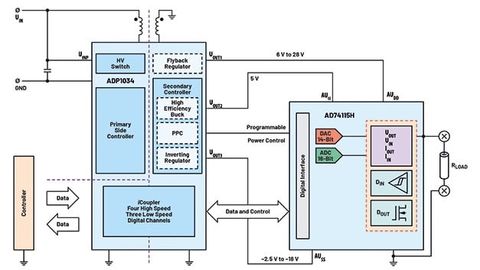
The ADP1034 is an isolated power management unit (PMU) that combines an isolated flyback DC/DC regulator, an inverting DC/DC buck/boost regulator and a DC/DC buck regulator with three isolated voltage outputs. The module also contains seven isolated digital channels with low power consumption. An additional PPC (Programmable Power Control) function allows the voltage at pin VOUT1 to be adjusted as required via a single-wire interface.
UOUT1 supplies between 6V and 28V for the AUDD supply of the AD74115H, VOUT2 supplies 5V for the analog supply voltage AUCC and digital supply voltage DUCC. This can also be used to supply an external reference if required. Finally, VOUT3 supplies between -5 V and -24 V for the AUSS supply.
Power loss and optimization
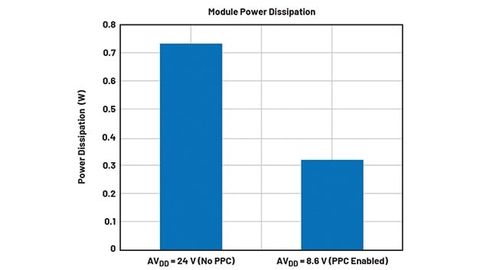
Figure 2: Measured values at 20 mA in a load of 250 Ω at AUDD = 24 V and AUDD = 8.6 V (with PPC).
© Analog DevicesWhen developing channel-to-channel insulated modules, developers essentially have to strike a balance between power dissipation and channel density. With ever smaller module dimensions and simultaneously increasing channel densities, the power dissipation per channel must decrease in order to remain within the maximum permissible power dissipation budget of the module. In the case described here, the module consists of the ADP1034 and AD74115H components, which combine to provide isolated power, data isolation and software-configurable I/O functions.
What makes the components the optimal solution in terms of low power consumption is the novel integrated PPC function in the ADP1034. The programmable power control allows users to adjust the voltage UOUT1 (AD74115H supply voltage AUDD) as required. This minimizes the power dissipation of the module at low load, especially in current output mode.
When programmable power control is active, the host controller in the system sends the required voltage code to the AD74115H via the SPI interface, which is then forwarded to the ADP1034 via a single-wire serial interface (OWSI). The OWSI interface includes a cyclic redundancy check (CRC) to ensure robustness against electromagnetic interference in harsh industrial environments. In the example calculation for the power dissipation, it can be seen that with AUDD equal to 24 V and a load of 250 Ω at an output current of 20 mA, a total power of 748 mW is converted in the module. If the PPC function is used to reduce the AUDD voltage to 8.6 V (load voltage + reserve), the power consumption in the module is reduced to ~348 mW. This corresponds to a power saving of 400 mW within a module.
Example calculation for the power loss
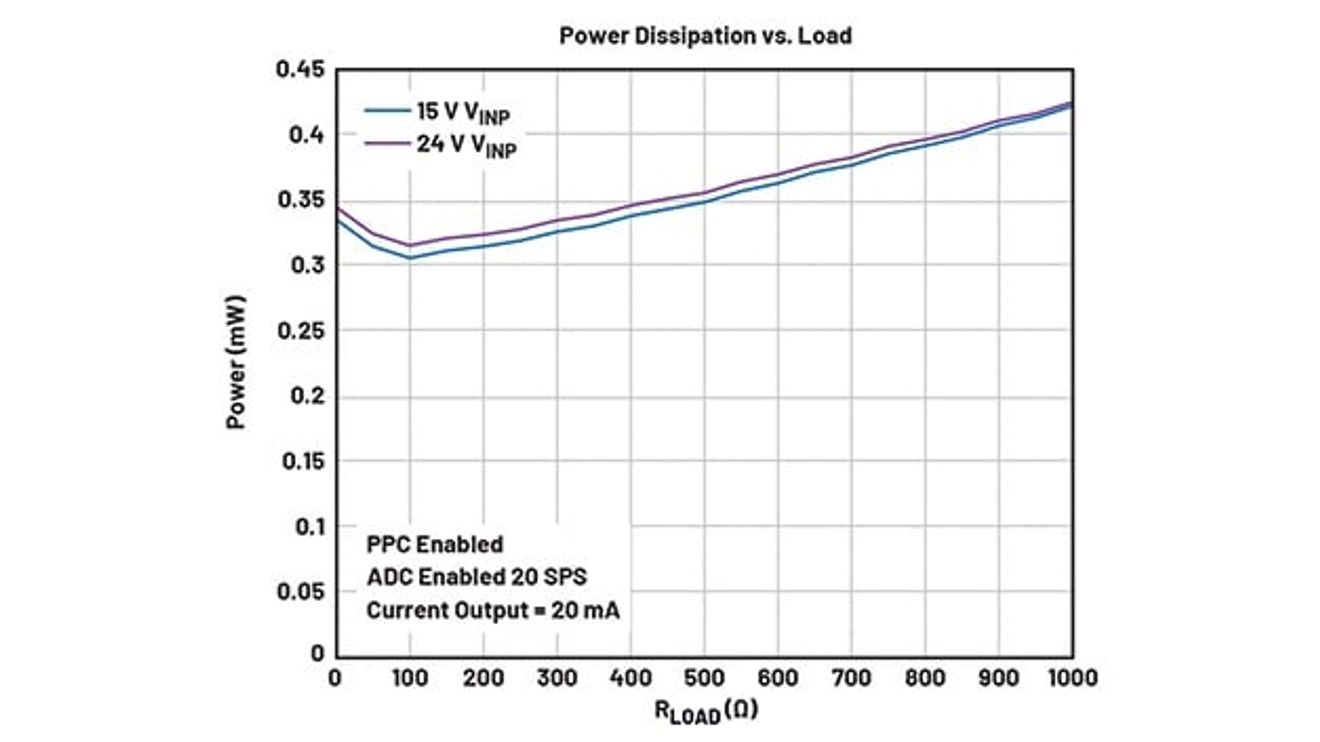
Figure 3: Power loss as a function of the load resistance RLOAD at an output current of 20 mA.
© Analog DevicesIn examples 1 and 2, the current output is selected and outputs 20 mA. The load is 250 Ω, the A/D converter is activated in its basic configuration and converts at 20 samples/s.
Example 1 (without PPC):
Output power of the AD74115H = (AUDD = 24V) × 20 mA = 480 mW
Input power of the AD74115H = quiescent current of the AD74115H (206 mW) + power consumption of the A/D converter (30 mW) + 480mW = 716 mW
Input power of the module = 716 mW + power consumption of the ADP1034 (132 mW) = 848 mW
Power consumption of the load = (20 mA)² × 250 Ω = 100 mW
Total power consumption of the module = input power of the module - power consumption of the load = 748 mW
Example 2 shows that the power dissipation of the module drops to 348 mW when the PPC function is activated to bring AUDD to the required voltage of (20 mA × 250 Ω) + 3.6 V reserve = 8.6 V.
Example 2 (PPC activated):
Output power of the AD74115H = (AUDD = 8.6 V) × 20 mA = 172 mW
Input power of the AD74115H = quiescent current of the AD74115H (136 mW) + power consumption of the A/D converter (30 mW) + 172 mW = 338 mW
Input power of the module = 338 mW + power consumption of the ADP1034 (100 mW) = 438mW
Power consumption of the load = (20 mA)² × 250 Ω = 100 mW
Total power consumption of the module = input power of the module - power consumption of the load = 338mW
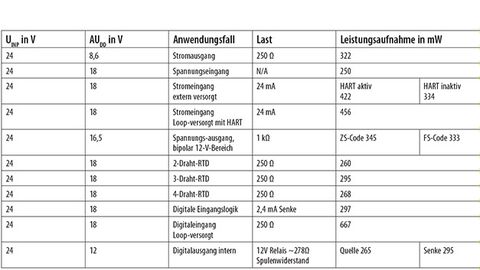
Table 1: Typical applications for the AD74115H I/O component and corresponding power dissipation with PPC.
© Analog DevicesFigure 2 illustrates the measured power dissipation on the board with the AD74115H at 25 °C. The measurement shows that the power loss is slightly lower than the calculated power loss. This will vary slightly from component to component.
Figure 3 shows the power dissipation curve of the module (ADP1034 and AD74115) with PPC (optimized AUDD was programmed for each load resistance value) over the load resistance. Two different voltages (15 and 24 V) were applied to the UINP connection of the ADP1034 to show the efficiency of the ADP1034. The measurements were carried out at 25 °C.
Figure 4 shows the power dissipation with PPC (optimized AUDD was programmed for each load resistance value) as a function of the load resistance at different temperatures.
Digital output use case
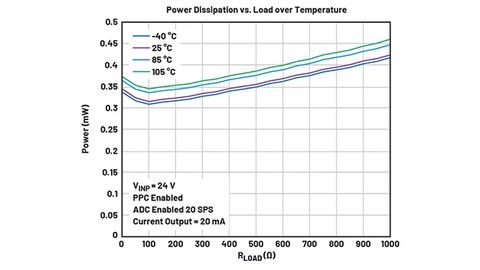
Figure 4: Power loss as a function of the load resistance RLOAD at different temperatures.
© Analog DevicesIn industrial applications, the digital output is the application with the highest power consumption. The AD74115H I/O component supports internal and external sourcing and sinking digital outputs. The ADP1034 power management unit can supply sufficient current for the internal digital output function, which can source or sink a continuous current of up to 100 mA. In this case, the supply voltage of the digital output circuit DO_UDD is connected directly to AUDD. The external digital output function is available for currents above 100 mA. It requires an additional power supply connected to DO_UDD.
Timeouts for the internal digital output use case
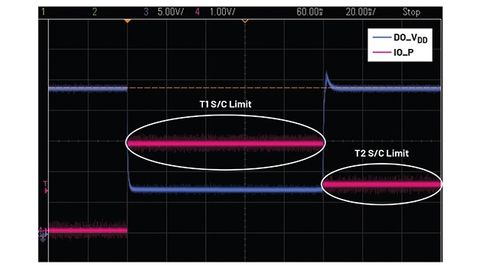
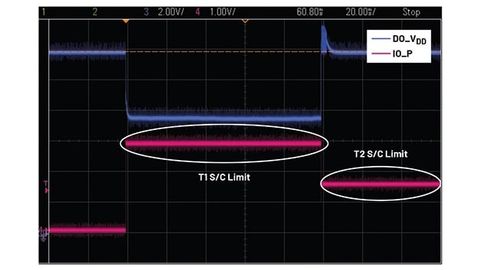
To charge capacitive loads at switch-on, a higher short-circuit current limit (~280 mA) can be activated for a programmable time period T1 while the internal digital output use case is used. A second short-circuit limit value (~140 mA) is used once the T1 time has elapsed. This is a lower current limit which is active for a programmable time period T2.
As the system requires more current during these short-circuit conditions, care must be taken to ensure that the output voltage UOUT1 at the power management unit ADP1034 does not collapse. To avoid voltage dips, a system supply voltage of 24 V should be applied to the ADP1034 if DO_UDD of 24 V is required. This is a typical voltage for a 24 V relay. For a 12 V relay, a minimum system supply voltage (ADP1034 UINP) of 18 V is recommended. This ensures that the system can supply sufficient current to the load.
Fig. 5 and Fig. 6 show the voltage DO_UDD to the short-circuit limit values T1 and T2. This demonstrates how stable the ADP1034 power management unit can deliver high currents.
Data isolation and size
The ADP1034 power management unit uses Analog Devices' patented iCoupler technology. The component contains three isolated power supply channels, one SPI interface and three isolated GPIO channels in a 7 mm × 9 mm housing. Due to this high integration density, the component requires little space on the PCB and at the same time fulfills the requirements for channel isolation. Power consumption is also reduced.
On the controller side of the ADP1034, the other SPI isolation channels are set to a low-power state when the channels are not in use. This means that the channels are only active when required. The three isolated GPIO channels are used to isolate the RESET, ALERT and ADC_RDY pins of the AD74115H. This fulfills all the isolation requirements of the AD74115H without the additional cost of another isolator IC.
Simplified development at system level

The author: Valerie Hamilton is a Product Applications Engineer at Analog Devices in Ireland
© Analog DevicesDeveloping an isolated channel-to-channel I/O solution with low power consumption and a small form factor can challenge even experienced developers. The solution presented here, using the ADP1034 and AD74115H devices, offers high integration density and simplifies system-level development. Since a single IC provides three isolated power supplies from a single system supply and integrated data isolation, component costs are significantly reduced. Combined with the flexibility of the AD74115H, the system design meets most industrial I/O applications.


You might also be interested in
Ultra-compact communication module
With the 'netRapid 90', Hilscher is expanding its chip carrier portfolio for industrial communication of highly integrated field devices.
 read more...
SmartFactory-KL and "Manufacturing-X"
Milestone towards Production Level 4
Resilience, sustainability, flexibility, digital twins, interoperability, skill-based manufacturing architecture and distributed production - all this is Production Level 4. "Manufacturing-X" shows how it works.
read more..."A path through the zoo of standards"
The OPC Foundation used its traditional press conference at SPS to call for more cooperation between OT and IT. The implementation of OPC UA cloud interoperability by AWS and Microsoft shows where the path needs to go.
read more...Hans Seifert to Become Chief Sales Officer
Sigmatek has appointed Hans Seifert as Chief Sales Officer (CSO). His area of responsibility includes international sales, marketing, application engineering, and support.
read more...CC-Link certification for modular I/O system
Weidmüller has received the CC-Link Partner Association (CLPA) certificate for its modular I/O system 'u-remote'. This makes u-remote the first modular I/O system with official CC-Link IE safety certification for CC-Link IE TSN.
read more...Innovation partner for automation
Bihl+Wiedemann is a medium-sized, owner-managed company - founded in 1992 by Jochen Bihl and Bernhard Wiedemann in Mannheim. It develops and manufactures complete solutions for functional safety and data communication in machines and systems.
read more...Certified according to IRIS Rev.04
Rail technology specialist Lütze Transportation has successfully completed certification in accordance with ISO 22163:2023 / IRIS Rev.04. The certification underlines Lütze's commitment to meeting the highest quality requirements of the rail...
read more...Joachim Herz Foundation invests
The Hamburg-based Joachim Herz Foundation acquires a stake in Weidmüller as part of a capital increase and thus holds around 20% of the shares in the family-owned company. The commitment is aimed at long-term corporate development and accelerated...
read more...Digital Twin platform for the process industry
R. Stahl introduces a digital twin platform in combination with digital nameplates for the process industry. This technology enables the efficient management and interactive use of digital twins of real plant components.
read more...