

Fraunhofer IESE/Bosch
A milestone on the road to implementation?
The implementation of the vision of Industry 4.0 is still slow! The 1.0 release of the open source reference implementation Eclipse BaSyx is set to give the transformation wings with immediate effect - an application report.

Ten years after German IT experts first coined the term 'Industry 4.0' at the Hannover Messe 2011, the term is now associated with Germany worldwide. However, Germany is still a long way from the digital home stretch. According to the current 'Digitalization Index for SMEs 2020/21', German industrial companies currently only score 62 out of a possible 100 points in terms of their level of digitalization.
If you also take into account the fact that Industry 4.0 goes far beyond the mere digital transformation of production processes, the result would certainly be even more alarming. The fourth industrial revolution is often mistakenly equated with the collection of data. In fact, the change is much more about achieving end-to-end networking of all machines. Only if all machines can communicate with each other across all systems will it be possible to achieve flexible - and therefore adaptable - production. First of all, however, the question arises: Why is it that we can currently only talk about 3.5 at most when it comes to industrial transformation? We are still a long way from the desired status of 4.0.
The sword of Damocles for SMEs
There are many reasons for this: digitization hangs over many small and medium-sized companies in particular like the sword of Damocles - it is clear that digital change is inevitable. However, how it can be tackled practically and as efficiently as possible still seems to be a big mystery to many industrialists.
In addition, the frequent lack of financial and human resources makes progress even more difficult. What's more, the lack of implementation of the relevant concepts and standardization as software solutions to date in particular has fueled additional concerns among company owners that they are taking a major risk by embarking on the transformation.
This fear was certainly justified to some extent; however, a product has been on the market since mid-March 2021 that could boost the digital transformation and make it much more secure. We are talking about the 1.0 release of the Eclipse BaSyx middleware. Admittedly, the name sounds abstract and cannot be explained in just one sentence. However, one thing can be anticipated at this point: The release marks a significant milestone in the feasibility of Industry 4.0 and could bring the digital transformation to the masses with immediate effect. But now the situation step by step:
What is the BaSys 4 middleware?
In mid-2016, the Federal Ministry of Education and Research, together with 14 other partners from industry and research, launched the 'Basis System Industrie 4.0' (BaSys 4.0 for short) project. The Fraunhofer Institute for Experimental Software Engineering IESE in Kaiserslautern has been the consortium leader ever since.
The aim of the research program was to develop a technology system for production plants that realizes the efficient changeability of a manufacturing process as a central challenge of the fourth industrial revolution.
The plan has now been put into practice: With the 'BaSys 4' middleware, the consortium has developed a reference architecture that enables companies to switch to changeable production on a broad scale. To achieve this, it is first necessary to prepare the data models and protocols in such a way that they are interoperable - i.e. can 'communicate' with each other. To make this possible, the middleware contains a collection of well-defined building blocks that can be linked and integrated with each other to form a centralized, decentralized or distributed system architecture. In short, the structure of the middleware resembles a modular principle. Each company can choose which components it needs for its specific use cases and then deploy them individually.
Assuming a company is still at the very beginning of its transformation, for example, the store floor must first be linked to the office floor. With the help of the Virtual Automation Bus (VAB) developed as part of the research project, a concept was developed for this very purpose that makes cross-network and cross-protocol peer-to-peer communication between the production machines and IT a reality.
Once all of a machine's data is digitally available in this way, it is then a matter of 'casting' it into a common form. After all, a standardized language is the basic prerequisite for being able to network production systems.
How does batch size 1 production work?
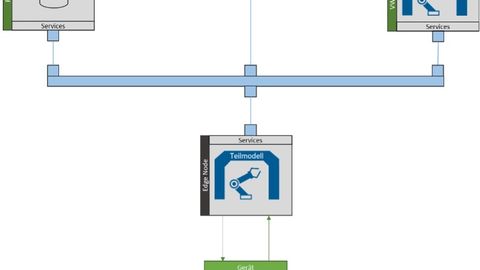
BaSys 4 uses the principle of administration shells for the language transfer of all data. These are standardized digital twins that are set up according to a uniform structure. Each asset administration shell contains sub-models that both virtually represent the status of a real asset and provide live data about it if required. The highlight here is that the asset administration shells can not only be passed on to other companies; above all, the standard is open and can be viewed at any time.
If a company is now planning to implement efficient batch size 1 production, BaSys 4 provides the concept of management components. This gives each machine a standardized service interface - by separating the execution of production processes from production services. In addition, each capability of a machine is described with sufficient precision so that a production line can be converted as easily and efficiently as possible to the production of a custom-made product.
To ensure that the BaSys 4 middleware can facilitate the digital transition for as many companies as possible, the reference implementation Eclipse BaSyx is available to companies as open source - without any license costs. Software developers can use the code provided directly in the form of embeddable libraries, saving them valuable time that they would otherwise need for code development and, for example, for implementing the administration shell standard and its interfaces. The off-the-shelf components enable even users without programming knowledge to get started straight away. The many examples also greatly reduce the time needed to familiarize yourself with the topic of the asset administration shell.
What will change with the 1.0 release?

Frank Schnicke is Expert 'Industrie 4.0 System Architectures' at the Fraunhofer Institute for Experimental Software Engineering IESE in Kaiserslautern. He also coordinates the implementation of Eclipse BaSyx at IESE.
© Fraunhofer IESEThe 1.0 release is a promise: The middleware now makes it possible to implement the standards and concepts developed as part of the 'Plattform Industrie 4.0' founded by the Federal Ministry for Economic Affairs and Energy in 2013 across the board and in compliance with standards.
As part of the platform, the 'Reference architectures, standards and standardization' working group has been working intensively on the development of open and uniform standards for Industry 4.0 in recent years. These are intended to both ensure fair competition and reduce investment risks for companies. The standards include all areas of networked production: Hardware and software, user and provider industries as well as product design through to product recycling.
Thanks to the 1.0 release, all interfaces of the Eclipse BaSyx middleware are now stable and compatible with future updates. This gives companies the guarantee that they will be able to integrate future features and updates without making changes to existing code.
Where is the middleware used?

Constantin Ziesche is project manager for product development at Robert Bosch GmbH and main developer of the .NET stack of the middleware Eclipse BaSyx.
© BoschRobert Bosch GmbH provides an illustration of the advantages of using middleware in practical applications. The company was involved in the development of the middleware from the very beginning. The 1.0 release is currently being tested in many areas of product development: from device and system automation to platform applications and the use of cloud scenarios.
One concrete example is the Nexo cordless screwdriver from Bosch's industrial screwdriving technology. The next generation of the screwdriver will already have a management shell that was created using BaSyx. This means that thanks to the modularity and diverse deployment options of the BaSyx Building Blocks, a management shell can even be provided on a (miniature) controller that is directly integrated into the screwdriver hardware.
Bosch hopes that BaSyx middleware will be widely used in a wide variety of scenarios in the future. The company sees great potential for the use of middleware, particularly when it comes to networking production.
For example, in the Customer Experience Center at the new Ulm site, where the middleware is used. All devices, machines and systems have an administration shell that was created using BaSyx. These are integrated in a central registry and enable a variety of different use cases that are based on them as applications. One application is the process control of the system using a business process model (BPMN) and a workflow execution engine. Bosch refers to this system of models and applications for process control as an orchestration solution.hap


You might also be interested in
Know your own needs
Bosch Connected Industry has set itself the goal of bringing the software into the field. One tool for this is the 'Nexeed Industrial Application System'. Matthias Fontius explains the differences to existing solutions and why digitalization cannot...
 read more...
Process and workflow documentation digitized
With the EPG | ONE mobile application, EPG is launching an 'all-in-one' solution that enables digital, centralized and comprehensive documentation of a wide range of workflows and processes in different areas of application.
read more...Steep career path at Bosch
Lively and open: The future Bosch CEO Stefan Hartung is the antithesis of outgoing CEO Volkmar Denner, who is considered to be more reserved and sober.
read more...The top dialog
The future-oriented Industry 4.0 project was officially launched at Hannover Messe 2011. The Industry 4.0 platform's research advisory board has now met for a top-level dialog and drafted a twelve-point communiqué on the work still to be done.
read more...The second phase
The BMBF project 'Basissystem Industrie 4.0' came to an end a year ago. Now, small and medium-sized companies are to be supported in the introduction of Industry 4.0 on the basis of the project. Project manager Dr. Thomas Kuhn explains the...
read more...followed up! - with Dr. Thomas Kuhn
From the digital twin to the data room
Fraunhofer IESE is working on the development of the open source middleware Eclipse BaSyx as part of the 'BaSys 4.0' research project. Thanks to a digital twin, the research focus is shifting towards the data space. Dr. Thomas Kuhn explains the...
read more...Is Industry 4.0 passé?
The Industry 4.0 Research Advisory Council and the Industry 4.0 Platform criticize the use of the term "Industry 5.0". Both criticize the frivolous and unnecessary use of the term, which contains no new content and contributes to uncertainty.
read more...followed up! - with Dr. Thomas Kuhn
From theory to practice
As part of the research project "BaSys - Basis System Industrie 4.0", Fraunhofer IESE and its partners want to enable companies to get started with Industrie 4.0 solutions. Dr. Thomas Kuhn, Division Manager Embedded Systems at Fraunhofer IESE,...
read more...AI research should be geared towards industry
The time for broad-based research into artificial intelligence in Germany is over, says Peter Liggesmeyer. Instead, more attention should be paid to the requirements of industry.
read more...