
Fraunhofer IESE
AI research should be geared towards industry
The time for broad-based research into artificial intelligence in Germany is over, says Peter Liggesmeyer. Instead, more attention should be paid to the requirements of industry.
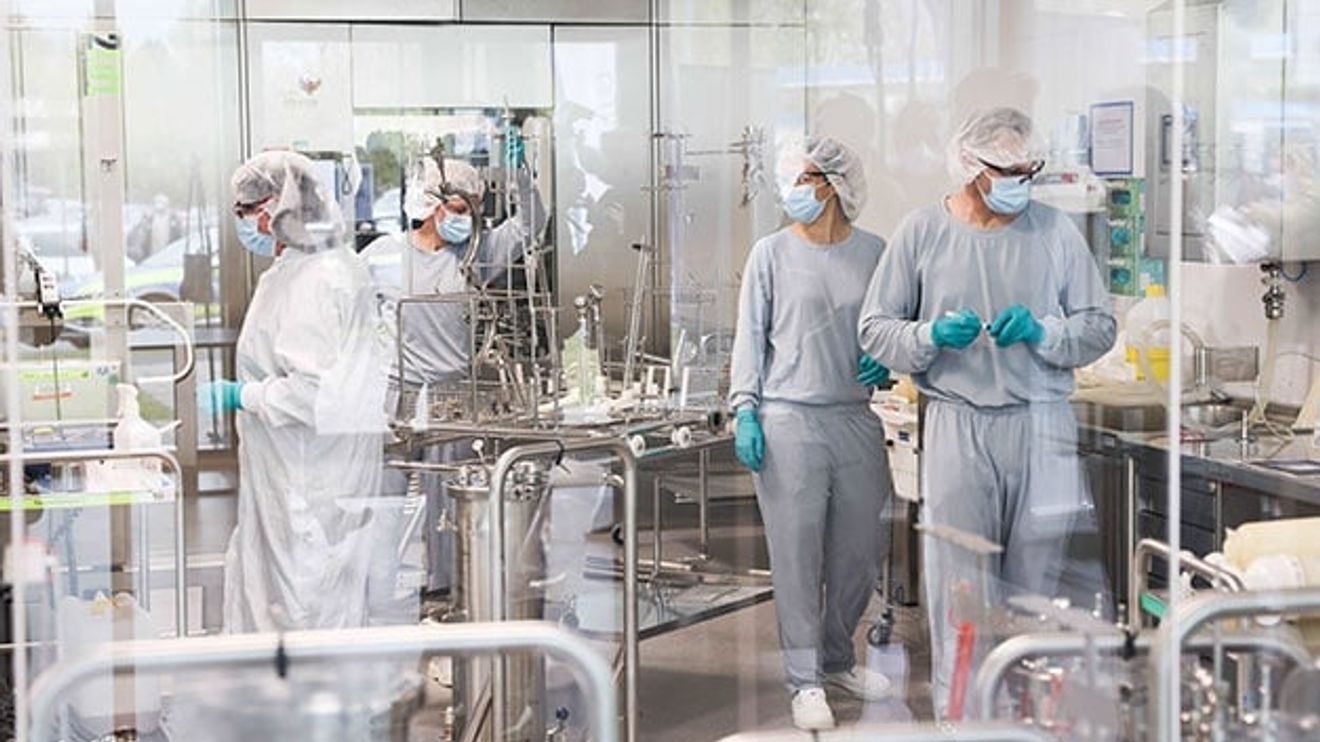
Employees in cleanroom clothing work in the production of the Comirnaty vaccine from Biontech/Pfizer at Allergopharma's production facilities in Reinbek. According to Fraunhofer expert Peter Liggesmeyer, the production of vaccines could be made more efficient with artificial intelligence than before.
© Christian Charisius/dpa/Pool/dpaThe new German government has resolved to strengthen 'investment in artificial intelligence (AI)' - this declaration of intent in the coalition agreement is being closely monitored in Kaiserslautern. With the German Research Center for Artificial Intelligence (DFKI) and other institutes, Kaiserslautern is a focal point of AI research. The Director of the Fraunhofer Institute for Experimental Software Engineering (IESE), Peter Liggesmeyer, would like to see new priorities set in research funding.
"Broad AI research is good," says Liggesmeyer. "But particularly important areas are not yet being funded in the concentrated way that they should be for our industry." In certain areas of AI research, German institutions are barely competitive, explains the scientist, citing speech recognition as an example.

The Director of the Fraunhofer Institute IESE in Kaiserslautern, Peter Liggesmeyer. The computer scientist argues that research into artificial intelligence should be geared more towards industry requirements than it has been to date.
© Fraunhofer IESE/dpa"We should consider which AI applications are particularly well suited to our economic structure," recommends Liggesmeyer. "Automotive engineering, plant engineering, the chemical industry and the pharmaceutical sector would benefit greatly from well-functioning AI if it can be used well and without risk. This could be a focus of AI research in Germany."
Under the buzzword Industry 4.0, a lot is already being done to research how humans and machines could optimally share tasks in production in the future, the professor notes. However, the use of cooperative robots, for example, presupposes that the risks are manageable.
"Nobody expects a residual risk to be reduced to zero, but you have to be able to quantify it." Only then can decisions on residual risk acceptance be made. Procedures therefore need to be developed to measure the residual risks of AI systems. In building statics, this is done with the use of theoretical models - for example, to assess the loads a bridge can withstand. In other technical areas, test procedures are the appropriate method. "Neither of these methods are currently available for machine learning processes."
For AI geared towards industrial applications, expertise in safety technology would have to be combined with AI expertise. Apart from Fraunhofer IESE and the University of Oldenburg, there are currently only a few locations in Germany where both are equally available, says Liggesmeyer.
Much more AI could be used in the chemical industry, for example at BASF in Rhineland-Palatinate, if this could be done safely. Vaccine production is also still very manual today because there is no reliable information on the risks of AI systems. "If we could manage to make AI more suitable for such critical areas of application, that would be an important step forward."


You might also be interested in
Artificial Intelligence Forum 2022
Call for Papers - Submit your presentation by January 7!
AI, machine learning, deep learning and neural networks are key technologies that enable systems to react and make decisions autonomously. The Artificial Intelligence Forum demonstrates the potential of the technology for industry. Submit your...
 read more...
Real-time object recognition thanks to AI
Fully automated production lines and autonomous transport systems such as AGVs require image processing systems that can implement complex object detections and classifications in real time. Artificial intelligence is proving to be helpful here.
read more...Artificial intelligence for image analysis
For soldered connections on printed circuit boards, the switch to lead-free solder causes increased failure rates. Quality control must therefore be improved. However, conventional methods with camera-supported automatic image evaluation quickly...
read more...AI marketplace goes live
Work on the AI marketplace project took a year. Now the platform for artificial intelligence is going live.
read more...When artificial intelligence recognizes the tumour
Analyzing and recognizing images is crucial in many medical fields, from diagnosing cancer cells to determining blood counts. Until now, this has mainly been done by humans. Deep learning image recognition systems can automate the process with AI.
read more...The top articles in August
The question of what role artificial intelligence already plays in predictive maintenance was of great interest in the most-read articles in August. And last but not least, the question: What are Google and Tesla planning in terms of robots?
read more...A milestone on the road to implementation?
The implementation of the vision of Industry 4.0 is still slow! The 1.0 release of the open source reference implementation Eclipse BaSyx is set to give the transformation wings with immediate effect - an application report.
read more...The second phase
The BMBF project 'Basissystem Industrie 4.0' came to an end a year ago. Now, small and medium-sized companies are to be supported in the introduction of Industry 4.0 on the basis of the project. Project manager Dr. Thomas Kuhn explains the...
read more...IUNO research project - Part 1
The technology data marketplace
The opportunities offered by I40 remain untapped, particularly in SMEs. One reason for this is that the IT used in companies to date is often not geared towards the security requirements of networked production. This is where the IUNO research...
read more...