
Micropsi Industries
Real-time tracking instead of flying blind
Vision systems for robots are central to modern automation. AI-based technologies can help to overcome the limitations of conventional 2D and 3D systems.

Image-based vision systems are used in manufacturing to control robots. Typically, a robot arm is equipped with one or more cameras that transmit secondary feedback to the native controller. This enables the robot to control variable target positions more precisely and manipulate objects more accurately.
However, traditional vision systems based on 2D or 3D technologies reach their limits in numerous applications. The main reason for this lies in the rigid assumptions that these systems have to make about tools, workpieces and their working environment. This is now changing with the spread of new systems based on machine learning, a branch of AI. AI-based systems enable eye-hand coordination in real time that is comparable to the human sense of sight.
Overcoming boundaries with AI
But what are the specific limitations of 2D or 3D technologies?

Problems with CAD and 3D data or 2D matching systems: Systems that are based on 6D pose estimation and use CAD models and 3D cameras often have difficulties with (rotationally) symmetrical parts. Recognizing and precisely handling such parts is a major challenge, especially for demanding joining tasks. In contrast, AI-based vision systems, such as Micropsi's 'Mirai' software, do not rely on CAD or 3D data and can effectively deal with symmetries. Simple 2D matching reaches its limits when confronted with variable lighting conditions, transparency or reflection. Such systems fail when the three-dimensional position and orientation of the workpieces are important. AI-based vision systems overcome these hurdles by using robust algorithms that deliver reliable results even under difficult conditions.
Dealing with variations in shape and appearance: Both 2D and 3D vision systems typically have difficulty processing workpieces that vary in appearance. They assume that the workpieces are completely rigid and do not change in shape or appearance from cycle to cycle. Even if the underlying CAD model is exchanged in a 3D vision system, the user must commit to a single, fixed geometry. There is no option to switch flexibly between different variants, which makes it difficult to handle components from processes with many variants. Variances occur, for example, when new component types are introduced, when a system has to process not only white square plugs but also black round plugs in random order. The challenge is even greater, for example with hand-soldered tubes in the quality inspection of refrigerators, whose shape and color change in every cycle. An AI-based system can be trained by the user to deal with a wide and gradually increasing range of variances. This makes it possible for a single robot station to efficiently process different variants of a workpiece, even in random sequence.
Geometry detection of moving parts: Perhaps one of the most serious limitations of traditional systems is that they can usually only determine the position of rigid parts in the robot's working area. Without additional measurements, they cannot detect the geometry of the parts moved by the robot, be it the tool itself or gripped components in the tool. Therefore, these systems must assume that the geometry of the moving parts is completely rigid and that their position relative to the robot remains unchanged. However, these assumptions are violated in many practical applications, which makes automation impossible and uneconomical. This particularly affects gripping and joining tasks with flexible parts or parts that cannot be gripped uniformly due to process variations. In contrast, AI systems constantly correct the relative alignment between the tool or the gripped component and the workpieces in the workspace in real time. This dynamic adjustment makes it possible to carry out precise tasks that could not be automated with traditional systems.
Lifecycle management of the installation: If vision systems initially function satisfactorily, even the smallest changes in upstream processes can lead to disruptions. A reaction to such changes is often only possible if the newly occurring variance is introduced as a one-off and comprehensive adjustment, whereby the vision system must also be adapted to the new situation. Problems arise when the new variance occurs as an additional case and the variety of objects to be recognized is increased - for example, by introducing a new component type while residual stocks of the old type are still being processed. In such scenarios, traditional systems quickly reach the limits of their adaptability. AI systems, on the other hand, can be adapted directly by the user and learn to handle both the old and the new components. This is even possible if sufficiently accurate CAD models for the new variant are not available, as training is carried out directly on the real object.
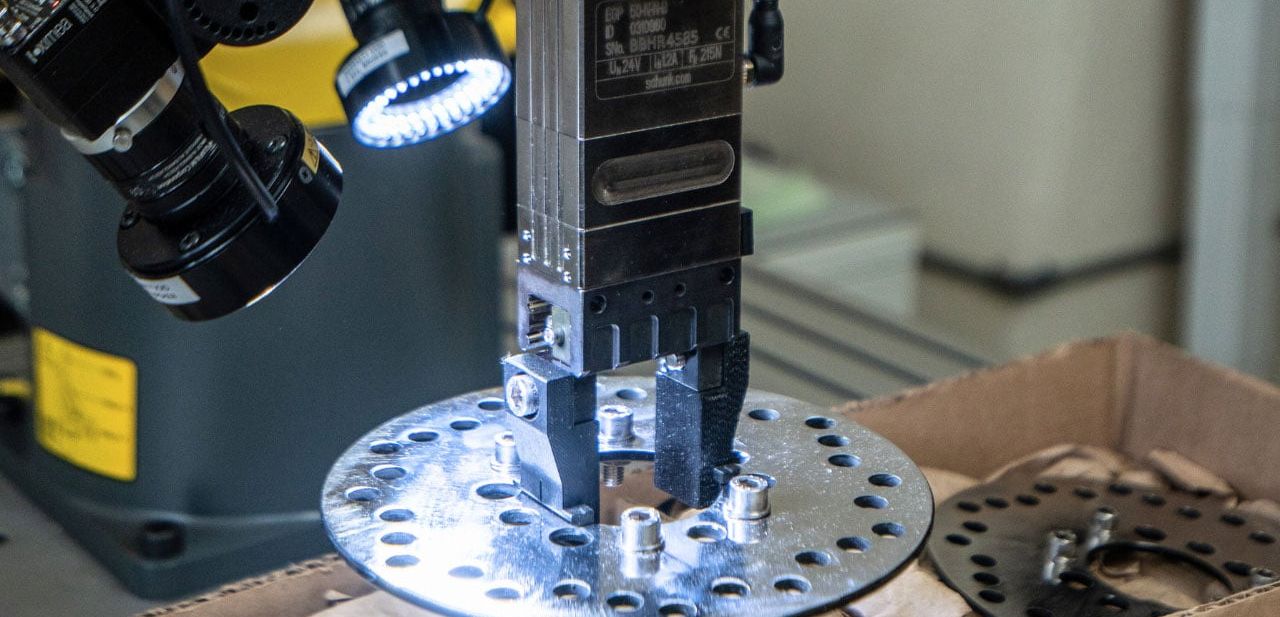
Dynamic tracking during execution: Most vision systems do not offer dynamic tracking of the robot during the execution of a task. This principle of 'flying blind' after a single measurement significantly reduces precision and reliability. For example, when automating a precise joining task on a moving conveyor belt, even with belt tracking in place, certain relative movements remain that can only be corrected by visual compensation. AI-based systems enable these real-time adjustments and thus ensure high precision even under dynamic conditions.
Setup effort and implementation times: For complex, non-trivial tasks, classic vision systems require enormous set-up effort and a high level of expertise. This effort scales massively due to the aforementioned limitations and often leads to long implementation times. It is not uncommon for customers to spend months or even years with traditional systems and ultimately fail at an automation step. In contrast, it has been shown that with AI systems, solutions can be achieved within a few days or even in a single morning.
Plus point reliability

All these limitations of traditional systems can also be described as serious reliability problems: The systems only work as long as the conditions do not change. As soon as variances occur in the workpieces, the environment or the process sequences, they often fail or require extensive readjustments. Thanks to their ability to learn and their flexibility, AI-based systems are more robust in the face of changes and offer consistently high reliability. In addition, the time required to implement and adapt the systems is drastically reduced, especially for complex tasks.


You might also be interested in
Early Access Program for AI Features
PTC has launched an early-access program with Onshape Labs for AI features on the Onshape cloud-based CAD platform. Users will receive early access to new tools for product development.
 read more...
Humanoid Robotics at BMW in Spartanburg
"Physical AI" combines digital AI with real machines and robots. This allows intelligent systems, such as humanoid robots, to be integrated into real-world production processes. Following the successful deployment of the Figure 02 humanoid robot at...
read more...Cybus Brings in Siemens Executive Stefan Schwab to Lead the Company
The Hamburg-based software provider Cybus will have a dual leadership structure going forward: Stefan Schwab will join co-founder Peter Sorowka as co-CEO.
read more...SensoPart and Cambrian Robotics
Partnership for 3D-Guided Robotics
Cambrian Robotics and SensoPart are jointly developing an AI-powered solution for 3D-guided robotic applications. The combination of vision sensors and AI is designed to simplify gripping and positioning processes.
read more...Why AI Agents in the SOC Don't Learn Over Time
AI agents support security operations centers, but so far they lack a permanent memory. A technical article explains the challenges facing autonomous security automation.
read more...Industrial AI and Manufacturing
Siemens and IFS Bridge the Gap Between Planning and Operations
Siemens and IFS are collaborating to use industrial AI to enable a closed-loop digital twin across the entire plant lifecycle. The goal is to more closely link design data with real-world operational information and optimize industrial processes.
read more...Four Steps Toward Greater AI Sovereignty
Following the failure of “Claude Fable 5,” the AI consulting firm Neurawork recommends a robust AI strategy focused on data sovereignty, reliability, and governance.
read more...Alibaba Expands 'Qwen' for Robotics
Alibaba is expanding its Qwen model family with a robotics suite for Physical AI. The three models support manipulation, navigation, and simulation for autonomous robotic systems
read more...Qualcomm Acquires AI Specialist Modular
Qualcomm is acquiring the AI software company Modular. The goal is to expand an open software platform for generative and agent-based AI in edge, cloud, and data center environments.
read more...