

Schaeffler
Next generation condition monitoring
A mesh network consisting of vibration sensors, a gateway with a SIM card, cloud data analysis and an app is set to take condition monitoring to a new level. The highlight: every operator of production sites can monitor machines and units themselves at expert level.

It is not uncommon for up to 95% of drives and units - pumps, fans, compressors, etc. - in process and manufacturing industry plants to be monitored either not at all or only on a route-based basis using manual measurements. The main obstacles to the use of condition monitoring systems (CMS) cited by operators are high costs caused by complex installations and configurations, fluctuating additional costs due to manual analysis of vibration signals and the often inadequate quality and significance of the analysis. Schaeffler has developed the CMS 'Optime' to eliminate these shortcomings. The target industries defined for the market launch include the process industry, the paper and pulp industry, the cement industry, mining, the steel industry, sawmills and the food and beverage industry.
In principle, the CMS should bring the following benefits: When switching from a monthly, manual, route-based measurement (offline measurement) to 'Optime', the costs fall significantly below 50%, while at the same time the number of measurements per measuring point increases many times over. The system thus enables comprehensive and automated condition monitoring. It provides specific information about the damaged component, the severity of the damage and recommendations for action. This provides operators of production or process plants with a basis for deciding which maintenance work needs to be carried out on which units and whether this can be completed in the available time window, for example during a planned shutdown. This brings the industry a significant step closer to economically attractive predictive maintenance, as the number of unplanned downtimes and the associated costs are significantly reduced. In addition, spare parts and units no longer need to be kept in stock 'just in case'.
The combination makes the difference

The low installation effort and fast commissioning make it possible to monitor the status of a large number of machines and units in a production plant. Configuration is carried out via an app on a cell phone, and an 'Optime' sensor is identified and activated using NFC.
© SchaefflerSo how does it work in detail? The CMS consists of wireless, battery-operated sensor units, a gateway with a SIM card, analysis software on an IoT hub and an app or web-based dashboard for commissioning and visualizing the analysis results. The applied sensors measure vibrations and temperature curves and use them to determine relevant key performance indicators (KPIs). They also automatically connect to a mesh network. With the help of the gateway, the data is transferred to Schaeffler's IoT hub. Algorithms are implemented there that transmit alarms and recommendations for decisions and actions to the cell phone or control room based on the KPIs and time signals.
Conceptually, 'Optime' differs from other monitoring solutions through the following combination of features:
- Minimized installation effort and Near Field Communication (NFC)
- Self-configuration
- Self-connectivity
- Automated analysis
- Aggregated visualization of the results
- Transparent cost model
The rod-shaped 'Optime' sensor is mounted on the machine housings using a screw connection. Electrical cabling is not necessary due to the battery operation of the sensors. Thanks to optimized data transmission, a battery life of five years is achieved.
It usually only takes a few minutes to install and commission the sensor. Once the sensor has been activated via NFC using the 'Optime' cell phone app and uniquely recognized with an ID, the user can assign a name to the measuring point and attach the sensor to the unit. The subsequent parameterization only requires a minimum amount of information: This includes selecting the machine type: compressor, electric motor, fan, gear drive, belt drive, pump, roller, shaft, water turbine, saw, optionally the ISO class, furthermore specifying whether it is a drive with a (constant) nominal speed or with a variable speed. Depending on the selected machine type, the app guides the user through simple queries - in the case of electric motors, for example, the selection of 'rigid' or 'elastic' mounting.
Several hundred measuring points can easily be installed and put into operation within a day. So that the user does not lose track, the sensors or machines in the app can be organized hierarchically in several levels, for example: Petroleum station, clean tank 3, pump 2. In pilot projects, customers have used the hierarchy and existing naming, for example from their maintenance planning system or asset management system.
Self-connectivity and automated analysis
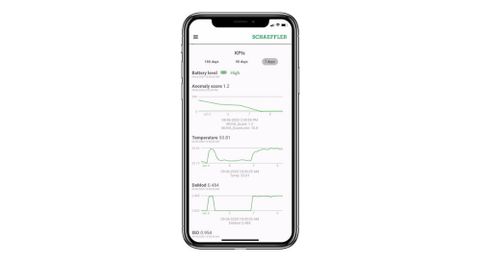
The analysis algorithms were used and optimized under practical conditions in Schaeffler production facilities - in some cases over many years. 'Optime' features technologies such as machine learning algorithms, analysis in the cloud and wireless mesh.
© SchaefflerThe 'Optime' sensors automatically connect with each other to form a mesh network. Should a sensor fail or the battery run out, the data transfer is automatically redirected to other intact sensors. This makes the mesh network extremely reliable, ensuring that the current status of entire production sites is always available.
One special feature is the fully automated vibration analysis. Unlike conventional vibration monitoring systems, 'Optime' does not require any complex configuration, the alarm thresholds do not have to be defined manually by an expert and the system is immediately ready for use. The operator or maintenance technician is shown the machine status for all monitored machines in the three levels 'Suspect', 'Warning' and 'Severe'. In addition, the system provides access to several KPIs calculated according to standards, such as RMS (low and high), ISO (velocity) or Kurtosis (high). With increasing operating time, 'Optime' gets to know the specific characteristics of the respective machine better:
The analysis is based on a combination of automated functions - for example, the generation of dynamic threshold values, algorithms for specific types of damage and also machine learning functions. Among other things, the system detects rolling bearing damage, imbalances, misalignment, cavitation in pumps, gearbox damage and lubrication problems.
As the analysis was implemented without an additional speed signal, the installation and hardware costs could be reduced to such an extent that the system is also economically attractive for a very large number of measuring points.
Aggregated visualization of the results

In order to maintain an overview even with hundreds of measuring points, the CMS initially offers an aggregated view of the analysis results. Below this, there are several levels of detail down to the individual machine. The 'Suspect', 'Warning' and 'Severe' status information in the app shows the status of the machines in a production facility at a glance. The user is shown which unit needs to be checked urgently or which machines are beginning to show anomalies. With further information about the damage and anomalies and their criticality for production, it is easy for maintenance staff to take action in good time and avert a machine or system shutdown.
A few cents per sensor per day

Dr. Philipp Jussen is Director Product Lifecycle Management in the strategic business field Industry 4.0 at Schaeffler in Herzogenrath.
© SchaefflerThanks to automated data analysis, the costs for condition monitoring can be kept low. They are divided into the costs for the hardware and a regular fee for the digital service. This simple and pre-calculated billing model protects operators and maintenance staff from unpleasant financial surprises that can occur with other concepts - currently, billing models with individual costs for hardware, accessories, commissioning, data transfer, parameterization, analysis and recommendations for action are still standard.

Sebastian Mergler is Solution Manager Condition Monitoring at Schaeffler in Schweinfurt.
© SchaefflerWith Schaeffler 's solution, the costs over the typical life cycle of a sensor amount to just a few cents per day. The customer knows exactly at what price he will receive a machine condition assessed at expert level and a recommendation for action as a complete solution. This makes Schaeffler's solution significantly different from the services offered by many maintenance companies, whose business model is based on the deployment of their specialized experts. In combination with the very low installation effort and fast commissioning, the condition monitoring of a large number of machines and units in production plants, which could not previously be monitored economically, is now feasible.


You might also be interested in
New ecodesign regulation comes into force
The updated Ecodesign Regulation came into force on July 1. This specifies new requirements for electric motors and frequency inverters. The documentation is digital.
 read more...
SPS Connect 11/25 - 11:20 - 11:40 a.m.
End-to-end connectivity combined with complete...
Process transparency: The next big step into the digital age. Get to know Festo Automation Experience - the software for condition monitoring, preventive maintenance of components as well as machines and systems.
read more...SPS Connect 11/25 - 11:30 - 11:50 a.m.
Across all boarders - operating requirements for tomorrow
IIOT & Industry 4.0 have already increased the demands on the simplicity and user-friendliness of operating concepts. Corona has intensified these requirements - especially when it comes to workstations and operating concepts for commissioning,...
read more...Schaeffler reports recovery in the 3rd quarter
Schaeffler reports a "strong" 3rd quarter despite a decline in sales. The reason for this is the EBIT margin before special items. The Group also ventures a forecast for 2020.
read more...Integrated monitoring
Failures in industrial heating processes can be reduced if faults and malfunctions are detected at an early stage. However, the basis for predictive maintenance is the constant recording and analysis of data from the various system components.
read more...Out of the fog
Machine operators increasingly expect digital services from manufacturers - more software, more connectivity, more intelligence in the machines to make their operation more efficient. Cloud and edge computing can be used to add precisely these...
read more...RWTH Aachen offers guidelines for action
The WZL at RWTH Aachen University has developed a generic guideline for the successful application of predictive maintenance. It is now available for download.
read more...Preventive maintenance management
Keeping the robot fit
Maintenance and servicing ensure high productivity and availability in industrial plants. This is especially true for complex industrial robots. New solutions for preventive maintenance management open up new efficiency potential.
read more...Optimizing predictive maintenance with AI
Predictive maintenance is not based on static models, but must constantly adapt to the circumstances. Machine learning algorithms can help with this.
read more...