
Predictive maintenance
Optimizing predictive maintenance with AI
Predictive maintenance is not based on static models, but must constantly adapt to the circumstances. Machine learning algorithms can help with this.
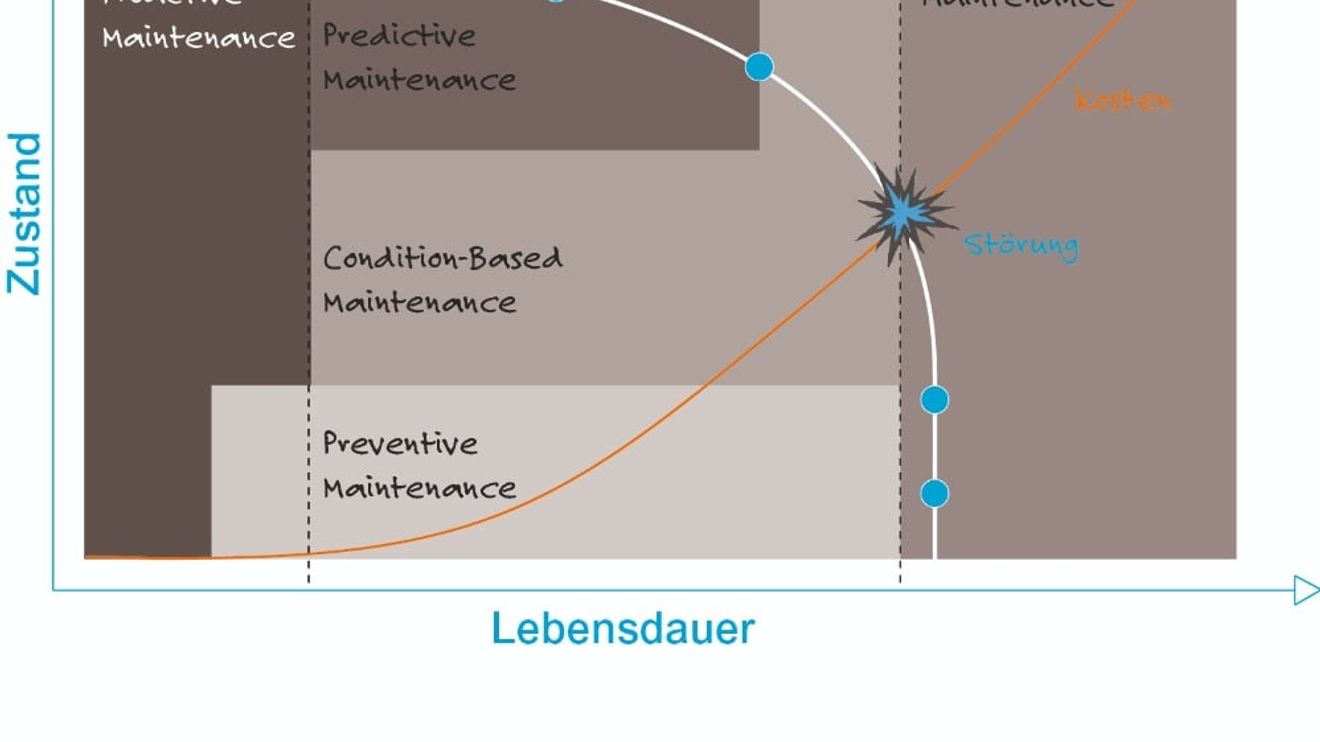
The prerequisite for predictive maintenance is the networked factory: the more machines and systems are equipped with sensors and networked with data technology, the greater the effect that can be achieved with predictive maintenance. Algorithms evaluate the recorded sensor data and draw conclusions about the actual wear of the respective component and its remaining service life. The more accurately the system works, the more precisely it is possible to determine when which component should be replaced: in good time before a failure, but only when it is necessary.
For this to succeed, the collected measurement data must be interpreted automatically. Machine learning algorithms can be used to derive functional correlations from the data. The aim is to find those correlations that allow a reliable diagnosis of the condition of the monitored system and make it possible to predict its remaining useful life (RUL) as accurately as possible.
What's more, these algorithms make the models capable of learning. This means that they not only automate predictive maintenance, they also ensure adequate results when changes occur in the behavior of the machines, but also in the general conditions. In this way, they create the prerequisites for adapting maintenance processes, intervals and spare parts stocks to current conditions. They also help to detect deviations before the respective machine suffers major damage or is no longer fully functional.
The more data, the better
But how should companies proceed if they want to implement a predictive maintenance project with the help of machine learning? The most important prerequisite is the database; ideally, the machines and systems have already been equipped with sensors and networked for some time.
The first step is to sift through the data, for example the machine's status or measurement data. Only those who know what machine data is available can take the next steps. This often involves time series such as the operating temperature at certain points in time. Unstructured data such as images or audio signals should also be included in the "data inventory", as should static features such as the date of manufacture, firmware version or installation location of the machine. The usability of the data is determined not least by how it is collected and how complete it is. For example, there is data that is only generated or recorded on the basis of certain events. Others are available in continuous series of measurements - the frequency with which they are collected and whether they are fully documented is important here.
The inventory is followed by data preparation. The data records must be cleaned up, incorrect values deleted and missing values filled in. At the same time, it is important to develop an understanding of which data was recorded, how and under what circumstances. This work is crucial for the success of a project.
Service data is valuable
Any existing service and repair data is particularly valuable. They are the most solid basis for a Remaining Useful Life (RUL) forecast. It can be used to determine which machine broke down when, what was faulty and what was repaired. If the service data can be linked to the condition data, the repair history can be used to compare the conditions before and after a repair. This already allows the first reasonably reliable statements to be made, which can be important for future forecasts. On this basis, the system can learn what "broken" actually means in individual cases.
In the next step, it makes sense to prioritize the available service data: Which machine types are most likely to break down? Which components are most likely to fail or are the most expensive to repair? Once these parameters are known, the root cause analysis begins: Which events or physical measurements, for example, correlate with the failure of a component or machine? With this knowledge, the available data can be viewed and evaluated with regard to modeling: What could be relevant, what is being measured at all? In this phase, the IT specialists must team up with experts who are familiar with the machines.
Once the existing data has been viewed and its basic relevance clarified, questions relating to the desired project objective must be defined. It is important to consider which questions can actually be answered based on the available data. The highest priority should be given to use cases with expensive machines or those that break down particularly frequently or cause particularly high costs due to breakdowns.
Keeping an overview
To ensure that someone has an overview of the complexity of such a project, it is advisable to involve a data scientist. He or she holds the reins and communicates with data collectors, developers, service technicians and other experts. He prepares their information and incorporates it into the project.
There are now a number of good tools for creating an "intelligent" algorithm:
Algorithms already integrated by IoT manufacturers or ready-made services such as Azure Cognitive Services or Amazon AWS AI Services provide a good basis for getting started quickly. Disadvantage: These tools are relatively uncustomizable.
Publicly available AI programming libraries or algorithm construction kits. The interpreted language Python is often used for rapid model development.
Open source program libraries such as PyTorch and TensorFlow support the complete in-house development of algorithms.
The IT specialists entrusted with the project must decide which tools to use based on their preferences and prior knowledge.
The quality of a prediction always depends on the specific application scenario. The most important question is: what consequences of an incorrect result are acceptable and what are not? Example: The prediction model initiates machine maintenance even though it is not yet necessary (false positive result). Or the maintenance is carried out too late and the machine fails (false negative result). This is certainly not acceptable for an aircraft turbine.
One thing is certain: companies that want to increase their added value with predictive maintenance cannot avoid dealing with artificial intelligence. After all, effective predictive maintenance is not possible without machine learning. Companies that want to set up such a project should involve a specialist who has the necessary expertise and can involve all stakeholders in a meaningful way.
The author: Julian Mehne, Data Scientist Machine Learning at DoubleSlash
This article first appeared on our sister site www.scope-online.de


You might also be interested in
Next generation condition monitoring
A mesh network consisting of vibration sensors, a gateway with a SIM card, cloud data analysis and an app is set to take condition monitoring to a new level. The highlight: every operator of production sites can monitor machines and units themselves...
 read more...
RWTH Aachen offers guidelines for action
The WZL at RWTH Aachen University has developed a generic guideline for the successful application of predictive maintenance. It is now available for download.
read more...Preventive maintenance management
Keeping the robot fit
Maintenance and servicing ensure high productivity and availability in industrial plants. This is especially true for complex industrial robots. New solutions for preventive maintenance management open up new efficiency potential.
read more...The potential of predictive maintenance
Machines that proactively request maintenance when needed, production lines that provide real-time information about their current capacity utilization - these examples show the great potential of the Internet of Things for the industry of the...
read more...AI system for machine learning
DFKI accelerates AI research
DFKI is further expanding its computing power to accelerate AI research into learning systems. The aim is to make AI algorithms available for practical use in industry.
read more...Why predictive maintenance?
Investments in predictive maintenance systems are worthwhile in order to proactively detect damage. Not only does this increase the service life of a machine, it also opens up new business models for machine manufacturers.
read more...New COO on the Executive Board
AMDT (formerly Auvesy-MDT), a provider of versioning and change management for automated production, has appointed Eva Wittka as its new Chief Operating Officer (COO).
read more...How legally compliant is AI in maintenance?
Lufthansa Industry Solutions has had its AI Maintenance Assistant assessed by TÜV SÜD and Calvin Risk. The aim was to ensure compliance with the EU AI Act in order to maintain a high level of legal certainty.
read more...Smart demonstrator for system maintenance
Fraunhofer IPMS has developed a demonstrator that combines sensor technology, data acquisition and AI-based data evaluation for condition monitoring and predictive maintenance.
read more...