

Festo
Digital twins boost machine development
Festo cooperates with German automation partners and the Industrial Digital Twin Association to promote standardization and digitalization. The first automation components from Festo receive digital images.
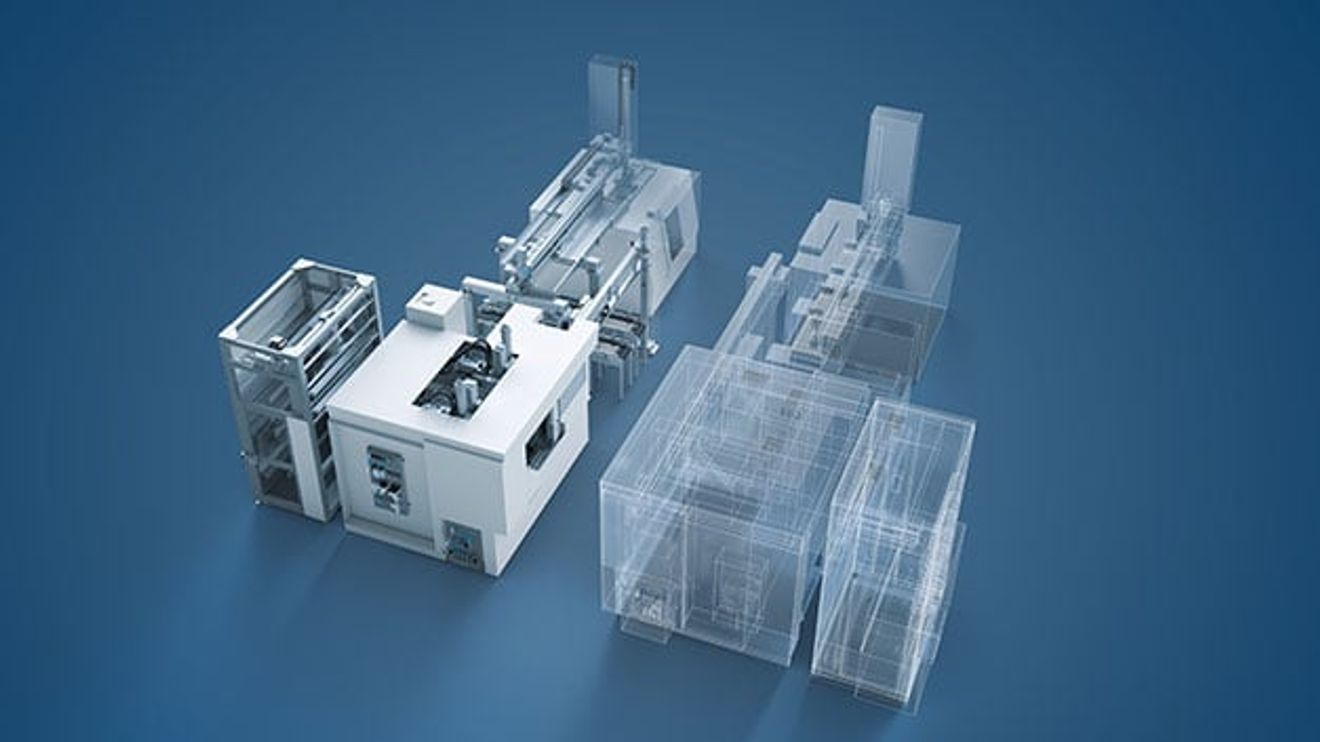
Digital twins can be used in many areas of engineering. "Machine and system manufacturers will increasingly demand digital twins in order to be able to develop their machines and systems faster and make fewer mistakes," explains Gerhard Borho, Chief Digitalization Officer at Festo. The "digital first" principle is developing step by step: components and machines are being developed virtually as far as possible before the first hardware is manufactured - this extends to testing and system integration. Analogous developments can be seen in factory planning.
Project duration decreases, productivity increases
Shorter development times require machine manufacturers to parallelize development steps. Digital twins shorten them. Even before a machine developer has assembled the machine as hardware, he can simulate, test and modify it again using a digital twin. For example, handling systems can already be designed and programmed optimally and efficiently on the virtual model. Errors can be found and rectified at an early stage, which contributes significantly to efficient operation. Customers' project lead times are reduced and productivity increases.
More than just 3D models
Digital twins of automation components are much more than just 3D models that move virtually. They are digital images with information about components, including a clear description of their capabilities, documentation, behavior - for example, simulation of their kinematics and kinetics - and communication with them. The Industry 4.0 machine architecture is based entirely on digital twins that make life easier with standardized communication interfaces throughout the entire life cycle of a machine: from virtual commissioning and machine control to data collection and the resulting value-added services such as maintenance or diagnostics.
Festo is working on break-free communication technology such as OPC-UA
Previously, a large amount of data was available for each automation component in different formats such as CAD, PDF or even paper manuals. Data management was therefore cumbersome, and the lack of digital consistency made it difficult to fully network all objects. Festo is therefore working on a seamless and consistent communication technology such as OPC-UA. Ultimately, the asset administration shell is used as a central information object in order to use digital twins throughout the life cycle. Digital twins already facilitate the planning and concrete preparation of quotations. "Intelligent algorithms allow the components to be designed and configured in an optimal and energy-efficient way," adds Festo's Chief Digitalization Officer.
Advantages during commissioning
In the virtual model, the developer can view process data or sensor signals, for example. If he wants to create the machine's control sequences, the developer has access to component capabilities such as extending, turning or gripping, which he can use to define a desired sequence.
Further value-added services can be implemented on the basis of digital twins. Before components reach the end of their service life, for example, condition monitoring reports this: the digital twin could then automatically order spare parts. In addition, condition monitoring can interact with the simulation models of the digital twins to create predictive maintenance plans. Customers can also use digital twins to develop subsequent changes, optimizations or reconfigurations to the machine in advance on the virtual model and thus implement them more quickly.


You might also be interested in
AR app connects switch cabinet with digital twin
Eplan presents new functions of the "eView AR" app: By overlaying a real control cabinet with its digital twin, the virtual world is linked to the real world.
 read more...
Digitization through photorealistic digital twins
Framence has announced a strategic partnership with the Indian company Pratiti. The aim is to support companies in their digital transformation by combining Framence's digital twins with Pratiti's understanding of digital technology.
read more...Immersive Field Simulator expanded to include AR
Honeywell has announced the addition of augmented reality to its Immersive Field Simulator (IFS). The platform uses a digital twin of a real plant to offer targeted on-demand training for industrial employees.
read more...Siemens and UL Solutions digitize certification process
For the first time, an industrial product was certified for the USA after some of the required tests were digitally simulated and the results confirmed by physical tests. This was made possible with the help of the digital twin.
read more...Pneumatics makes technological leap
With Festo's 'Controlled Pneumatics' compressed air technology, the 'VTEP' proportional valve terminal achieves sensitive pressure control down to less than 1 mbar. According to the supplier, the technology also uses piezo valves to reduce...
read more...Autonomous flying in a swarm
The 'BionicBee' is an ultra-light flying object from Festo that can fly in large numbers and completely autonomously in a swarm. The BionicBee performed its first air show at the Hannover Messe 2024.
read more...Expansion in North and South America and India
After years of strong growth, 2023 was a year of consolidation for Festo. At around 3.65 billion euros (- 4.3%), turnover was just below the previous year's level
read more...Phoenix Contact at the Hannover Messe
Strategic technology partnership with Festo
Festo will use PLCnext Technology, the open ecosystem from Phoenix Contact, in future intelligent devices. In this way, both companies want to combine their innovative strength with the aim of taking industrial automation to a new level.
read more...E-Paper: HANNOVER MESSE DAILY Day 2
In today's issue, you can read about the tour of the trade fair by German Chancellor Olaf Scholz and the Prime Minister of the host country Norway, Jonas Gahr Støre, the partnership between Festo and Phoenix Contact and the demands of the...
read more...