
CAD in the factory
Cloud-supported engineering
The switch from 2D to 3D design took place around 20 years ago. With the next evolutionary stage now imminent, not only is the design methodology changing, but completely new ways of using engineering software are emerging.
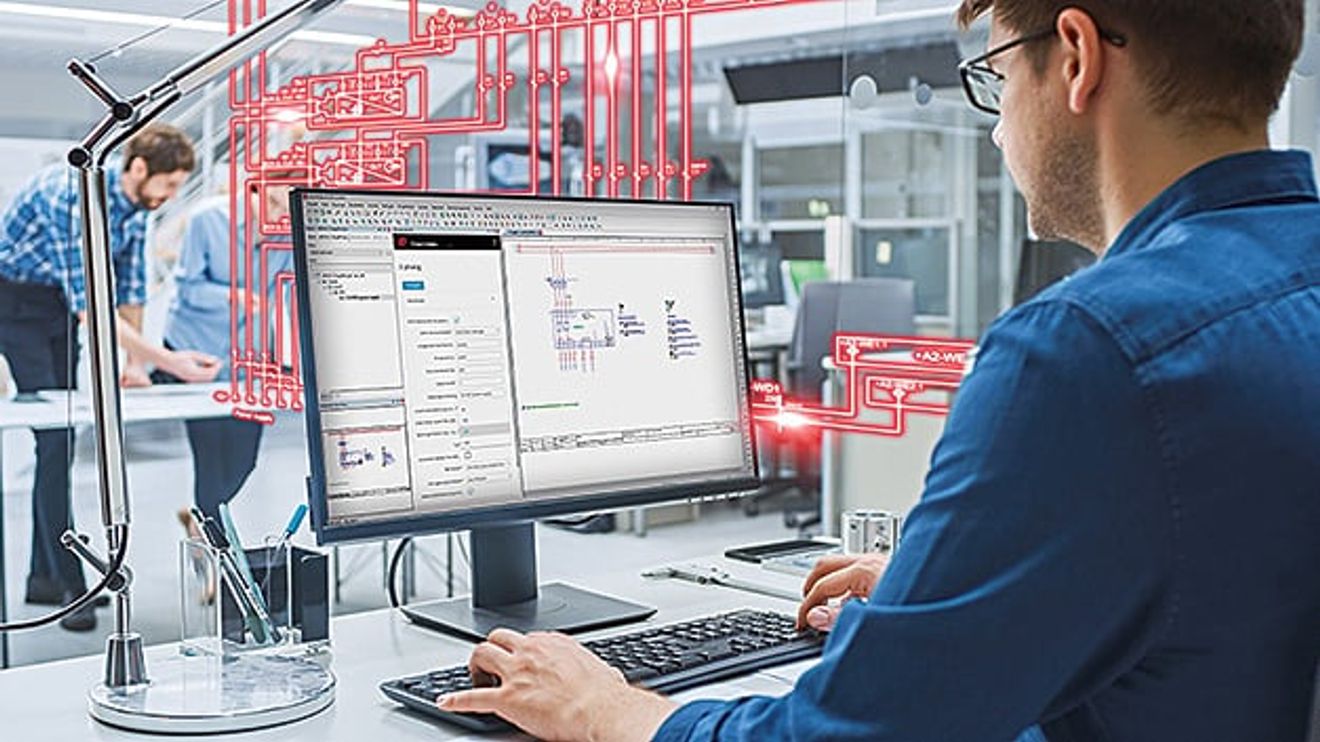
In this article, we will take a closer look at the changes that are imminent in the CAD world, particularly for the field of application of enclosure manufacturers. And the changes start at the factual level of software use: in addition to the classic engineering solutions that this clientele uses in its own IT landscape, interfaces and cloud-based applications offer enormous potential for greater data consistency and consistent digitalization. This applies both within the company itself, but also in particular when collaborating with partners and clients in the industrial automation ecosystem. In addition, new licensing models from software providers - subscription, SaaS - enable a decisive increase in flexibility with professional engineering solutions.

The cloud benefit provider
The user decides whether the data for the projects to be processed should be stored in their own IT landscape, i.e. on premise, or in the cloud. The new concept, which is explained in this article using the example of Eplan Platform 2022, is not tied to the use of the cloud. However, it only unfolds the full extent of its advantages with it. These advantages include location-independent electrical engineering. This already existed in the days before the cloud, with emails and FTP servers. However, the Eplan Cloud now gives customers the opportunity to give all project participants access to the current and identical data status.
The advantage is that electrical engineers and other project participants can now work with consistent data. The central provision of data simplifies the handling of project versions and changes and facilitates collaboration within the project team. Clear access authorization determines who can view and change which data. Depending on requirements, the project manager can define an authorization and release the project for a colleague or the customer. This makes collaboration across locations, departments and the product life cycle much easier than before. This increases the quality of projects and productivity because, for example, coordination between project participants is much faster and discrepancies can be identified earlier. It increases transparency and simplifies the installation and commissioning of control cabinets on site, for example, because commissioning engineers can always call up the current data status via laptop. What's more, they can use redlining/greenlining to directly document changes that occur on site and pass them back to their colleagues in engineering. This also increases the quality of the design data and ensures a consistent 'as built' status.
These new possibilities are not only interesting for large companies working on international projects. If, for example, control cabinet and mechanical engineering companies work together, it is just as advantageous if they have consistent data and can use one and the same digital platform in the cloud - especially as such a platform does not have to be 'built' or operated and maintained. At Eplan, for example, it is part of the scope of the cloud offering. This means that companies can share, mirror and exchange the status of their projects virtually free of charge and without any administrative effort.
A must: Define standards!
This significantly expanded type of collaboration - which is also characterized by the fact that all participants can be both senders and receivers - brings with it new freedoms. However, this also means that users and those who collaborate with them should define standards. Both for the process - when are project statuses shared? - as well as for the way in which changes and comments are entered and edited.
Such standards can be stored in an editor system, for example, which also defines the type of collaboration with the respective customer on the shared software platform - whether in the cloud or 'on premise'. In addition to the added value of efficient and comprehensive communication and coordination, this also opens the door to new business models.
'Digital twin' business model
Some Eplan users have already developed and implemented ideas in this regard. A northern German enclosure manufacturer, for example, which primarily works on very complex projects for energy systems, large ships and hospitals, offers its customers access to the latest documentation via a QR code on the enclosure - for the entire service life of the system. In this way, it is expanding its range of services and maintaining permanent contact with the end user of the control cabinets, providing them with a comprehensive 'digital twin' of the switchgear. This also eliminates the need for paper documentation - saving time, effort and costs.
New license options - new opportunities
If cloud-based software products are available according to the software as a service model, this also simplifies the first steps towards the cloud. At the same time, the new extended options also simplify interaction with on-premise solutions. Users do not have to implement a new software module in their infrastructure or migrate to a new version. The applications, which are tailored precisely to the task at hand, reduce training and are generally intuitive to use. He can simply try out the new way of working with a project - and does not have to coordinate this with his customers in the first step, for whom nothing changes in the collaboration until the new possibilities are also used in the collaboration.
It is all the easier to try things out if the first new services and offers are available free of charge. This applies to Eplan eView Free, for example. With the help of this tool, projects in Eplan can be shared with other participants: across the entire value chain - from engineering to production and assembly to service and maintenance - and without media discontinuity. This applies to circuit diagrams as well as control cabinet design and also includes fluid technology - if it was planned with Eplan. A first option for cloud-based collaboration, which is free of charge if the user is registered in the Eplan cloud environment.
At the same time, users can take advantage of new collaboration options. This is because the latest version of the tool includes AR functionality through a combination with the free Vuforia app from PTC. This means that the enclosure manufacturer can present the virtual model of the planned enclosure - which does not yet exist in reality - to the customer or end user in the real environment. This is more than just a marketing tool, as it allows the customer to see how the enclosure will integrate into the production environment.
Managing projects in the cloud

Modern look and feel: Today's user interfaces feature multifunction bars with modern ribbon technology that can be flexibly adapted to the respective application. The picture shows the new Eplan platform 2022.
© EplanUploading to the cloud comes before use. This is done with Eplan eManage, which is also already available in a free version. With this tool, the user sends the project from the Eplan platform to the secure cloud environment. They can also use it to organize the assignment of rights and implement cross-company review processes digitally. The full version also allows the project to be synchronized with everyone involved in the process.
An additional component of such software solutions are ready-made libraries that allow the largely automated creation of circuit diagrams. Eplan, for example, has developed such libraries together with partners such as Phoenix Contact, which is why they also include a wide range of functions and components. However, such libraries can usually also be created by users themselves and adapted to their own individual requirements. One example shows just how intelligent such automated electrical engineering is today: If the user enters that the circuit diagram is to be created in accordance with the US UL standard, the eBuild software from Eplan automatically takes into account all UL specifications, for example for the design of a motor control unit, and at the same time creates the required UL-compliant verifications.

Providing data - beyond the design
Cloud-based electrical engineering therefore offers advantages to everyone involved in the enclosure construction value chain. On the one hand, these advantages result from the perfect interaction between desktop and cloud-based engineering solutions. The tools are tailored precisely to the task of the respective user and the cloud-based applications in particular are directly accessible in the simplest possible way.

Secondly, however, data storage in the cloud offers considerable advantages because the project data is available across the board. And this opens up new possibilities for data usage - far beyond the project planning phase. In future, the data created during electrical engineering and enclosure construction will be used, updated and maintained over the entire service life of the system in terms of product lifecycle management (PLM) - as a 'digital twin' of the real system. This also opens up new business opportunities for the enclosure manufacturer, such as continuous data maintenance for existing systems.


You might also be interested in
The digital circuit diagram
Rittal is doing away with paper and making data usable for operation and service. A digital circuit diagram called 'ePocket' ensures this. Uwe Scharf, Managing Director Business Units and Marketing at Rittal, reveals the details behind it.
 read more...
Switch cabinets in virtual space
With the AR-supported application Eplan eView Free AR, Eplan brings the digital twin to wherever users are. Designers share their 3D designs of the enclosure layout from 'Eplan Pro Panel' with colleagues and business partners via the cloud.
read more...More collaboration thanks to the cloud
Eplan goes Cloud - under this motto, the company is presenting not just a module, but a comprehensive cloud concept for generating and using design data.
read more...The benefits of data standards
Fully digitized data is the driver for optimizing engineering in control and switchgear construction on the basis of a digital twin. This means that the corresponding article and device data must be available right at the start of project planning.
read more...Jon Stevenson becomes Executive Vice President and CPO
PTC has appointed Jon Stevenson as Executive Vice President and Chief Product Officer. Stevenson will be responsible for the strategy, development and delivery of PTC's Digital Thread product portfolio.
read more...Dassault Systèmes takes over Ascon Qube technology
Dassault Systèmes is strengthening its strategy for virtual twins and integrating Ascon Qube technology into its Delmia portfolio. The acquisition is intended to provide companies with more flexible and AI-supported production control.
read more...Leo AI and Core Technology integrate AI analysis into CAD engineering
The AI platform Leo AI and the software provider Core Technologie are cooperating to automatically evaluate CAD data using artificial intelligence. The integration of the SDK 3D_Kernel_IO enables AI-supported analyses of technical data from over 40...
read more...Solid start to the year
Dassault Systèmes has announced its unaudited IFRS financial results for the first quarter ended March 31, 2025.
read more...Capture drawing information with AI
Version 11.8 of 'Simus classmate', a digitization solution for manufacturers and suppliers in mechanical and plant engineering from Simus Systems, integrates drawing information with 3D models using artificial intelligence (AI) and transports it to...
read more...