
Power supplies
Optimized network quality
More and more loads in the grid are operating non-linearly, which has strong repercussions on the grid and degrades its quality. Active harmonic filters", which reduce grid perturbations, can help.

There are hardly any electrical loads that draw current linearly in industrial plants, office buildings, data centers and private households. Non-linear loads are, for example, frequency converters in drive technology and the large number of switched-mode power supplies in information and communication technology devices and increasingly in household electronics. Lighting technology also works on the basis of mostly non-linear power supplies.
The non-linear current consumption leads to harmonic currents, which cause distortions in the sine wave voltage. These in turn interfere with other consumers. Harmonics are integer multiples of the fundamental frequency (the mains frequency of 50 or 60 Hz), which have different amplitudes and extend into the upper kHz range.
Harmonics have negative effects on power quality - among other things
■ they cause problems for other consumers due to poor power quality
■ they generate an additional current load on the neutral conductor, as harmonic currents of the 3rd, 9th, 15th, 21st order and so on add up and lead to impermissibly high currents;
■ they lead to phase unbalance - especially when operating single-phase switching power supplies - which additionally favors the generation of harmonics.
In addition, coupling via data or power lines can disrupt the function of sensitive devices or even destroy them. Typical examples of this are process computers in production plants or data centers, where incorrect data or data loss caused by coupling can cause enormous damage.
Attempts are often made to eliminate harmonics directly at the load that generates them using passive components. However, this requires a corresponding, well-coordinated absorption circuit consisting of capacitors and inductors for each frequency. This solution is therefore only practicable if a limited spectrum of harmonics occurs.
Active harmonic filters
Active harmonic filters, such as those offered by TDK with the 'Epcos PQSine' series, are an alternative. PQSine' is connected to the mains in parallel with the load that is causing the harmonics.
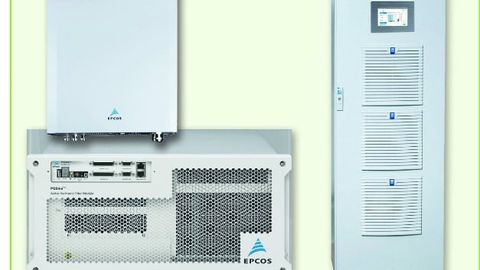
The basic module (below) can be installed in switch cabinets for wall mounting (left) or floor mounting (right). Cascadability allows systems to be set up for currents up to a maximum of 600 A.
© EpcosThe core of the Active Harmonic Filter is a controller based on a 32-bit digital signal processor (DSP) and operating at a sampling rate of 48 kHz. With a response time of 21 µs and the Selective Drive Control (SDC) algorithm, this solution is faster than conventional algorithms based on Fast Fourier Analysis (FFT). Based on the data determined in real time, a compensation current is fed into the grid, which eliminates the non-linearity of the load current.
The device series is designed for three-phase networks with and without a neutral conductor at voltages from 200 V(AC) to 480 V(AC) at 50/60 Hz. Harmonics up to the 50th harmonic (2500 Hz/3000 Hz) can be detected and filtered. The filters can be cascaded in steps of 60 A up to a maximum compensation current of 600 A.
Modular design

Voltage and current curve of non-linear loads: The current curve does not follow the sine of the voltage, which leads to undesirable harmonics.
© EpcosThanks to the modular design of the active harmonic filters, the 60 A modules can be easily replaced; in addition, a standard cabinet with 180 A filter capacity can be upgraded with one or two 60 A modules up to a total capacity of 300 A (five modules). To do this, the modules are pushed into the enclosure, whose busbar is always designed for currents up to 300 A. No screwing or drilling is required for contacting, as both the power connections and the control cables are pluggable.
In contrast to classic power factor correction, which only compensates for inductive loads, the filters can also be used to compensate for capacitive reactive power components. In addition to filtering, the devices ensure that the loads are balanced across all phases. When using the 4-wire devices, neutral conductor currents are also compensated. Integrated self-monitoring systems include overload protection, shutdown in the event of overtemperature, protection against overvoltage or undervoltage and fan monitoring. Ethercat with 100 Mbit/s, USB, Active Sensor Bus and Display Bus are used as interfaces.
Low-loss output topology
Many active filters work with two-stage IGBT bridges at the output - a concept that is comparable to the output structure of 6-pulse frequency converters. PQSine, on the other hand, uses a three-stage concept with a total of twelve IGBTs (four IGBTs per phase string). This results in a better approximation to a sine wave form of the output signal than with two-stage systems. As the IGBTs only have to switch half the operating voltage each in this concept, switching losses are significantly reduced.
Author: Lukas Motta is Director Business Development Power Quality Solutions at TDK in Munich.


You might also be interested in
Additional output voltages for power supply series
TDK-Lambda is expanding the 250W AC-DC power supply units 'CUS250M' with additional models, so that the range now includes 12 V, 15 V, 18 V, 24 V, 28 V, 36 V and 48 V.
 read more...
Christopher Haas succeeds Gustav Erl
Christopher Haas took over the management of TDK-Lambda Germany on April 1. He succeeds Gustav Erl, who is retiring on June 30.
read more...DIN rail power supply units with three-phase input
Newly available from Hy-Line Power Components is a compact series of TDK Lambda DIN rail power supplies that can be fed from a three-phase network.
read more...Under power
TDK-Lambda presents current power supplies in the core markets of industry and medical technology. The company is announcing new power supplies for next year, as it needs to be prepared for the economic upturn.
read more...Rack power supply for up to 15 kW
The Genesys+ programmable power supply for rack mounting from TDK-Lambda has been extended to include models with output powers of up to 15 kW.
read more...Isolated standby voltage option
A series of AC/DC embedded switching power supplies (SMPS) from TDK-Lambda is available from RS Components.
read more...New products at the industrial trade fair
'Industrial Intelligence' - this is the guiding theme of the Hannover Messe 2019. Computer&AUTOMATION shows an excerpt of the products that can be seen in Hanover in a picture gallery.
read more...New products at embedded world 2019
At the end of February, the Nuremberg exhibition halls made way for everything to do with embedded systems technology. Computer&AUTOMATION presents a selection of new products that were on show at the embedded world 2019 stands.
read more...TDK-Lambda acquires
TDK-Lambda, a wholly owned subsidiary of TDK Corporation, has acquired the Swiss company Nextys SA to expand its presence in the DIN rail power supply market.
read more...