
Organic photovoltaics
Lapp Kabel and Belectric OPV cooperate
The Lapp Group has concluded a cooperation agreement with Belectric OPV - a supplier of organic photovoltaics (OPV). The partners want to develop new technologies for the connection and cabling of flexible organic solar modules.
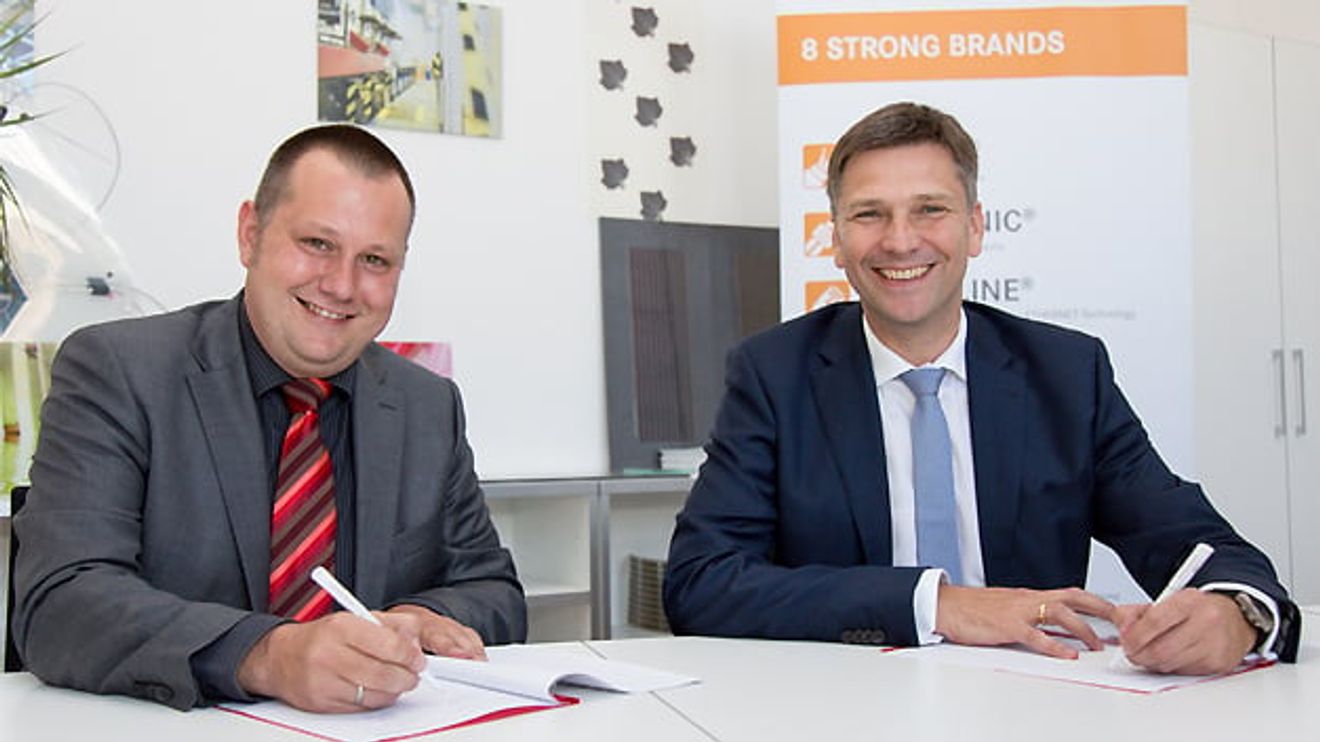
Georg Stawowy (right), Chief Technology and Innovation Officer of Lapp Holding AG, and Dr. Ralph Pätzold, CEO of Belectric OPV, signed the cooperation agreement at Belectric OPV's production site in Kitzingen.
© U.I. LappThe aim of the cooperation is to create a solution that is more versatile than before and suitable for any film material. In addition, the so-called module connection points - the contact point between the film and cable - are to become even more compact. According to Lapp, this is important in order to integrate the film modules inconspicuously into building façades, where they generate clean electricity from the sun. This should give designers and architects as much creative freedom as possible. "Development is already underway and should be completed in 2017 with a product ready for series production," says Reinhard Probst, Market Manager Solar at the Lapp Group.

Solar modules from Belectric OPV with connection technology from Lapp were already on display at the 'Solartrees' in the German pavilion at Expo 2015 in Milan.
© U.I. LappFor Lapp and Belectric OPV, the collaboration is the continuation of a long-standing partnership. Lapp has already developed a connection point for Belectric OPV that was used in the solar modules for the German pavilion at Expo 2015 in Milan. The solar sculptures there stretched up into the sky like giant ferns, and the electricity was fed into the cables via almost invisible connection points that looked like fine branches on "leaves".
According to Lapp, the process it developed is a major step forward in the use of organic photovoltaics. The connection points in the Milan pavilion are particularly compact and absolutely waterproof. The new solution should also have these properties, but it should be much more flexible - for example in terms of the choice of material and the thickness of the carrier films. The connection point should also be able to be applied independently of the production location of the modules, which means high flexibility in production. The partners are keeping how exactly this will work a secret for the time being until the patent procedure has been initiated. Both companies are granting each other exclusive rights to this technology for a fixed period of time. During this time, Belectric OPV will purchase the connection points from Lapp, while Lapp will only supply Belectric OPV.
Further joint projects
The two partners are already planning further projects to utilize the new process. One idea is to make better use of existing areas. "Thanks to the new system technology, we can provide architects with a connection system that can be visually integrated into the overall appearance and thus further emphasize the advantage of aesthetically valuable OPV integration," comments Hermann Issa, Director Business Development at Belectric OPV. In addition to building integration, areas that were previously out of focus can also be developed - such as roofs that could not previously be used for structural reasons. "This system is of course much lighter and can be easily adapted to the building or its surroundings in terms of shape and, in some cases, color," says Reinhard Probst.


You might also be interested in
New appointments to the HR Board and European CTO
The Stuttgart-based Lapp Group has made two important new appointments: Dr. Hilmar Döring has been appointed Board Member for Human Resources and Organizational Development at Lapp Holding, while Boris Katic is the new Chief Technical Officer of...
 read more...
Bonfiglioli divests PV division
The Italian drive technology manufacturer Bonfiglioli is selling its photovoltaic division to the Spanish company Ingeteam and intends to focus more strongly on its core business in future.
read more...Predicting the yield of solar cells under real conditions
In future, the expected yield of solar cells will no longer have to be estimated on the basis of their behavior under standard test conditions. Researchers at PTB can use a new method to adapt the test conditions to the real climate at the place of...
read more...Uninterruptible power supplies
Only supposedly safe
UPS systems provide energy security in the event of a power failure or mains fluctuation. But: In certain scenarios, the UPS switches off for reasons of self-protection and protection is no longer provided. What to do?
read more...Optimized network quality
More and more loads in the grid are operating non-linearly, which has strong repercussions on the grid and degrades its quality. Active harmonic filters", which reduce grid perturbations, can help.
read more...Wind power / Predictive maintenance
Bonfiglioli cooperates with Schaeffler
A compact solution package for the predictive maintenance of azimuth drives for wind turbines is the result of a long-term development partnership between Bonfiglioli and Schaeffler.
read more...ABB sells solar inverter division
The ABB Group has sold its solar inverter business to the Italian company Fimer. With this transaction, ABB is continuing to systematically focus its business portfolio on other growth markets.
read more...Renewable energies cover 44 % of electricity demand
According to the ZSW and BDEW, renewable energies accounted for 44% of electricity demand in Germany for the first time. Compared to the previous year, the share of green electricity thus increased by 5%.
read more...10 MW wind turbine and rotor diameter of 193 m
Siemens Gamesa plans to launch a 10 MW turbine with direct drive on the market in 2022. Compared to the previous model, the offshore turbine is expected to increase annual energy production by 30 %. Each rotor blade is approximately the length of a...
read more...