
Pulse
New markets in our sights
Puls describes the current year as the most successful in the company's history to date - with above-average growth in terms of both turnover and the number of employees worldwide.

Ewald Braith takes over the management of Puls Vario at the Drebach and Vienna locations.
© PulseBernhard Erdl, Managing Director, Chief Developer and owner of Puls, expects sales of EUR 160 million for 2017 - an increase of around 25%. Of this, 18% will be generated organically and 7% through the acquisition of Etasyn. Ambitious target for 2020: 200 million euros.
The German power supply manufacturer Etasyn, with its own production site in Drebach and a total of 75 employees, was incorporated into a new business unit called Puls Vario as part of its integration into the Puls Group. Thanks to a site closure of the power supplier Artesyn in Vienna, an additional development team was also acquired. The developers will be working on devices for Puls's standard power supplies as well as developing customer-specific solutions. Ewald Braith, who has been General Manager of Etasyn since 2015, will take over the management of Puls Vario at both locations.
With the founding of Puls Vario, the "Puls Power House" will be supported by two pillars in future: in addition to the portfolio of standard power supplies, customer-specific solutions, modifications of standard devices and complete assemblies form a second important business area in the group of companies. With this strategy, the company aims to intensify its presence in market segments with a strong focus on customer-specific solutions: Medical technology, for example, accounted for a good half of Etasyn's turnover in the last financial year. The company also has market expertise in the area of conveyor technology for unit loads (material handling) and railroad technology.
Lower performance range expanded
According to Bernhard Erdl, the company also wants to "open up a new market for Puls" with new power supplies from the 'Piano' series - the DIN rail power supplies 'PIC60' and 'PIC90' as well as the 480 W power supply 'PIC480.241D' - and reach users "who could not previously afford Puls".
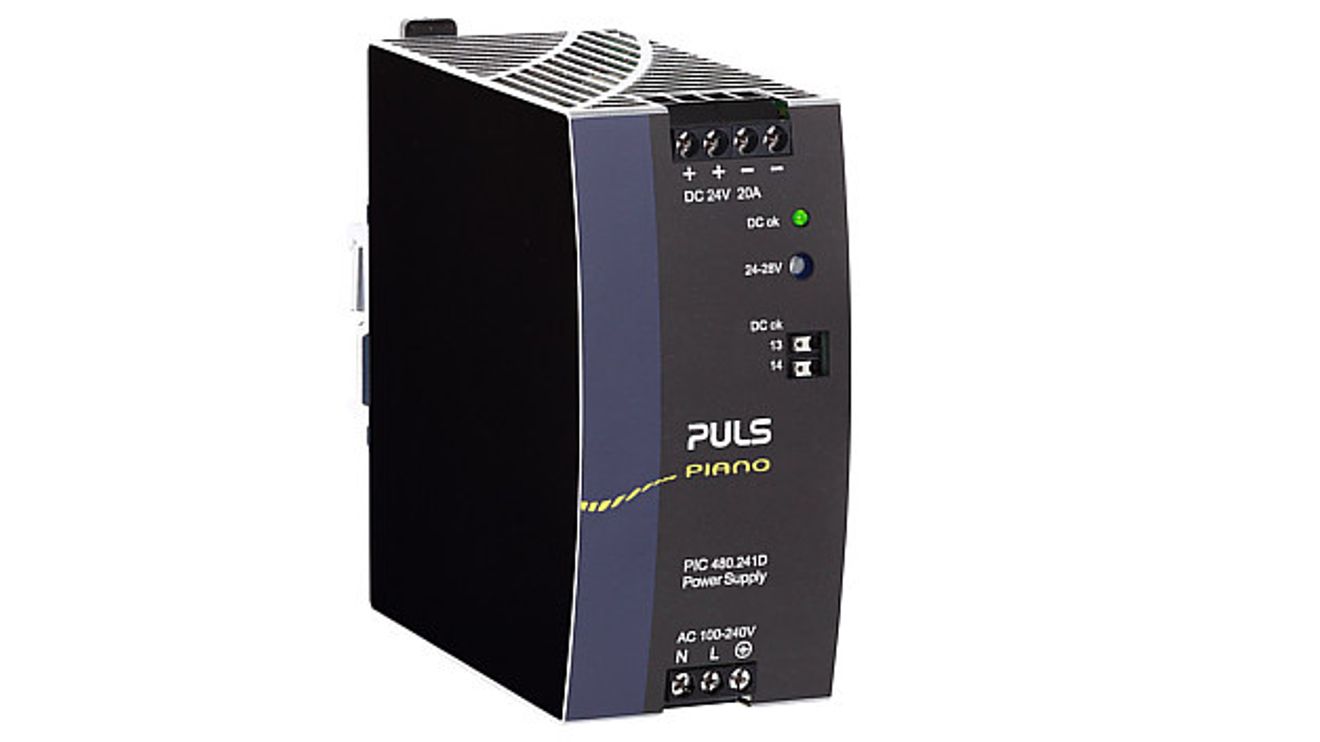
The cost-oriented 24 V/20 A power supply 'PIC480.241D' offers an efficiency of 95 % and a width of only 59 mm.
© PulseWith the power supply units, users receive the "familiar quality at 25% lower costs". This is achieved by dispensing with secondary features and design innovations such as a plastic housing.
The power supply units are based on a single-board design, they only require one PCB and a reduced number of components. On the one hand, this design makes it easier to manufacture and test the devices, and on the other hand, the design has a positive impact on the reliability of the power supplies as the number of potential sources of error is reduced.

The existing 120 W, 240 W and 480 W power classes of the 'Piano' product family are joined by a 60 W and a 90 W power supply.
© PulseThe 'PIC60' and 'PIC90' power supply units are housed in a polycarbonate casing that is suitable for ambient temperatures of up to +70 °C. It was possible to dispense with a metal housing due to the high efficiency of the devices. Due to the low power losses, the housing of the 'Pianos' does not have to act as a heat sink. For the user, the polycarbonate housing offers not only a cost advantage but also a significant weight advantage over metal housings.


You might also be interested in
New power supply products
In a product picture series, Computer&AUTOMATION presents the latest power supply products - from industrial power supply units to load-break switches.
 read more...
With IO-Link interface and integrated display
Puls presents the new 480 W DIN rail power supply 'CP20.248-IOL' with IO-Link interface and integrated display for a reliable 24 V power supply.
read more...22.5 mm wide electronic circuit breaker
The electronic 4-channel circuit breakers (ECBs) 'Pisa-M' from Puls are aids for protection and power distribution in applications with power requirements from 90 W to 480 W.
read more...Collaboration on Open Energy Standards
Weidmüller Joins the EEBus Initiative
Weidmüller has joined the EEBus Initiative. Together, they aim to further promote the international EEBus communication standard for smart grids and intelligent energy management.
read more...AI Platform Aims to Enable Energy Sharing in Industry
As part of the EU project FlexBit, Fraunhofer IFF is developing an AI-powered platform to optimize energy storage systems and manage industrial energy-sharing systems. The concept is being tested in an Industrial Energy Community in Magdeburg and is...
read more...EMC and radio testing in Germany and worldwide
In a world filled with smartphones, connected cars, medical devices and smart appliances, supporting optimal electromagnetic compatibility (EMC) and wireless performance to minimize interference between electronic products is critical.
read more...Marco Geiser becomes new Vice President Secure Power DACH
Marco Geiser has held the position of Vice President of Secure Power DACH since April 1, 2026. In this role, he will strategically develop the Secure Power business in Germany, Austria and Switzerland, strengthen it operationally and focus it on...
read more...Promoting the use of direct current
Current/OS and the Open Direct Current Alliance (ODCA) have agreed a strategic partnership aimed at accelerating the creation of a coherent and interoperable ecosystem for direct current (DC). A Memorandum of Understanding (MoU) has been signed by...
read more...IT Partnership in the Energy Market
CGI and Schneider Electric cooperate
CGI and Schneider Electric are expanding their collaboration in the DACH region. The aim is to support energy suppliers with grid modernization, digitalization and regulatory requirements. The focus is on ADMS-, GIS- and AI-based solutions.
read more...