
Pulse
Forget about system availability
System availability stands and falls with a reliable power supply. To ensure high availability, the system should already be considered during the planning phase.
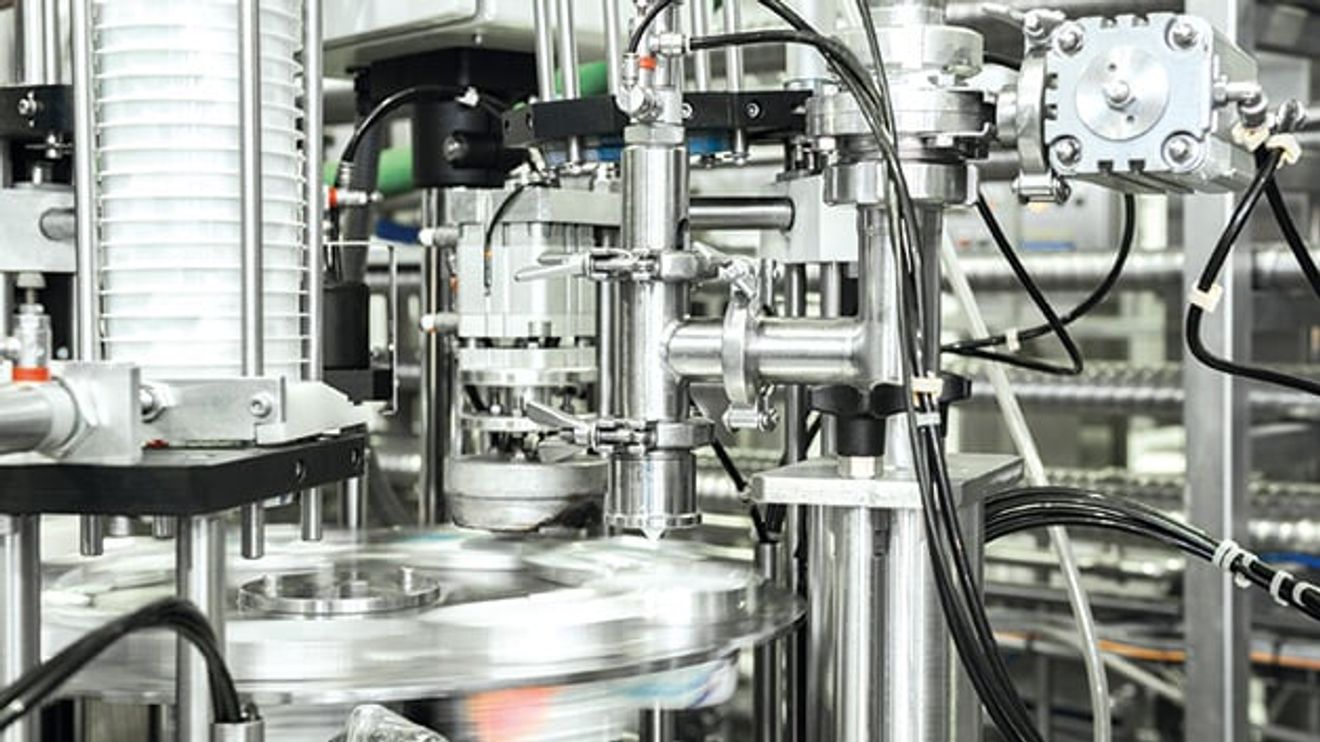
Plant availability is a key figure that indicates the percentage of the planned production time during which the plant was actually in operation. The higher the figure, the more efficient the production and the higher the profitability. With the right system approach, users can consider the topic of "plant availability" to be a given.
In order to increase system availability, it makes sense to consider possible solutions as early as the planning phase. As a manufacturer of industrial switched-mode power supply units, Puls has a strong focus on the 24 V side - i.e. the application - but the switched-mode power supply units also form the direct interface between the power grid and the application. The availability of the grid therefore also plays a role in the overall view. System developers should factor this factor into their system planning at an early stage.
Grid stability as a risk
Puls operates three plants in Germany, China and the Czech Republic to manufacture its products. System availability is a top priority. Local grid stability is important for this. The example of the plant in the Czech Republic makes this clear: statistically, Czech companies are affected by 0.6 grid outages per month; this is just above the European average of 0.3 grid outages per month. This figure may seem low, but it means that a European factory is statistically affected by a power outage four times a year. In East Asia and the Pacific region, the power grid statistically fails 4.8 times per month; in the USA, 24% of the companies surveyed report at least one outage per month.
Without appropriate protective measures such as uninterruptible power supplies (DC UPS) and battery systems, an outage can quickly lead to high costs. This can result in damage to production machines due to suddenly stopped processes, losses due to downtime or the loss of entire production units. The safety aspect also plays a role: in the event of a fault, a system must always remain safe and must not pose a risk to operating personnel and technicians. For large production sites, a power and production outage can quickly cost millions. This makes it all the more important to rely on the right overall system and a suitable solution.
Power supply unit at the heart of the application
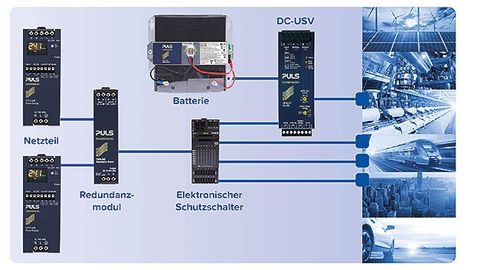
The heart of every application is the power supply unit. In this example (image), a CP10.248, a single-phase 24 V power supply unit with 10 A, was selected for the system operator. The display version provides the operating personnel with all relevant information on the status of the application and the power quality at a glance. In real-time mode, the device provides, for example, the current value of the input voltage, output current and voltage, the number of operating hours and the current temperature of the power electronics. In addition to the real-time data, the power supply unit provides an overview of recorded data such as the minimum and maximum value of the input voltage or the device temperature. The device also detects and counts mains transients. In the event of a fault, the component alerts the user and informs them of the status. This enables the situation to be analyzed quickly and reduces downtimes.
This is also achieved by using a redundant power supply system: a second, similar power supply unit is connected to a MOSFET redundancy module (Puls YR20.242). The 1+1 redundancy created by connecting the two power supply units in parallel on the output side enables immediate switching to the second power supply unit if one power supply unit fails (or if the cable to the first power supply unit breaks). Each of the power supply units used must be designed in such a way that it can handle the load to be applied in the application on its own. The MOSFET redundancy module ensures that the two power supply units are decoupled in the circuit. In the event of a short circuit, the second power supply unit continues to supply the application and does not feed into the short circuit. This significantly increases the availability of the system.
Electronic circuit breaker for load protection
If different loads are connected to a power supply unit, the use of an electronic circuit breaker is recommended. In this example, this is the PISA-B circuit breaker with 8 channels. The circuit breaker distributes the current to the corresponding channels and enables different tripping characteristics. Channels 1 and 2 are optimized for loads with large capacities. An LED matrix on the front of the device can be used to display both the current output currents and the threshold values for the tripping behavior on a channel-by-channel basis. To increase safety and make tampering more difficult, the device can be locked with a PIN code. If a channel is overloaded and the electronic circuit breaker trips, the operator is informed of this via an alarm signal. Switched-off channels can also be reactivated remotely via a relay input, which reduces downtimes.
DC UPS for safety-critical loads
As already mentioned, grid stability is an important factor when designing a system. Particularly in applications with safety-critical loads, for example for plant safety equipment such as light barriers, emergency stop switches, emergency lighting or pumps in municipal water treatment, it is worthwhile using an uninterruptible power supply (UPS).
In combination with a battery, mains failures and other faults, such as a cable break near the power supply, can be bridged. The buffer time is determined by the selected battery size and the known load. This is either designed so that it buffers for as long as possible until a repair has been carried out, or just long enough for the machine to be shut down and a safe state achieved.
Depending on the objective and local network characteristics, optimum protection can be provided for all critical loads and applications. The DC UPS together with the battery is connected between the respective load and, in this application example, the electronic circuit breaker. For the device combination presented, the customer opted for a UB10.241 together with the UZK12.261 26 Ah lead battery module. This results in a minimum buffer time of around 40 minutes for a 10 A load with an already aged battery. For the present application, this covers the expected failures and ensures operation. The constant availability of the system is thus ensured.
System availability determines production costs
Downtime costs include more than just the loss of profit due to lower production output. There are also additional costs - some overt, some hidden: increased personnel costs due to the deployment of service teams or the overtime required by the entire workforce to make up for the loss of production. Even with smaller systems, this very quickly leads to downtime costs of several tens of thousands of euros. Depending on the branch of industry, the basic components may only have a short shelf life in the system and have to be disposed of and the system completely cleaned after short downtimes - for example in the chemical or pharmaceutical industry or in machines for food processing. Especially if spare parts are not available, the disposal of raw materials (e.g. raw milk) is added to the loss of production.
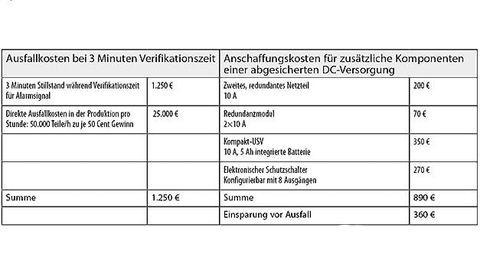
This loss can be reduced either by keeping various spare parts immediately available in stock or by implementing a power supply concept that is still available in the event of a fault. The latter is ultimately more cost-effective. This can also be demonstrated by a brief rough calculation (see table). For many systems, the direct downtime costs within the few minutes required to verify the fault already exceed the additional costs for an optimized, permanently reliable DC power supply!
By investing in a reliable power supply system, production costs can be reduced not only in the event of a failure, but also permanently during the operating phase.
System approach instead of individual devices
Puls develops its power supply systems according to the 'We Care' philosophy. Design thinking processes are used to develop solutions that address the actual challenges and needs of customers. The aim is to really understand possible use cases. The focus here is not on an individual power supply unit, but on the overall system, which is made up of the safety-relevant components described in the article. For the user, this system solution is worthwhile in every phase of the system's life and protects against high downtime costs.


You might also be interested in
For marine applications
The 24 V, 20 A top-hat rail power supply CP20.245-R2 from Puls was developed for onshore and offshore use in the shipping and process industries.
 read more...
DIN rail power supply unit with condition monitoring
Puls is expanding its CP20 power supply series with the CP20.248 version with a display on the front of the device.
read more...Quantum-resistant hardware security for Nvidia robotics platform
Infineon Technologies integrates the hardware security module 'Optiga TPM SLB 9672' into Nvidia's 'Jetson Thor' computing platforms for robotics and autonomous systems. The module secures cryptographic keys directly at chip level and thus protects...
read more...Safety solutions for the smart factory
Schmersal is launching IO-Link safety products on the market with the solenoid interlock 'AZM42' and the safety sensor 'RSS362'.
read more...Security portfolio expanded
Adlon is further developing its Security Operations Center and adding another module to the existing Managed SOC for Microsoft 365 environments (based on Managed XDR): 'Managed SOC Advanced'.
read more...New Vice President of Global Partner Ecosystem appointed
Effective immediately, John Ryan is the new Vice President of Global Partner Ecosystem at Claroty, a specialist in the security of cyber-physical systems (CPS).
read more...Increasing cyberattacks on the manufacturing sector
A report from Check Point Exposure Management on the threat landscape in the manufacturing industry shows a dramatic increase in ransomware, supply chain attacks and OT-related cyber incidents. As smart factories and connected supply chains become...
read more...Platform for AI security in companies
Check Point Software Technologies has introduced 'Check Point AI Defense Plane'. This unified AI security control plane helps organizations manage the networking, deployment and operation of AI across the enterprise.
read more...Compact, safe, self-monitoring
Georg Schlegel With the 'MKTOSFE' and 'MKPTOSFE' contact elements from the 'MK/MKP' series, Georg Schlegel is launching two compact solutions on the market that offer increased protection for man and machine in industrial applications thanks to...
read more...