

Transformer electronics block
DC on the rise
The energy infrastructure in Germany is designed for alternating voltage. However, a DC voltage supply would be particularly advantageous in industry. The DC Industry project funded by the BMWK is committed to DC infrastructures in industrial plants. An overview.

| Block at the Hannover Messe 2023 |
|---|
| Hall 12, Stand E79 |
In 1890, George Westinghouse with AC voltage and Thomas Alva Edison with DC voltage competed against each other in the so-called electricity war. At the time, alternating current technology won because of its ability to be transformed to the highest voltages using transformers and the long transmission distances this made possible. Edison's conclusion: "I am not discouraged, because every recognized error is another step forward." Today we can say that direct current was not a mistake, but simply too early for the times.
Compared to those days, energy is now increasingly generated, consumed and transported in the form of direct current. Some applications are shown here.
DC and its advantages
Photovoltaics and fuel cells generate DC voltage directly. Wind power generates DC voltage via full converters with a DC link and then AC voltage again. In some cases, energy is already being transmitted using high-voltage direct current transmission (HVDC). This is made possible by technological advances in power electronic circuits and semiconductors. In addition, the grid voltage is currently rectified in almost all consumers. The DC voltage generated is then used directly (switching network components, storage charging) or converted back into AC voltage, for example with the help of frequency converters.
The basic advantages of direct voltage over alternating voltage are:
- Compared to AC cables and busbars, 50 percent less copper is required due to the elimination of reactive power as well as the higher voltage with DC (≥ peak value of AC voltage with the same insulation requirements). Alternatively, the transmission losses can be significantly reduced. Installation costs are also significantly reduced by eliminating cables.
- The electronics of consumers become smaller and more efficient as the internal mains rectifier is no longer required.
- Renewable energies and storage systems can feed in their energy without further AC voltage conversion.
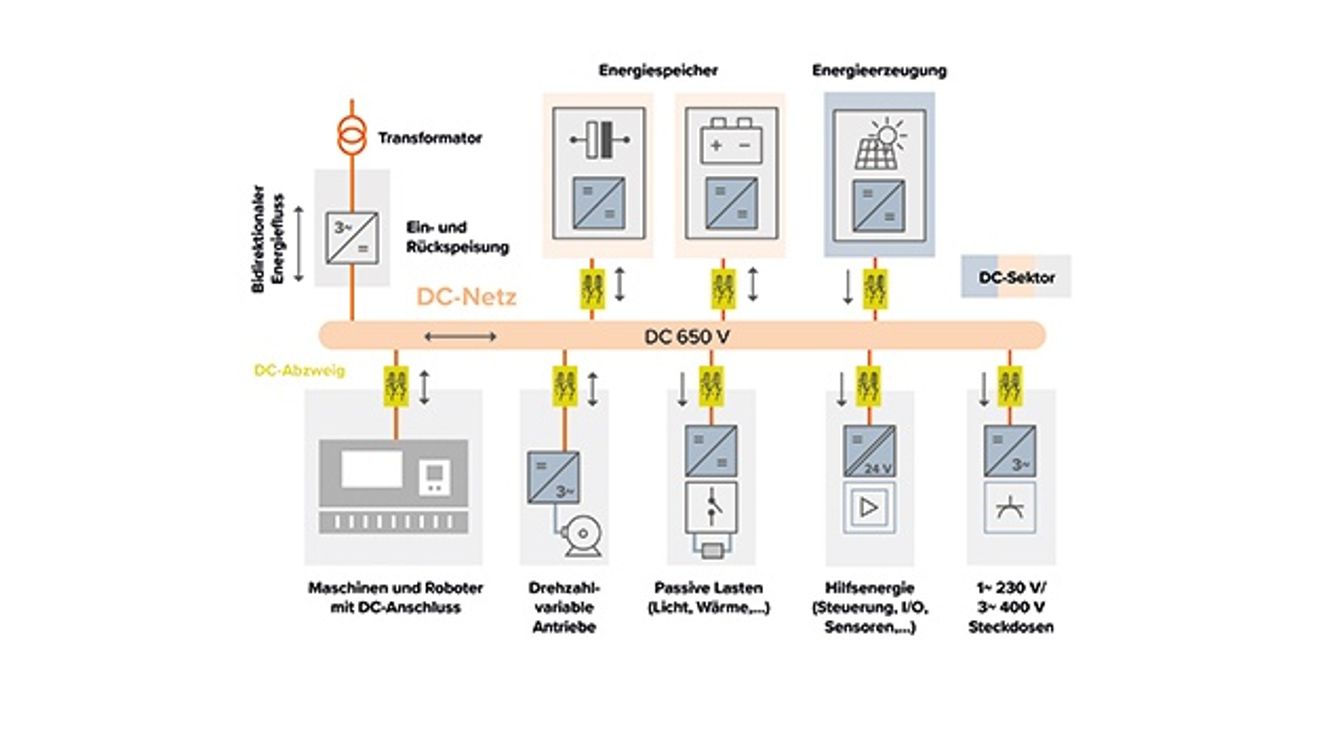
In view of the energy transition, it is therefore a necessary goal to further expand direct current and utilize its advantages. In the 'DC-Industrie2' research project, 39 partners from industry and research have been working on the question of how industrial direct current grids can be set up and used sensibly in industrial production halls since 2019. The aim is to develop a comprehensive, manufacturer-independent system concept for industrial power supply in production. Ten test facilities and transfer centers are now available to make it easier for users to introduce DC grids. An industrial DC system for a production hall offers additional advantages:
- Energy can be exchanged directly between consumers without converters. Braking energy in particular no longer has to be consumed via braking resistors.
- Photovoltaics from the company roof and storage systems can be integrated and used directly.
- The DC grid can continue to run independently in the event of an AC grid failure if sufficient storage is available.
- Load peaks are drastically reduced when storage systems are used and connected load is reduced. A test system with a peak load of 350 kW was reduced to 50 kW connected load.
- The line losses in the cables are reduced by 40 percent, as only two current-carrying conductors with a lower current are used for DC instead of three current-carrying conductors with a higher current for AC.
- Using the same copper cross-section for DC as for AC pays for itself within months through energy savings (≈64 percent).
- Reduction of energy consumption by five to eight percent in the test systems.
- Stored energy can also be made available across factories to compensate for fluctuations in demand and supply in power generation.
Block Transformatoren-Elektronik is involved in the research project with its own basic research department for the DC power supply units required in a DC grid for the auxiliary voltage supply. The focus is on a wide DC input voltage range, robustness and reliability. Furthermore, parallel connectivity or redundancy modules must enable a supply from the AC mains. Increased efficiency and a reduction in installation space were achieved in the research project through the use of silicon carbide semiconductors and innovative winding materials.

The author: Dr. Dennis Kampen is Head of IT, Research and Knowledge Management at Block Transformatoren-Elektronik.
© BlockA comprehensive and coordinated product portfolio is required to meet the needs of the wide range of industrial applications. DC Industry2 has shown that DC grids make sense. They are particularly worthwhile in companies where many drives with frequency inverters and regular braking energy are installed and photovoltaics and energy storage are planned.
| The DC-Industry2 project |
|---|
|
Since October 2019, 39 partners, including 33 companies and six research institutions, have been working on the seamless, efficient integration of renewable energies, for example solar panels on factory roofs, and storage systems to balance electricity supply and demand in factories. The focus of DC-Industrie2 is the DC supply of an entire production hall, after the DC supply of a production cell has already been realized in DC-Industrie since 2016. The DC infrastructure is being implemented and extensively tested in nine model plants and transfer centers at various partners. The output of these systems ranges from a few kilowatts to two megawatts. As a direct follow-up project, the ZVEI has founded the Open Direct Current Alliance. The aim of the ODCA is to build a global direct current ecosystem and establish direct current technology across all applications. The ZVEI was able to recruit 33 companies from industry, academia and research for the founding of the project. The ODCA, a working group of the ZVEI, follows on seamlessly from the DC-Industrie2 research project, which will be completed this year, and is primarily dedicated to implementing the research results. |


You might also be interested in
Follow-up project for DC-INDUSTRIE2
ZVEI founds Open Direct Current Alliance
As a direct follow-up project to DC-INDUSTRIE2, the ZVEI has founded the Open Direct Current Alliance, ODCA for short.
 read more...
Compact design for the top-hat rail
Block launches the PowerCompactChamp (PCC) series of power supplies onto the market.
read more...followed up! - ZVEI DC industry
The DC initiative
With the DC Industry project, the ZVEI is driving forward direct current grids in industry. The brains behind the project explain what synergies are being created with electromobility and what benefits can be expected in relation to the climate...
read more...Getting to the bottom of cable asymmetry
Many faults in industrial networks and systems are caused by electromagnetic compatibility (EMC). However, it is often not known exactly what these are - such as interference currents due to asymmetrical supply lines.
read more...Innovation Prize 2024 awarded
This year's AMA Innovation Award from the AMA Association for Sensors and Measurement (AMA) honors the development team around Stanislav Aksarin. The prize was awarded at Sensor+Test 2024 in Nuremberg.
read more...Full power of attorney in management
Block Transformatoren-Elektronik has been run by an eight-strong management team for six years. Now all members of the team have been appointed authorized signatories.
read more...IO-Link functionality for Industry 4.0
The 'Omniplus-F' is a versatile thermal flow sensor from GHM Messtechnik that measures the flow velocity, temperature and volume of liquid media in a single device.
read more...Schneider Electric takes over climate protection consultant EcoAct
With the acquisition of EcoAct from Atos, Schneider Electric is further expanding its range of sustainability consulting services.
read more...Installation behind the safety edges
Redur launches the 4R21.3 plug-in cable transformer. The 4R21 small signal converters from the 'Regulus' series are available for primary rated currents from 50 to 500 A and a round conductor dimension of 21 mm.
read more...