
I/O peripherals in IP 67
Transparency down to the last meter
While the industry currently seems to be focusing exclusively on Industry 4.0, the question arises: What role do conventional machine-related components such as I/O systems with IP65/67 protection still play in this environment?
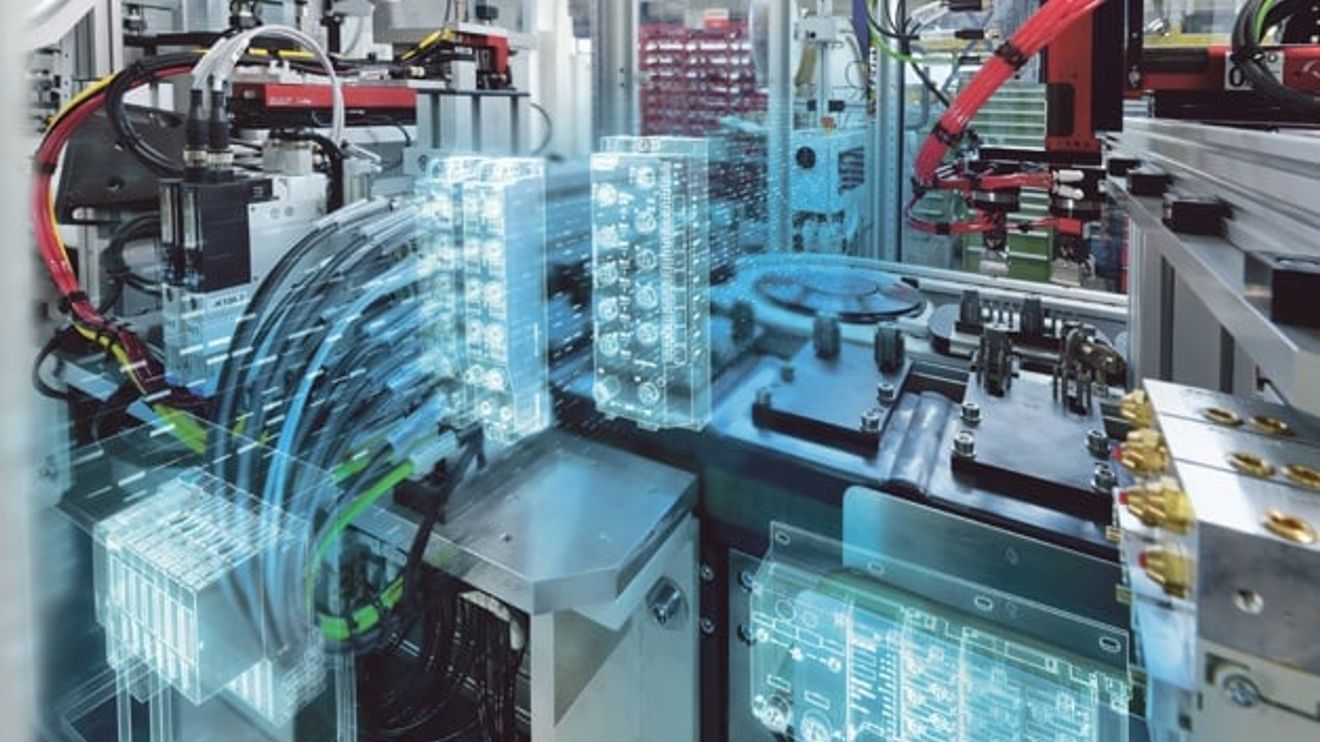
The concepts of Industry 4.0 are based on the progressive networking of machines, devices and sensors. This inevitably requires more and more intelligence from the devices - right down to the I/O level. In addition to classic control cabinet systems, I/O systems with IP65/67 protection in the form of small, machine-oriented systems can really come into their own in this context. As these are fully protected against dust and water, they can be installed almost anywhere on the machine or in the system, which offers a high degree of flexibility and simplifies planning phases.
In the case of the Simatic-ET-200 series from Siemens, for example, each peripheral module has so-called I&M data in addition to detailed parameter and diagnostic data. This 'electronic type plate' of the component allows the
system status, including all data, can be called up completely virtually from a higher-level controller or system. When it comes to data transparency and intelligence at field level, the IO-Link communication standard is particularly important. This is rightly becoming increasingly popular, as it promises a number of advantages:
- Device-dependent detailed diagnostics down to field device level,
- Cable break detection,
- the possibility of re-parameterizing connected actuators or sensors (so-called IO-Link devices) during system operation from a central control station
- as well as significantly lower cabling costs, especially for high-channel devices such as valve terminals.
Due to the comparatively short range of IO-Link communication of 20 meters, it makes sense to connect the devices to be connected directly to a corresponding master module in IP65/67 on site in the field. This architecture is particularly suitable for very distributed sensors or actuators that are difficult to access, as such an IO-Link master can be mounted very close to the device and even where space is limited, which also minimizes cabling routes and the associated effort. IO-Link offers the advantage that the parameterization of the connected devices is stored in the master module, particularly in the event of maintenance - i.e. if a device needs to be replaced. When a device is replaced, this is automatically transferred to the new device without any additional effort on the part of the user.
Keeping an eye on the footprint
However, if an IO-Link master module fails instead of an IO-Link device, the port configuration of the master would have to be reloaded. For this reason, function blocks are available for the 'TIA Portal' engineering tool, which save the parameter data of the devices stored on the connected IO-Link masters of the ET 200pro, ET 200eco PN and ET 200AL I/O series as well as the port configuration of the master on the controller. This means that parameterization and port configuration remain available even if a defective master module is replaced.

Because IO-Link allows parameter data to be changed dynamically directly from the application, the devices can be adjusted to the respective production requirements during operation.
© SiemensIn addition to the requirements for transparency and intelligence, space requirements and flexibility are also decisive factors for modern machine concepts.
In other words, more and more sensors and actuators need to be connected in less space. By using peripherals in IP65/67, time can be saved during project planning by replacing more complex control cabinet systems in terms of planning and design with flexibly mountable cabinet-free systems. Another advantage of using peripherals in IP65/67 for outside the control cabinet is that they can be easily retrofitted: If it becomes apparent during the implementation of a machine that additional IOs are required - for example, as a result of a customer request at short notice - these can be retrofitted without great effort. In the case of control cabinets, on the other hand, either reserves have to be planned from the outset or new control cabinets may even have to be designed.
Configuration control - also known as option handling - is a help for the machine manufacturer in this context. This I/O system function makes it possible to operate different expansion stages of a (series) machine in a single project without having to change the hardware configuration or the user program. This makes it possible to define different types (options) of a machine based on an existing 'maximum configuration'. This means that projects and hardware configurations do not have to be maintained individually for each machine type, just one. Later, by activating and deactivating the previously defined options, different configuration levels of the machine or system can be realized. This even works during the runtime of the CPU and also applies to fail-safe assemblies, so that existing machines can easily be supplemented and retrofitted with additional options at a later date.

The ET 200pro modular system is characterized by the separation of function and connection module. It also has an active backplane bus so that modules can also be replaced during operation - i.e. hot swapping.
© SiemensDue to the variety of different machine and system types, it is difficult to combine all requirements in a single, universal I/O system. For this reason, Siemens has designed several ET 200 variants in protection class IP65/67, adapted to the individual application - but all with the same database and standardized handling in the engineering environment.
One of these is the modular ET 200pro system. With a wide range of (fail-safe) digital and analog I/O modules, it is particularly suitable for motion tasks. In addition to motor starter and frequency inverter modules for the direct control and regulation of motors, the system also includes its own CPUs with full Simatic S7-1500 functionality in terms of technology, performance, safety and security. This makes it easy to implement tasks such as positioning, relative synchronization and position control using integrated technology functions.
Data protection from the outside and inside
As data - the new 'raw material' of Industry 4.0 - can be one of a plant's most valuable assets, protecting it must be the top priority. Siemens is pursuing an 'in-depth' security concept here. For the CPU, this means access protection from the outside and manipulation protection from the inside, so that the subordinate I/O level is securely encapsulated - for example through a protection level concept with multi-level access rights for the monitoring and control functions of the HMI and integrated web server, as well as encrypted data transmission including access control for remote access via a WLAN network or directly via the Internet. Last but not least, this concept can also be used to detect manipulated communication data between the CPU, engineering and HMI. In short, data from the field can be collected safely and transmitted securely to higher-level controllers, systems or even locally connected HMIs. And the OPC UA interface even makes it easy to connect to third-party systems.

The simplicity of handling peripherals in IP65/67 lies in particular in their small footprint and easy mounting options. This means that even the most remote parts of a machine or system can be easily reached.
© AmbotecHowever, when it comes to flexibility and simplicity - two further I/O cornerstones in Industry 4.0 - hardly any other solution can hold a candle to a block periphery with IP65/67 protection, such as the Simatic ET 200AL. Its robust modules can be installed almost anywhere within a machine or system and are therefore particularly suitable for space-critical environments. Thanks to their small design (30/45 mm x 159 mm x 40 mm) and lightweight plastic housing, they can even be mounted on moving system parts.
A new addition to the portfolio for this system is a 16-channel digital module whose channels can be freely parameterized as inputs, outputs or even counters as required. For the user, this means They can standardize their stocks without losing flexibility in the application. Other advantages of the solution that contribute to easy handling include: free choice of installation position, CAx designations applied to the modules, color-coded cable markings and an integrated fastening option for cable ties.
In order to provide full functionality even under the most adverse environmental conditions, the Simatic ET 200eco PN - as well as a compact block periphery with IP65/67 protection - is packaged in a fully encapsulated zinc die-cast housing. This gives it a very high resistance to vibrations (permanent up to 20 g), dust, oil or moisture, which enables it to be used even outside production halls at temperatures from -40 °C to + 60 °C. However, the stability of the housing and the resulting extreme robustness against vibrations and shocks make it just as suitable for use close to the machine.
Redundancy ensures availability

The Simatic ET 200eco PN is mechanically very robust and resistant to vibrations up to 20 g, dust, moisture and even oil thanks to its fully encapsulated zinc die-cast housing. This enables it to be used in outdoor areas and in Ex zone 2.
© SiemensBut what good is the best 'data satellite' if the connection to it is cut and it can no longer supply data as a result? In order to prevent an often costly failure of the machine or part of the system due to a disconnection of the bus connection, the I/O systems mentioned above all support the so-called Media Redundancy Protocol (MRP). This enables the Profinet bus to be set up in a ring structure so that communication with the I/O systems is maintained despite the failure of a bus line or bus segment.
However, the members of the ET-200 family, which are individually tailored to the respective target application, only reach their full potential in conjunction with the TIA Portal engineering platform. This includes, for example, system-wide diagnostics in plain text (without programming), as well as the new function for automatic detection of connected Profinet I/O devices. The latter saves the time-consuming manual search for modules in the hardware catalog and their insertion into the configuration. Instead, the I/Os can be automatically recognized and integrated into the project using 'Hardware detect'. This saves a lot of time and eliminates a typical source of error - namely the inadvertent incorrect selection of a module.
With the increasing demand for machine performance and product customization, the demands on decentralized I/O systems will also continue to rise. For example, technological functions such as clock synchronization are increasingly being used in IP67 in order to further increase the machine cycle. Or that intelligent data evaluation is increasingly finding its way into the I/O level - supplemented by modules that can still be functionally adapted at runtime.
To summarize, the question posed at the beginning can be answered clearly: peripheral systems for installation outside the control cabinet have never been more up-to-date than they are today. They provide a degree of flexibility and versatility that could never be achieved by systems for the control cabinet, but which is essential for meeting the requirements of modern machine and system concepts.
Author:
Alexander Kessler is Marketing Manager for I/O systems at Siemens.


You might also be interested in
Siemens and UL Solutions digitize certification process
For the first time, an industrial product was certified for the USA after some of the required tests were digitally simulated and the results confirmed by physical tests. This was made possible with the help of the digital twin.
 read more...
Strong finish to the 2023 financial year
According to Siemens, revenue and order intake increased by 10% and 6% respectively on a comparable basis in the fourth quarter of 2023. In the Industrial Business, Siemens recorded its highest earnings and profitability figures ever.
read more...Security test suite for industrial networks
Siemens has expanded its industrial cybersecurity portfolio by launching an all-in-one security test suite for industrial communication networks.
read more...Innomotics launches as a Siemens subsidiary
Siemens is bundling its range of motor and large drive systems under the name Innomotics. The company was launched in Germany on July 1, 2023 as a wholly owned Siemens subsidiary.
read more...Cooperation expanded
Prostep and Siemens Digital Industries Software have expanded their collaboration: Now the Siemens software Polarion ALM and Teamcenter Manufacturing from the Siemens Xcelerator portfolio can also be connected to Prostep's OpenPDM integration...
read more...Plus 27 % in industrial business
Siemens has continued its strong growth momentum with comparable order growth of 20% since the beginning of the fiscal year, as CEO Roland Busch explained on the occasion of the publication of Siemens' quarterly figures. The figures in detail.
read more...Prototype interface for advanced robotics
The coupling between PLC and robot controller is crucial for the integration of advanced robotics applications in an automation environment. With ArTIA, Artiminds and Siemens have developed a software connector that links their engineering tools.
read more...Siemens stops new business with Russia
More and more German companies are withdrawing from Russia due to the war in Ukraine. Siemens is now discontinuing new business in the country. The impact on sales is likely to be limited.
read more...Siemens raises forecast - also thanks to demerger
Splitting up Siemens was a huge experiment. Less than a year after the IPO of the energy division, the move is proving to be the right one - at least from the perspective of the booming remaining group.
read more...