
M12 circular connector
Transmit currents of up to 16 amps
M12 circular connectors for data and power applications are becoming increasingly important in automation - and the number of variants available on the market is growing accordingly. What do users need to consider when selecting a connector system and what are the most important characteristic values?

As a consequence of the rapidly increasing networking of all production facilities in the course of the 4th industrial revolution, the demands on connection technology for the factory of tomorrow are increasing. In addition to reliable, secure contacting under difficult conditions (limited installation space, vibration, dirt, temperature stress, tightness), the requirements for energy efficiency, power consumption, miniaturization and electromagnetic compatibility are increasing significantly.

FEM simulations can be used to determine the optimum contact material and contact design for the crimp connection and the contact area.
© BeldenM12 circular connectors are no exception. Their success story began in the 1980s. Today, they are available in a wide variety of designs - internationally standardized and also established as a standard in the industrial environment. The standard M12 connectors available on the market with different codings and numbers of poles in accordance with the IEC 61076-2-101 and IEC 61076-2-109 design standards (data transmission up to 500 MHz) are specified for a current of up to 4 A depending on the number of poles and are usually designed for a connection cross-section of 0.14 mm2 to 0.5 mm2.
Industry requirements for miniaturization and a uniform or standardized mating face for data and power connectors ultimately led to the development of the M12 power connector family. This standard has been developed over the last two years in the DKE working group 651.1.1 and is fully described in IEC 61076-2-111/Ed 1. Depending on the application, users can choose from variants with different codings, numbers of poles, rated voltages and rated currents.

The user can use the derating curve to quickly draw conclusions about the current carrying capacity of the connector system.
© BeldenThe L- and T-coded versions are used for applications in the low voltage range (SELV, PELV). For applications with voltages above 50 V(AC)/60 V(DC), the S and K codings are required. The latter can be used, for example, for connecting servomotors with a power range of 630 V/16 A and at temperatures of up to 125 °C. The clearances and creepage distances of the K-coded connector variants are dimensioned to withstand a rated surge voltage of 6 kV.
The L-coded connector variants, on the other hand, can be used in sensor-actuator boxes and enable continuous standardized M12 cabling. The L-coded variants are included by the Profibus & Profinet user organization in the 'Profinet Cabling and Interconnection Technology Guideline'. This variant is characterized by two circuits plus additional functional earthing, a rated current of 16 A and a size with a maximum outer diameter of 18 mm. Cabling with connectors of larger dimensions, such as 7/8-inch connectors, is therefore no longer necessary.
What has changed?

Micrograph of an M12 power contact, crimped on a 1.5 square millimeter stranded wire: It shows a gas-tight hexagonal crimp without cracking for the contour defined from the FEM.
© BeldenThe requirement for the M12 power connectors to be able to transmit a rated current of 16 A with a wire cross-section of 1.5 mm2 in the same installation space required a new contact material and a new contact design. Among other things, the challenges for the contact material in terms of high electrical conductivity were at odds with the required mechanical material characteristics. In contrast to the previously used Ms alloys, the new contact material used by Belden therefore has a significantly higher copper content, among other things. In addition, the tension between high contact rigidity and good formability had to be resolved - using iterative FEM simulations.
The most important parameters
An important parameter for connectors and a measure of the quality of the contacting of the contact system is the current carrying capacity. It is determined by the contact heating (Joule's law) that occurs when a current flows. In a stationary load case, the current carrying capacity is described by the derating curve according to DIN EN 60512-5-2 and determined by the thermal properties of the materials used for the contacts and plastic parts. The operating temperature results from the self-heating and the ambient temperature at which the connectors can be used.
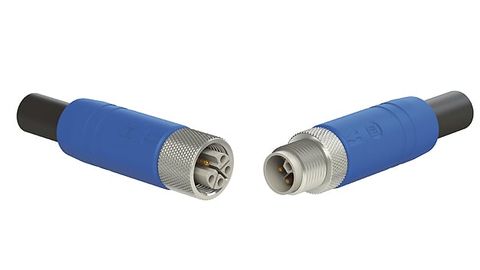
The overmolded and freely configurable versions of Belden's power connector feature a mating aid in the form of an arrow on the housing parts to enable users to quickly align the plug pins and sockets.
© BeldenThe rated current specified by the manufacturer - preferably defined in accordance with DIN EN 61984 chapter 3.27 at an ambient temperature of 40 °C - is the current that the connector can carry continuously and that flows through all contacts simultaneously. In the case of the Belden solution, this is 16 A for all four coding variants. To measure the temperature, temperature sensors are attached to the warmest points and the ambient temperature is measured at the same time. Possible hotspots can be identified using thermographic images. Finally, a good contact system is characterized by an even temperature distribution over the entire connector system, including the conductor connection.
Other important parameters of a contact system are the number of mating cycles, which are specified as 100, 50 or 20 mating cycles depending on the performance level of the contact system, as well as the quality of the stress relaxation of the spring laminations. Reliable contacting is ensured if the normal contact force over the entire service life does not fall below the minimum value required to penetrate the foreign layers.
Stress relaxation can generally be observed in contact materials. This means that a live electrical contact is subject to thermal ageing at elevated temperatures, as a result of which it loses part of its contact force. The Larson-Miller parameter can be used to calculate the long-term behavior of the residual stress after thermal relaxation by showing a relationship between the stress relaxation ∆σ (%), the operating temperature and the load duration.
Compared to conventional brass materials, the copper alloy used in Belden's M12 power contacts offers significantly improved relaxation behavior, which allows the upper temperature range to be increased to +125 °C compared to the upper limit temperature of +85 °C defined in the design standard for M12 power connectors.
The wires are usually connected to the connectors using crimping technology. This means that a high-quality, gas-tight connection to the connector can also be made quickly on site using standard crimping pliers. The crimp connection is described in DIN EN 60352-2 and is essentially evaluated by the pull-out forces of the stranded wire, the contact resistance and by assessing the gas-tightness using micrographs. The standard wire cross-section for M12 power connectors is 1.5 mm2. To minimize the voltage drop with longer cable lengths, cables with 2.5 mm2 and the corresponding components are also available. Smaller cross-sections are also available as an option. For EMC-critical applications, the application can be set up completely with shielded components.
Author:
Uwe Widmann works in the Technology & Standardization department at Belden Germany.


You might also be interested in
Rosenberger joins the EBO MSA initiative
Rosenberger has joined the newly formed Expanded Beam Optical Multi-Source Agreement (EBO MSA). This industry initiative is developing open and interoperable standards for optical connectivity in next-generation AI data centers.
 read more...
Sales growth and future investments in anniversary year
In the past 2025 financial year, the Wago Group achieved an eight percent increase in turnover compared to the previous year. The company is also expanding its product portfolio and entering the smart home market.
read more...Jens Hunecke becomes a member of the Wago Management Board
Jens Hunecke will join the Management Board of the Wago Group as Chief Business Officer (CBO) of the Interconnection division on May 1, 2026.
read more...Asia strong, Europe weak
The Lapp Group achieved sales of 1.93 billion euros in the past 2025 financial year (October 1, 2024 to September 30, 2025). Driven by growth in Asia and America, the Stuttgart-based family-owned company is thus compensating for its decline in sales...
read more...Ad van de Noort takes over management of EMEA sales
On January 1, 2026, Ad van de Noort officially took over the role of CSO EMEA at the Lapp Group. He had been in charge of sales in the EMEA region (Europe, Middle East, Africa) on an interim basis since June 2025.
read more...Lapp founds company in Taiwan
On January 1, 2026, the Lapp Group assumed operational responsibility for the cable business, which was previously managed by the DKSH Business Unit Technology, Taiwan. With this strategic agreement, Lapp establishes its own company in Taiwan.
read more...Lapp Group takes over JJ-Lapp joint venture in full
The Lapp Group, a provider of cable and connection technology, has fully acquired JJ-Lapp, a joint venture between Jebsen & Jessen and Lapp with a focus on the Southeast Asian market. At the end of 2025, the companies completed the transaction...
read more...Efficient cabling with hybrid connectors
According to Conec, the hybrid connector series offers the right connector for almost every performance class thanks to its various sizes (B12, B17, B23, B40).
read more...M23 motor connector for servomotors
A new addition to Lapp's portfolio is the circular connector 'Epic M23P A3 Quickflex', a solution for voltages up to 1000 V that can be used directly on the servo motor.
read more...