
Electromechanics
Enclosure construction in the spirit of Industry 4.0
Digital networking in production often takes place in control and switch cabinets. Accordingly, more and more 'smart' approaches are being introduced here.
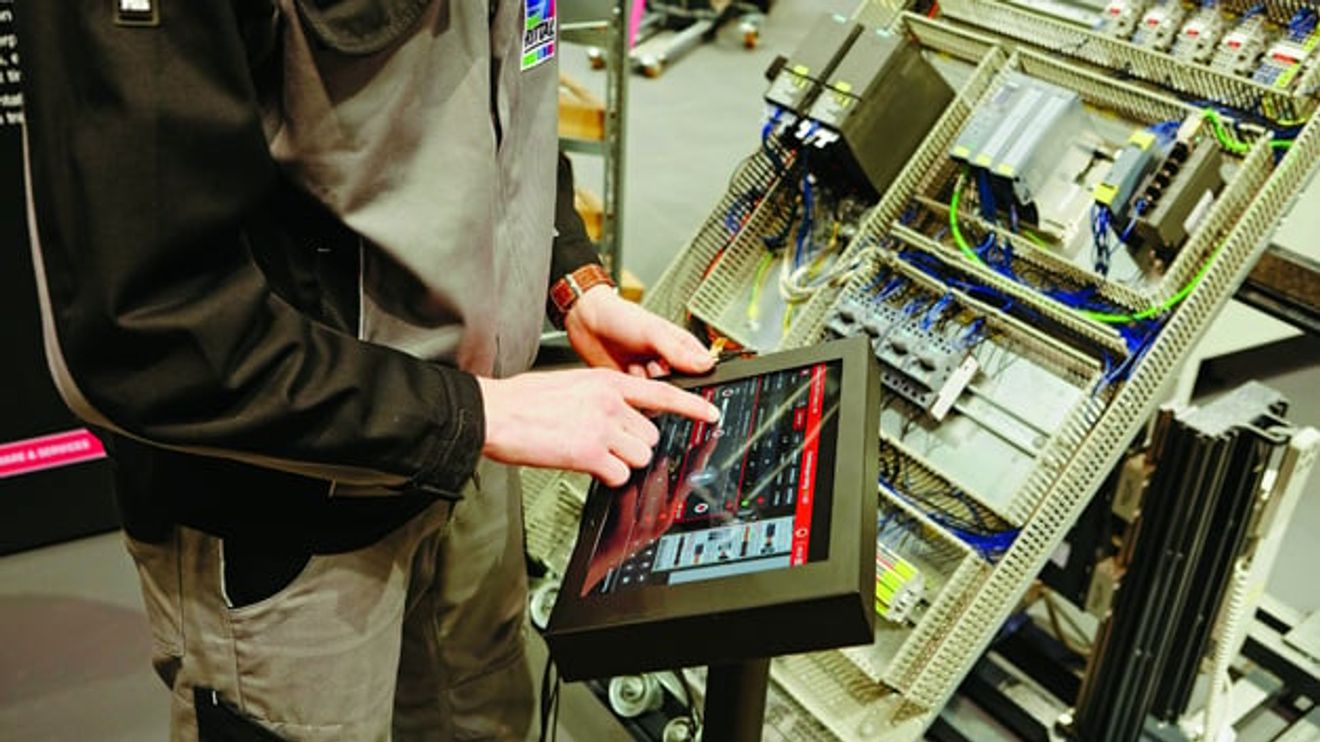
Whether you're looking for the right kitchen, creating a photo book or choosing the right car, it has never been easier to put together your own dream product. With just a few clicks, the online configurator lets you choose the color, features and delivery date. But what is taken for granted today was barely conceivable for years - especially in switchgear manufacturing. To select accessories for an enclosure or control cabinet, for example, plant engineers used to have to pore through thick catalogs and choose from thousands of components.
Although catalogs still dominate the ordering process today, things are now working differently in this area too, using a configurator. One example of this is the new 'Rittal Configuration System' (www.rittal.de/configuration-system), which can be used to plan small enclosures such as terminal boxes and compact enclosures from the AE series (from 200 mm × 300 mm × 120 mm up to 1000 mm × 1400 mm × 300 mm), including expansion.
The configurator works on the basis of electronically stored rules and regulations. Incorrect or unsuitable accessories are not even displayed. This ensures that no time is wasted on unproductive trial and error. However, the planning tool not only makes it easier to select individual components, it also places the selected accessories in the designated position using a 3D model. This is then reserved and blocked for other accessory components.
However, to ensure that both the necessary accessories and the required cut-outs and drill holes are taken into account, the system configurator provides for the creation of mechanical processing. Whether cut-outs, bolts or nuts - all mechanical processing options can be taken into account and displayed in the 3D model. In addition, with the new release of Eplan Pro Panel - version 2.6 - the data from the configurator can also be transferred directly to this ECAD software. There, they form the basis for the electromechanical planning of the control cabinet in 3D and the provision of comprehensive production documentation for the workshop.
In addition to selection, placement and processing, ordering of the selected items via an online store is integrated into the system configurator. Depending on the rights assigned, the user is either supplied with the standard components or an individual cabinet. If the former is the case, the configurator provides the associated CAD data, NC data and precise assembly instructions, which later help to install the individual parts in the right place. This increases quality and helps to avoid errors. The biggest advantage of the new planning tool: System builders do not have to laboriously describe their ideas to a sales contact and then wait for the corresponding quotation. Instead, they can design the enclosure and accessories themselves and use the online store to see at a glance what costs they will incur when ordering the items.

Smart wiring
The advancing digitalization in control and switchgear construction is also reflected in smart application solutions for wiring, which make work much easier even for non-specialists. Depending on the control cabinet application, up to 43% of working time in control cabinet construction is currently spent on wiring. This process is therefore very time-consuming and requires a great deal of specialist knowledge: What needs to be wired, how and in what form, and how are the required wires optimally laid? These are questions that often have to be answered in control technology using the circuit diagram.
As a result, highly qualified specialists pore over hundreds of pages of circuit diagrams and work through them page by page in the course of assembling and installing the wiring. The implementation is not always clear. This enormous amount of time could be used more productively. An alternative to this is the use of software-based wiring support such as 'Eplan Smart Wiring'. Whether source/destination description, connection point designation, cross-section, color, wire length, end treatment or exact installation routes: all the necessary wiring information as well as the engineering data of the assembly structure in the control cabinet are provided and visualized 100% digitally for production using this software. The digital representation references the 3D layout of the virtual model in Eplan Pro Panel.

Eplan Smart Wiring' provides step-by-step instructions for the wiring engineer based on the engineering data.
© RittalBut even without a 3D layout, the solution described can be used to increase productivity. For example, Excel lists with all the necessary connection information can be imported. Although the visualization of the installation routes and assembly steps is no longer possible without a 3D layout, the step-by-step processing and comparison of different connection lists for last-minute changes remain possible. The worker therefore has clear information at all times about how far the wiring has progressed overall, what still needs to be wired and what changes he needs to make if necessary.
A simple menu describes each individual connection. This information is supplemented by a visualization of the equipment, including connection points and the planned routing of the wires in the control cabinet. The software also provides information about the required diameter of a wire, the color to be used and the defined final treatment - crimped or ultrasonically welded, for example. It also shows exactly which wire belongs to a bundle. This means that every connection and every work step can be traced. As soon as a connection is completely wired, it is set to green using the traffic light principle. In the case of several work shifts, this is a considerable relief. The colleague can continue exactly where his predecessor left off in the wiring.
Last but not least, the software-based wiring support also comes into its own for last-minute changes. The changes are simply entered and updated in Eplan Pro Panel. Eplan Smart Wiring can then be used to compare both project statuses and the software documents all changes. This takes considerably less time than the manual process. The software displays all obsolete connections and all connections that are already wired but need to be removed, as well as additional connections. Gone are the days of searching and thinking about how a change will affect the entire wiring and production process.
Cooling via smartphone
A third solution that also benefits control and switchgear manufacturers is enclosure cooling units with smart communication interfaces. Several options are now available for communicating with higher-level systems. A new feature of the 'Blue e+' series from Rittal, for example, is an NFC (Near Field Communication) connection, which can be used to transfer the most important data using a smartphone. This option is ideal for transferring set-up data to a whole range of cooling units using the appropriate smartphone app. This makes setting up the appliances considerably easier and saves time.

A new feature of the Blue e+ range of cooling appliances is the NFC (Near Field Communication) connection, which allows the most important data to be transferred using a smartphone.
© RittalAt the same time, evaluations - for example from the temperature control - can be easily visualized and saved on a smartphone. A PC can be connected via the integrated USB interface, on which all data from the cooling unit can be displayed and evaluated in detail in the corresponding diagnostic software.
With an optional add-on module, which is expected to be launched on the market next year, real-time connection to a PLC, for example, is also possible. Standardized communication interfaces ensure simple integration into the control systems of production plants. In addition, various protocols, such as CAN, Modbus TCP or Ethernet/Profinet, allow data transfer in real time.
The networking of cooling appliances opens up new possibilities for condition monitoring and predictive maintenance for both operators and manufacturers. Especially with a large number of cooling appliances, it is important to be able to locate and organize them precisely (asset management). This allows the operator to use mobile condition monitoring and query the status of system cooling and appliances at any time. Networked cooling appliances will also significantly improve industrial maintenance in the future if the appliances are able to register necessary repairs or service calls proactively. This saves time during monitoring and also significantly increases the operational reliability of production. Rittal will therefore be equipping the 'Blue e+' cooling units with a new, secure communication module in future, which can be used to transfer data such as the temperature or the current device status to a cloud via common protocols such as OPC UA or SNMP.
Author: Hans-Robert Koch is Head of Product Communications and works in Corporate Communications at Rittal, Herborn.


You might also be interested in
The lubricant problem in food production
Lubricants for components used in food production machinery must be safe for human consumption. However, as these are very expensive, alternatives are in demand - for example in drive chains.
 read more...
IO-Link for the vacuum
To make electric vacuum generators, grippers or compact ejectors visible for the smart factory, they must supply digital energy and process data in real time. This works using interfaces such as IO-Link, Ethernet or NFC in the vacuum components.
read more...Integrated microchips
Whether medical devices, product tracking, vehicle systems or 5G communication - the demands on safety, performance, documentation and user-friendliness are increasing. What is the significance of microchips integrated into connectors or cable...
read more...RJ45 - fit for the IIoT
Industrial-grade RJ45 connectors are a good solution for applications without increased protection against dust, dirt or splash water. What must the data interface look like so that the 'dinosaur of data transmission' can serve industrial...
read more...Engineering with a digital twin
There is simply not enough time for time-consuming activities such as drawing up parts lists based on circuit diagrams in control cabinet construction. How can the process - from planning to installation to operation - be optimized?
read more...The effects of the F-Gas Regulation
Can refrigeration units and chillers still be used when the F-Gas Regulation on climate protection comes into force on January 1, 2020? What do the bans on the use of refrigeration and air conditioning systems and new regulations for their...
read more...Choosing the right heat sink
In order to equip a data center with high-speed modules for optical interfaces, AFCI was looking for a suitable solution for cooling the high-performance servers. Pin heat sinks were the solution.
read more...(Ethernet) cables put to the test
The dynamic requirements for cables and the associated energy chains are high. How must (Ethernet) cables be designed so that they can be safely routed in energy chains even under the highest bending stress?
read more...Predictive maintenance of cables subject to wear
A sophisticated concept is needed to be able to maintain cables subject to wear and tear in a predictive manner. Lapp is currently developing one for Ethernet cables that uses machine learning approaches, among other things.
read more...