
Control cabinet technology
Efficiency check for refrigerators
Once switch cabinets have been installed, they quickly fall out of sight of the system operator and maintenance work is often neglected. The opportunities offered by an efficiency and service check of cooling units are illustrated by an example from car manufacturer Ford.
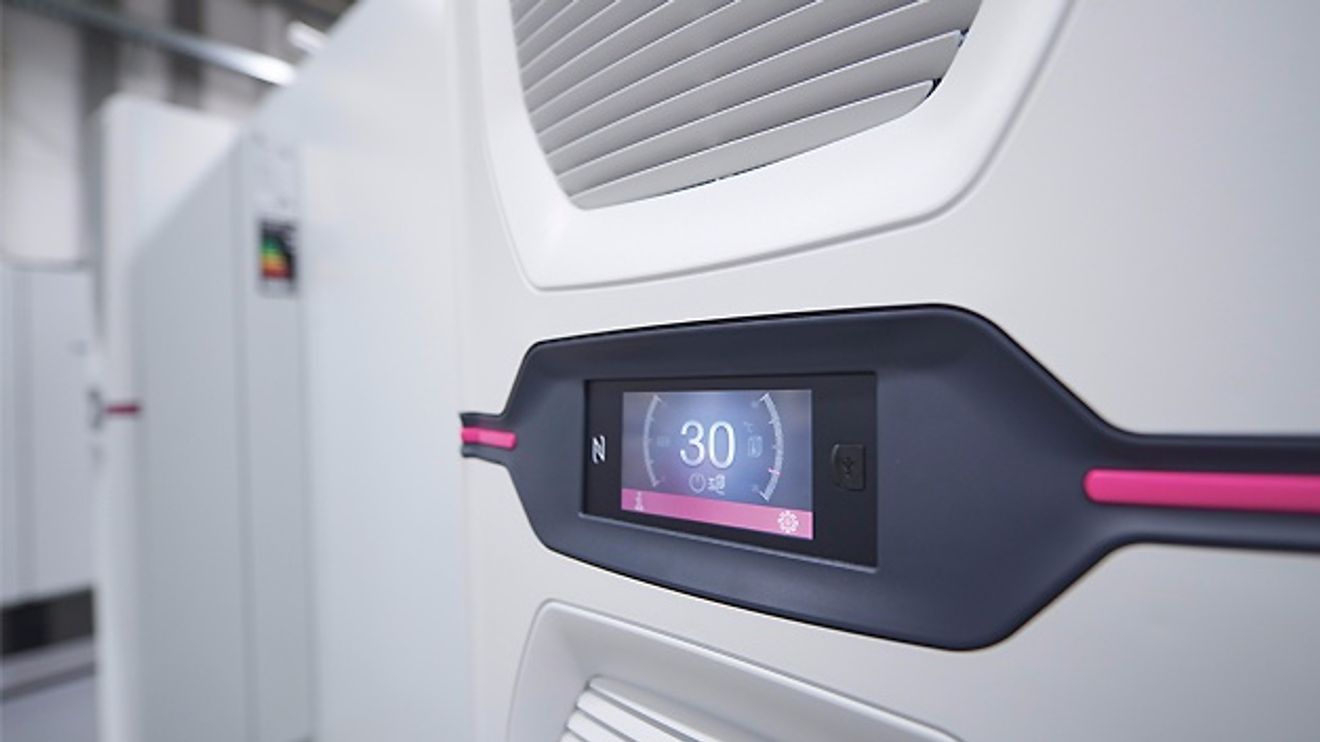
The incident: A cooling unit in engine production has failed. The result: the worst-case scenario of a 'production stoppage' occurs. It can take some time before the cooling unit is repaired. And time is money in this case. "In 2015 alone, we had a total of thirteen system downtimes due to defective cooling units," says Helmar Bencker, co-responsible for energy efficiency at Ford in Cologne, adding: "Of course, we have our own air conditioning technicians, but they don't wait for a system to break down on our premises." If they are working at other locations, they are therefore not available promptly.
Against this backdrop, those responsible at Ford found Rittal's offer to carry out an inventory of all cooling units and also look at potential energy savings to be a good idea. Two service technicians from the Herborn-based enclosure manufacturer then spent a week carrying out an efficiency check of the enclosure and machine cooling systems at the Cologne plant, inspecting the maintenance status of over 220 units from various manufacturers. They checked the cooling unit components for dirt, damage and bearing noises. They then drew up a maintenance checklist and formulated suggestions for improvement. "We also look at how processes can be optimized and give users one or two tips on possible savings. This does not mean that we necessarily recommend replacing the devices," emphasizes Andreas Karl, Head of Technical Processing at Rittal Service International, who was responsible for the service check at Ford together with his colleague Ralf Schneider.

Neglected cooling appliances? A service check of the entire cooling appliance infrastructure often reveals major maintenance requirements or even defects.
© RittalThe analysis at the Cologne production plant revealed that of over 220 installed cooling units, 25 - or 11%! - were defective and required repair or replacement. The majority of these defective appliances were products with an average age of just five years. The remaining ten defective devices included six devices between ten and 20 years old and only four devices from Rittal with an average age of 15 years.
Parallel to the service check, the Rittal team set up a practical test facility at the motor factory. From July 2016 onwards, a 2.6 kW cooling unit from Rittal's 'Blue e+' series was compared with a 2.5 kW cooling unit from another manufacturer. "The results so far show energy savings of 88.9% for the Blue e+ unit compared to the competitor's product," says Andreas Karl.
Based on the data collected, a comprehensive efficiency calculation was then carried out for the plant and the results presented at an international meeting of the 15 global Ford Engine Plant Managers at the beginning of November 2016. The main conclusion: by replacing 150 cooling units with 'Blue e' and 'Blue e+' appliances, energy savings of over 552,000 euros and 276.3 tons of CO2 can be achieved in Cologne over a useful life of ten years. After deducting the investment sum, the payback period is 2.42 years, which is significantly less than the 3.5 years required by Ford. This was a decisive argument for the plant managers present to examine the savings potential shown in Cologne for the plants in England and the USA as well.
For Ford, the topic of maintenance and analysis and the resulting replacement of old, defective systems with new, more energy-efficient cooling units is also a means of countering the cost pressure in the automotive industry: "If you look at the service life of a cooling unit, energy costs account for 48% of the costs on average, whereas only 28% is accounted for by the actual unit price. Investing in a more energy-efficient cooling unit is therefore a sensible decision in almost all cases," explains Karl. This also played into the hands of those responsible at Ford with regard to the ISO 50001 standard, which is intended to support the development of systematic energy management and according to which Ford is certified accordingly. Another plus point is that lower energy consumption also reduces CO2 emissions, which has a positive effect on climate protection.
Author:
Martina Pump is an editor at Muehlhausmoers in Cologne.
Cooling appliance data in the cloud
With the increasing communication capability of cooling appliances, the topic of the cloud is also within reach in the enclosure environment. For example, devices and chillers from Rittal's 'Blue e+' series can easily transfer important data with a smartphone via an NFC (Near Field Communication) connection. Thanks to a new Com module, the devices can now also communicate with any higher-level systems via OPC UA, Profinet, SMNP, Modbus RTU and CAN master. This enables new applications such as predictive maintenance and data analytics.
At the Hannover Messe in April, Rittal presented two example applications that demonstrate the possibilities offered by this new communication capability. The first use case shows the integration of the corresponding devices in Siemens MindSphere. This cloud-based, open IoT (Internet of Things) operating system can be used to develop your own Industry 4.0 applications. MindSphere can also be used to collect and analyse large volumes of data in a scalable manner in order to implement smart factory applications in the areas of predictive maintenance, energy data management or resource optimization. One example of this is predictive maintenance through targeted data analysis. In other words, by switching to demand-driven maintenance, costs can be reduced and availability increased at the same time compared to interval-driven maintenance.
The second use case showed the analysis of data on the cloud-based data analytics application IBM Watson IoT. The Watson architecture is designed to use learning systems to analyze the constantly growing volumes of data more precisely and find better answers to a wide range of questions. Such data analytics applications could make maintenance even more efficient in the future - along with higher machine availability and further reductions in maintenance costs. Last but not least, the new technologies are opening up new business models - such as smart maintenance contracts.
The cockpit for cooling units

In addition to the refrigeration circuit, the appliance cockpit also contains the electrical diagram. In the event of a system message, the component generating the message is displayed there directly.
© RittalWith the update to version 3, Rittal has completely revised its RiDiag software for the diagnosis and parameterization of cooling units. The software runs under Windows and can communicate with the cooling units either via USB or, in future, via a network. In general, all functions, displays and operating options provided by the control panel on the cooling unit are also available in the software. Any firmware updates can also be downloaded directly via RiDiag and installed on the controller of the cooling unit. A working Internet connection is required.
A special feature of the new version is the support for the user during maintenance and servicing. When the user moves the mouse over status or error messages, the software immediately displays a help text explaining how to rectify the error. The diagnostic data can also be sent directly to Rittal Service via a web form. If the user has specified the location of the cooling unit in the configuration, this works worldwide - i.e. the software forwards the request to the appropriate service branch.
Another new feature in version 3 is the efficiency cockpit. The measured values of all sensors in the cooling unit are displayed here and the user can visualize and evaluate all data accordingly. In addition to the temperatures, input voltages and currents at the motors can also be displayed. The display of the EER (Energy Efficiency Ratio) is particularly important for energy-efficient operation. Here the user can see the energy efficiency of the cooling unit under which ambient conditions and with which settings. In addition to the detailed refrigeration control diagram, the appliance cockpit also includes a display of the electrical diagram. In the event of a fault, the software also shows directly which component is defective. This saves time during servicing and increases availability.
RiDiag is suitable for all Blue e+ cooling appliances, cooling appliances with Comfort Controller and Blue e+ chillers.


You might also be interested in
Modular for mounting rail and wall mounting
The products in Polyrack's 'Railo' series are suitable for holding PCBs and Eurocards as well as for fitting individual electronics or backplanes, which can be inserted into the grooves provided in a stable and torsion-free manner.
 read more...
Protective camera housing with water cooling
Autovimation launches its first camera protection housing with an integrated water cooling circuit.
read more...Managing Board expanded
The Friedhelm Loh Group is aligning its group of companies for the future and is expanding its Executive Board to include Prof. Dr. Niko Mohr. He joins owner and CEO Prof. Dr. Friedhelm Loh and CFO Ralph Lindackers on the Executive Board.
read more...Outdoor-optimized wall-mounted control cabinets
With the 'Arca IEC' series, available in 17 housing sizes, Fibox offers solutions made of fiber-reinforced polycarbonate for indoor and outdoor use.
read more...First control cabinet made of green steel
The Siemens subsidiary Alpha Verteilertechnik claims to offer the first control cabinet for industry made entirely of green steel.
read more...Housing for Raspberry Pi 5
Fischer Elektronik offers the right housing for the Raspberry Pi 5. The housing consists of an upper and lower shell made of punched and bent 1.5 mm thick aluminum sheet.
read more...Megawatt cooling for AI using only water
The demand for computing power from AI and high-performance computing requires a modified IT infrastructure, as the power density in data centers is increasing rapidly. Cooling technologies are particularly affected.
read more...Heat forecasts thanks to temperature simulation
With 'Airtemp 2.0', practical heat forecasts can be created for control cabinets equipped with the 'Airstream' wiring systems from Lütze.
read more...Cooling switch cabinets as required
What to do when production facilities are 'getting on in years' and their retrofitting needs to meet both digitalization and sustainability requirements? A long-term project for temperature monitoring of control cabinets helped an automotive...
read more...