
Lapp
A guard for the data line
In the smart factory, predictive maintenance is an important tool for avoiding unplanned machine downtimes. In Ethernet-based networks, attention should always be paid to the data line.

Until now, most maintenance technicians have only had two alternatives: either they follow a reactive maintenance approach, in which parts are only replaced when the machine is already at a standstill, or they rely on the preventive maintenance approach, in which parts that are still functional are replaced at certain intervals as a precaution. Thanks to Industry 4.0 and digitalization, the third variant is the concept of predictive maintenance: it is based on sensor data that is recorded and evaluated during the process and allows conclusions to be drawn about the actual ageing of a part.
This is also possible for connection systems such as cables or connectors. Although cables usually last for many years, it is advantageous (and cost-saving) for highly dynamic, demanding movements with high speeds and strong torsion if the connection systems are also monitored.
The 'Etherline Guard' from Lapp, for example, can take on this task. This stationary monitoring device evaluates the current performance of a data line and displays it as a percentage. By providing important performance forecasts of a data line, the device contributes to the realization of a 'digital twin' within production plants - until now, lines were not considered in such models.
Sensor database
This is based on data that is determined from the physical properties of the data transmission via a sensor system. The real-time status display of the 'data line guard' makes it possible to detect the wear limit of a line and plan the optimum replacement time in advance. Lapp recommends the 'Etherline Guard' primarily for data lines in accordance with the 100BASE-TX transmission standard (up to 100 Mbit/s) as per IEEE 802.3, but also for Ethercat, Ethernet/IP and 2-pair Profinet applications. Examples are the 'Etherline Torsion Cat. 5' or 'Etherline PN Cat. 5 FD' cables, which are often part of drag chains or torsion cable guides, such as those found in robot arms. Movements with high speeds and accelerations, changing motion sequences, rotations with very high axial torsion angles, fast cycle times and small bending radii are the order of the day here.
Two compact variants
The 'Etherline Guard' is prepared for top-hat rail mounting and is designed for switch cabinet mounting with protection class IP20. It is slightly larger than a matchbox, is operated with 24 V(DC), works in the temperature range from -40 to +75 °C and is vibration and shock resistant in accordance with DIN EN 60529. An easy-to-use SET button is provided for calling up various functions, such as teach-in or activating the access point.

An external SMA antenna connection enables a secure radio link if the device is located in the control cabinet, for example - the antenna is then simply mounted outside. The cable status is based on a traffic light system. The indicator lights up green continuously when the cable is working perfectly and is within the specifications.
© LappThe device is plugged into a data line node between the critical application or the line to be monitored and the control side. For this purpose, it has a 'guard'/data port for the data line to be monitored with an RJ45 plug, which leads from the critical application to the device, and a DATA port for the data line with an RJ45 plug, which leads from the device to the controller. The maintenance data can be transmitted to a higher-level controller by connecting a third data line to the LAN socket or by using the antenna connection for WiFi. Both device variants can be configured for cloud communication with MQTT. An external SMA antenna connection enables a secure radio link if the device is located in the control cabinet, for example - the antenna is then simply mounted outside.
In addition to the usual LEDs on each RJ45 port, there are three centrally arranged multi-colored diagnostic LEDs on the device: PWR for operational readiness, STATUS for the status of the data line to be monitored and COM for Connect (LAN version) or WiFi (WiFi version). The concept is based on simple diagnostics and setting options on the device - if a user wants to access additional settings or function parameters or obtain information about the graphical history of the cable status, they can use the web interface of the 'monitor'. The settings for integrating the device into a control level via MQTT can also be found here.
Commissioning takes just a few minutes thanks to automated and self-learning parameterization (teach-in). It is started at the touch of a button or via the web interface. No brand-new data lines or changes to the cable design are required for the application. Retrofitting into an existing network structure is therefore possible at any time.
The cable status can be recognized by one of the LEDs visible all around. The type of display is based on a traffic light system. It lights up green continuously when the cable is working perfectly and is within the specifications. If the web interface reports the yellow area or the status LED flashes red, the first signs of wear have already occurred and there is a need for action. The cable should therefore at least be checked and replaced soon if necessary. If the LED lights up red continuously, the cable has reached the end of its service life and data transmission is now restricted at the latest.
Reliable IIoT communication
Lapp's patented predictive maintenance algorithms make it easy to detect irregularities in the analyzed data. The two digital outputs Q1 and Q2 enable the cable status to be output as a switching signal or as a PWM-modulated analog signal, whereby the alarm threshold for the switching output Q1 can be specified by the user. Both the LAN and WiFi versions can output the cable status via MQTT. The LAN version has a LAN RJ45 connection for this purpose, while the WiFi version communicates wirelessly. The data can also be read out using the access point, for example with a mobile device. All data can also be stored on a (micro) SD card for several years.
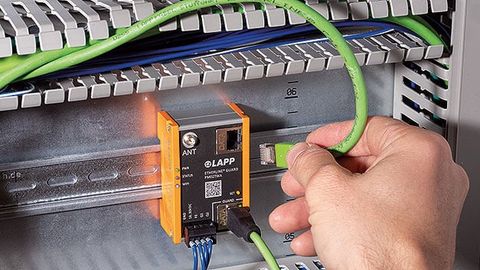
Lapp recommends the 'Etherline Guard' above all for data lines in accordance with the 100BASE-TX transmission standard (up to 100 Mbit/s) as per IEEE 802.3. The 'Etherline Guard' is only slightly larger than a matchbox.
© LappThe current performance of the data line is indicated as a percentage for both variants. The 'guard' continuously calculates the cable status and sounds an alarm if the performance or transmission properties of a cable deteriorate and a failure could be imminent. The alarm trigger threshold is set to 80% at the factory, but can be individually adjusted between 99% and 21%.
Findings from pilot projects
In the course of pilot projects, the development team at Lapp was able to gain some important new insights - for example with regard to the ageing process of Ethernet cables. Contrary to the general opinion that a wire break in the copper conductor causes the end of the service life of a dynamically moving data cable, it turned out that in most cases wear and tear and changes in the insulation layer are to blame for the deterioration of the transmission properties of data cables. The reason: it is not the copper but mainly the insulation that determines the propagation speed of electromagnetic waves.

The insulation layer is applied to the conductor in a three-stage extrusion process in which different functional layers are produced. With this high technical effort, a very low permittivity value can be achieved. To put it simply, the lower the permittivity (also known as dielectric conductivity), the less interference with the electrical field of the conductor and the higher the speed of an electromagnetic wave in a core. Polyethylene or polypropylene with low relative permittivity values are therefore used as insulating materials for data cables. Special processes such as 'foaming' are also used to introduce air pockets into the insulation material in order to further reduce the effective permittivity. If a data cable is subjected to permanent high mechanical and dynamic loads, this causes a change in the insulating layer. This results, for example, in a local change in capacitance, which in turn changes the local characteristic impedance of the cable. Undesirable reflection effects then occur at these interference points or unacceptable signal propagation time differences occur, which in turn reduces the data transmission properties. This effect occurs some time before the actual copper wire break.


You might also be interested in
Multiple introductions extended
Lapp is expanding its portfolio of 'Skintop Multi' multiple entries with two further sizes for the round version of the 'Skintop Multi-M' series.
 read more...
With a focus on electromechanics
The e-paper of issue 12/2021
Your opinion is needed at the end of the year: in issue 12, we present the nominees for the 'Products of the Year 2022' readers' poll. We also take a closer look at automated guided vehicles in our special Robotics&Automation section.
read more...High level of fire protection included
Lapp is expanding its portfolio of cables and wires with halogen-free plastic composition with two new products.
read more...Kontron Begins Production of 5G Modules in Düsseldorf
Kontron has launched mass production of 5G communication modules in Düsseldorf. The modules, which were developed in Berlin, are used in a variety of sectors, including industry, transportation, and critical infrastructure.
read more...Embedded module for CRA-compliant communication
With the 'comX 90' embedded module, Hilscher is expanding its industrial communication portfolio with a new generation of compact communication modules.
read more...Softing Industrial Automation takes over Delta Logic
Softing Industrial Automation has acquired 100% of the shares in Delta Logic Automatisierungstechnik in Schwäbisch Gmünd.
read more...Range of embedded communication interfaces expanded
HMS Networks is launching another version of the embedded communication interfaces 'Anybus CompactCom'. Anybus CompactCom B40 Mini' complements the 40 series with a communication interface that is optimized for automated production.
read more...Update brings support for TIA V19
Delta Logic has updated the 'Accon OPC UA Server' software to version 1.4.0.0. The new features include support for TIA Portal projects of version V19 and for the latest firmware for CPUs of the Siemens S7-1200 and S7-1500 controllers.
read more...The e-paper for the special issue
Communication & networking 09/24
Communication and networking form the backbone of industrial automation. It enables flexible production processes and creates the basis for innovations and new business models. The news is now available in this e-paper.
read more...