
SEW-Eurodrive
The influence of the Ecodesign Directive
The EU's Ecodesign Directive, the first environmental package in legislation, was adopted 15 years ago. This affects many areas of energy conversion. It has had and continues to have a major impact on industry - particularly in drive technology.
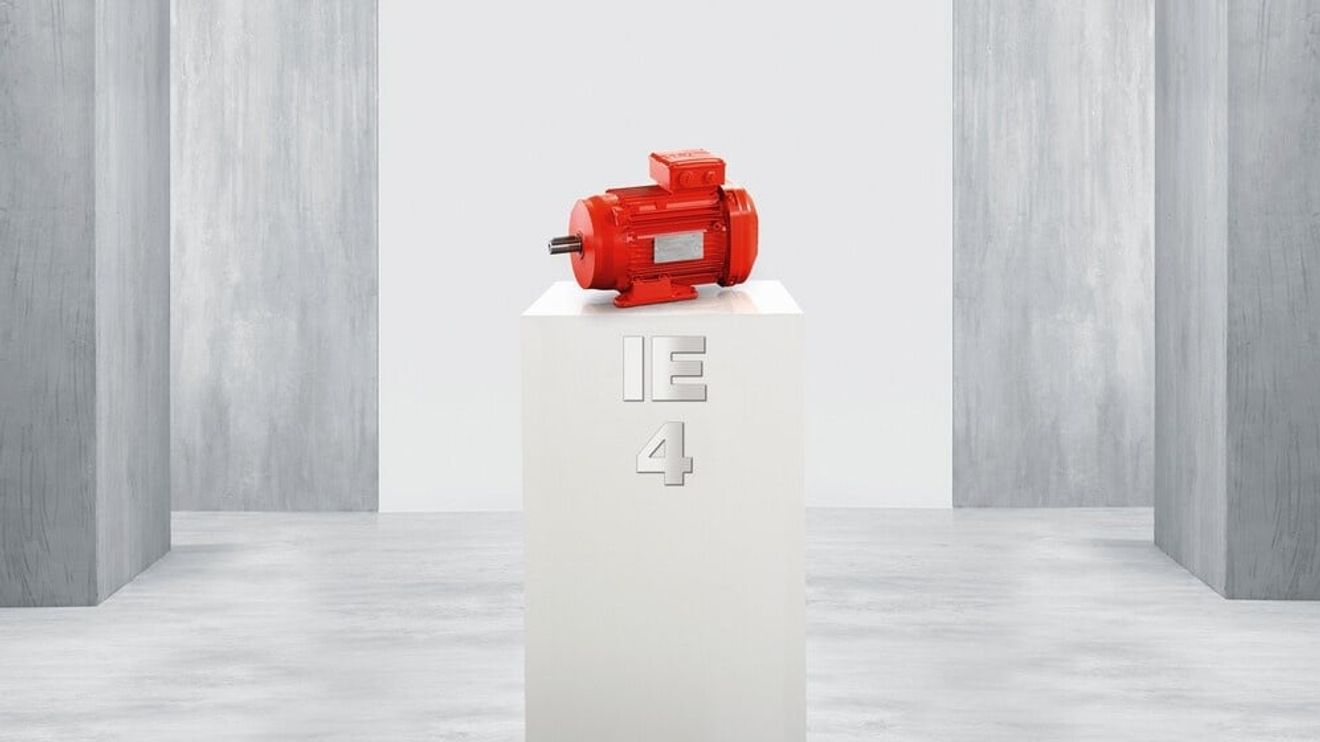
New mains motor with energy efficiency class IE4: The DRU.. series completes the modular system of mains motors with the maximum class IE4 defined in the standard.
© SEW-EurodriveThe conversion of one type of energy into another is always lossy. The proportion of energy lost must be paid for, but does not contribute to the usable result. Since the construction of the first electric motors around 1880, the development goal for new designs has always been the efficient use of materials for price reasons. In order to compete successfully, cost-cutting programs were a recurring cycle for manufacturing companies. Despite the same output power, engineers and technicians repeatedly found ways to build electric motors with less but better material. The further development of available components, for example higher sheet metal quality and lower sheet metal thickness, advanced calculation and simulation methods and modified manufacturing processes were also always helpful.
Efficiency becomes a criterion
Around the turn of the millennium, there was a significant change in attitude. In addition to the monetary influence of the amount of material, energy efficiency increasingly took center stage. The rediscovery of the efficiency of electric motors as a decision-making criterion posed enormous challenges for manufacturing companies. It quickly became clear that higher efficiency and the use of appropriate materials went hand in hand with a higher sales price. In the ten years that followed, the consideration of energy efficiency was left to the forces in the European market on a voluntary basis. However, the legislator was not satisfied with the proportion of voluntary users. The economic framework conditions prevented the large-scale success and sales of motors with increased efficiency.
In order to ensure fair competition with comparable products, the industry drew up and adopted standards with efficiency classes IE1 to IE4 for the operation of electric motors on the grid. These were respected by European legislators and in 2009 Europe passed the first law specifying the minimum efficiency of electric motors. In Regulation 640/2009/EC, not only one level was specified, but a staggered increase in minimum efficiency over time. Furthermore, a power range was specified for the motors concerned.
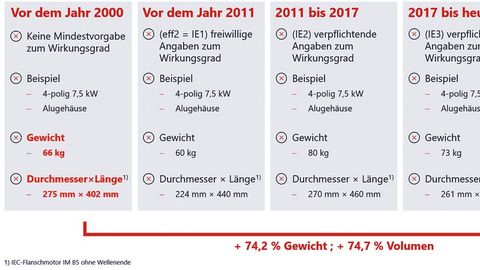
New efficiency level, more volume: Using the example of a four-pole 7.5 kW three-phase AC motor for mains operation, the table shows how the volume of the motor increases with each efficiency level. (1) IEC flange motor IM B5 without shaft end
© SEW-EurodriveThe variety of electric motor solutions already implemented led to a limited number of exemptions in the law, including brake motors, explosion-proof or unventilated motors. The legislator took it upon itself to continue the further development of materials and processes and in 2011 called on the industry to offer products with the minimum efficiency level IE2. After this came into force, the industry was given a six-year window to complete the design change to IE3 and only offer motors with this efficiency. However, the EU was not satisfied with what was achieved in 2017: the law was amended and extended in 2019. In addition to reducing exemptions and thus setting minimum limit values for other motors, a further increase in efficiency to IE4 level was specified for a small number of motor outputs. The reduction and expansion of exemptions took place on July 1, 2021. The final stage with the IE4 level for 75 to 200 kW of the current law came into force on July 1, 2023.
Statutory efficiency requirements
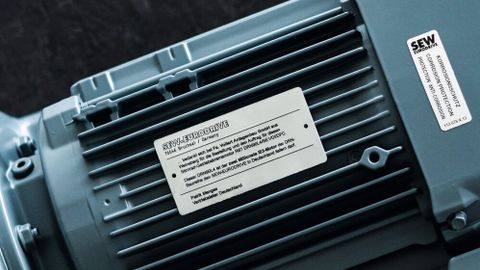
In spring 2023, SEW-Eurodrive delivered the two millionth DRN... motor to a customer in Germany - there are already ten million worldwide. They ensure a significant reduction in the primary electrical energy required.
© SEW-EurodriveIf you look at the development of the last ten to 15 years side by side, it becomes clear that the idea of efficiency dominates the design process and has become secondary to the amount of material used. This means that the motor has grown in size for the same output, which poses a challenge when installing it in machines and systems. Using the example of a 7.5 kW electric motor for IE4 (voluntary in terms of output, not a law, see table), it can be seen that the construction volume, i.e. the size of the motor, has increased by almost 75% and its mass, i.e. the amount of material used, has also increased by almost 75%. The legislator specifies the minimum efficiency and leaves the realization to the manufacturing companies and market forces to achieve the necessary price and economic profitability. Isolated national support measures for the benefit of the economy are just a drop in the ocean.
Three under one roof: sustainability, recycling, energy

The author: Gregor Dietz is market manager for motors and geared motors at SEW-Eurodrive.
© SEW-EurodriveA look back helps to classify the outlook for the future. In addition to energy efficiency, two other aspects now come into play: Sustainability and circular efficiency are now flanking the topic of energy. Here, the European legislator is directly focusing on a regulatory variant and will determine specifications and limit values for products by the mid-2020s. From then on, it will be difficult to reconcile opposing trends: Material efficiency could stand in the way of energy efficiency, and circular components could counteract the demand for technically safe and high-quality products. If we leave the European focus and look around the world, we can see what further and other requirements need to be met in individual countries. The tasks and hurdles are not diminishing, and more will be added. Some of these are already visible and tangible. But here too, the industry and the talented people working there will find a solution.
Reading tip: You can find an application example of energy-efficient motors in logistics here


You might also be interested in
Innomotics launches as a Siemens subsidiary
Siemens is bundling its range of motor and large drive systems under the name Innomotics. The company was launched in Germany on July 1, 2023 as a wholly owned Siemens subsidiary.
 read more...
Drive technology - The winners
In the drive technology category, the winners impressed with their energy efficiency, integrated torque sensor and safety functions, among other things.
read more...Space-saving rotor position encoder for confined installation situations
For applications where the installation space in electric drives is extremely limited, Lenord+Bauer offers an inductive rotor position sensor for detecting pole position, angle and speed with extremely small dimensions.
read more...Bearingless, flexibly configurable encoder
Baumer is opening up new possibilities in drive technology with its 'LowHarmonics' encoder technology. The first product with this signal processing is the compact incremental magnetic ring encoder 'EB260'.
read more...Encoder offers multiturn absolute value position
Kollmorgen launches the 'SFD-M' (Smart Feedback Device, Multi-Turn). It provides machine builders with high-resolution multi-turn feedback with absolute position information that is available at system startup.
read more...VDMA large-scale plant engineering
New board elected
The VDMA Large Industrial Plant Manufacturers' Association (AGAB) has a new Executive Board. Jürgen Nowicki, CEO Linde Engineering, was re-elected as Chairman at the members' meeting on September 30 in Darmstadt. He has held this honorary position...
read more...Changes to the Executive Board
At its meeting on September 26, Schaeffler's Supervisory Board made two appointments to the Executive Board. There is also another change in the Executive Board. As a result, the Executive Board will consist of nine members from October 1, 2024...
read more...Sales growth in the first half of the year
Schaeffler increased its revenue by 2% excluding the impact of currency translation in the first half of 2024. This growth is primarily attributable to the Automotive divisions. The Industrial business had an offsetting effect.
read more...Relieving the load on large gearboxes with a new control strategy
The IMA at the University of Stuttgart has developed a new monitoring and control system that detects damage to large gearboxes and provides relief without affecting the overall performance of the system. Unscheduled maintenance is reduced.
read more...