
Decentralized drive technology
Reduce material and installation costs
The more compact the power electronics in drive technology become, the more significant the cabling and installation costs become. The question is therefore: How can we achieve flexible and quickly installed machines with as little material and effort as possible?
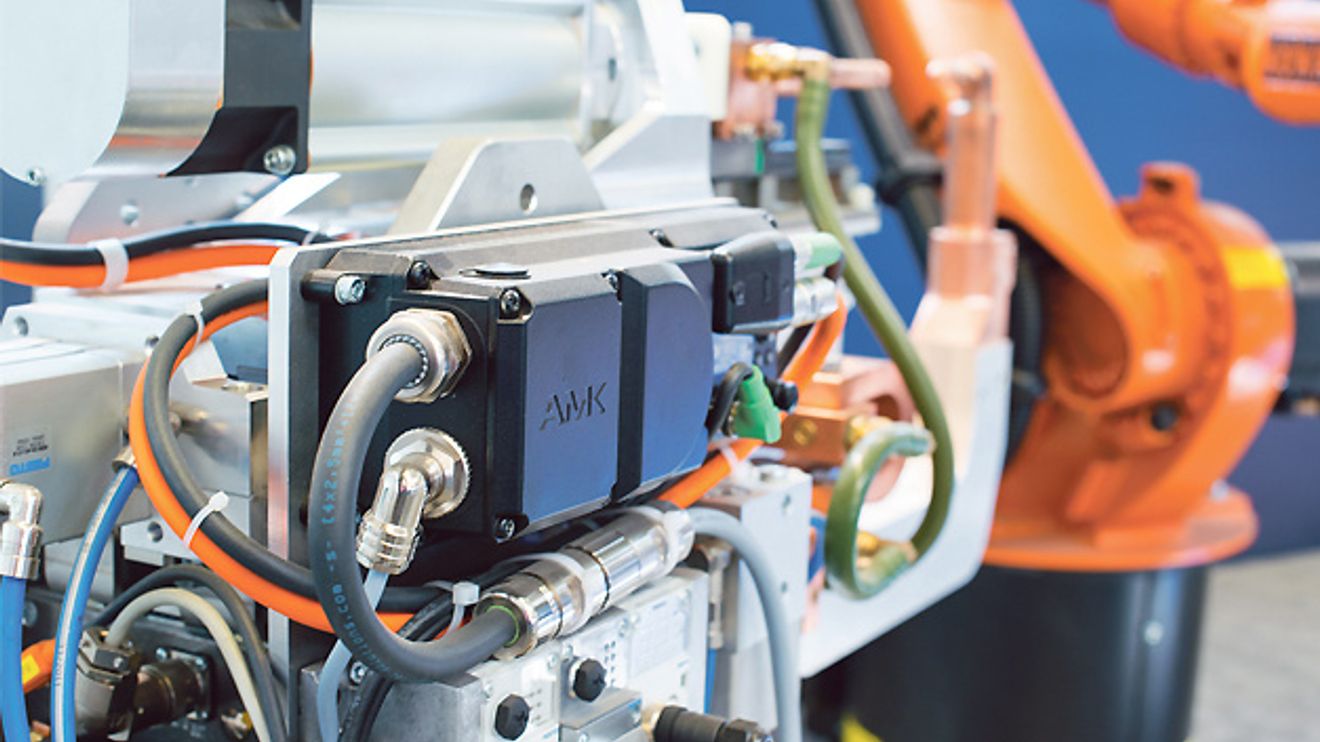

Decentralized drive technology offers enormous savings potential: on the one hand, the cable length is massively reduced and, on the other, installation costs are lowered, while a number of expensive plugs are also eliminated.
© AMKThe sizes of the power electronics used in modern drives have shrunk massively in recent years. As a result, cables and connectors have become disproportionately expensive, especially for low-power inverters (<5 kW). If you look at current standard machines with central drives, the wiring is star-shaped from the inverters in the control cabinet to the motors in the machine. What this means in concrete terms for the wiring can be explained using the example of a packaging machine with six axes, of which the first axis is four meters away from the control cabinet and each additional axis is two meters further away.
The motors of the packaging machine must be supplied with both power and the corresponding encoder cable from the control cabinet. This involves a considerable cable length of 108 m in total. Added to this is the time required not only for installation, but also for subsequent maintenance. And last but not least, a lot of cabling always means many possible sources of error. In short, this type of application clearly offers great potential for savings and improvements. But how can a significant cost reduction be achieved in concrete terms?
The single-cable solution
The first logical approach would certainly be to reduce the number of cables used overall. Thanks to the encoder systems now available, which enable the transmission of position signals and power in one cable, the single-cable solution is now a tried and tested technology in mechanical engineering. Here, two cables - one each for power and the encoder signal - are reduced to one cable. And this halving not only saves cable and connector costs, but also the corresponding installation work.
In the example machine from the packaging industry, this approach would reduce the cable length from 108 to 54 m and halve the number of connectors. However, these savings also come at a price: higher hardware costs for the special encoder can quickly neutralize the savings in cabling. This is why single-cable technology is certainly a tried and tested approach for machines where a single drive is located far away from the center of the machine. Other machines, however, require alternative approaches.
Decentralized drive technology

Not only is the cable length reduced: the decentralized approach also significantly reduces the number of cables that are looped through the machine.
© AMKOnly a decentralized arrangement of the power electronics within the machine leads to significant savings in cabling. This approach is primarily based on the long-term trend towards modular machine construction. For independent, flexibly combinable individual modules, it must first and foremost be possible to flexibly network and control the increasing number of servo drives. This changes the cabling architecture: if the servo controllers are placed close to the motor in the machine, the motor cables (power cables and encoder cables) no longer have to be pulled centrally from the control cabinet to each drive. Instead, only the power and real-time Ethernet cables need to be looped through from one servo controller to the next. The motor cables are therefore very short.
On a machine with several axes, this quickly adds up to several meters that can be saved. To stay with our example of the six-axis packaging machine, only around 32 m of cable would be required, assuming a cable length of around 30 cm between the servo controller close to the motor and the servo motor. The cable saving would be around 70 %. And with every cable that is not present, the corresponding installation costs are also eliminated.
Inverter-integrated motors

An example of decentralized drive technology: The compact ihXT series from AMK, consisting of a servomotor with inverter, relies on a simple and cost-effective cabling concept with plug-in terminals.
© AMKDepending on the requirements of the machine, different drives can be used in a decentralized arrangement. In addition to the variant described above with servo controllers positioned close to the motor, it is also possible to use inverter-integrated motors. The structural unit of servo motor and servo inverter also eliminates the two motor cables for the encoder signal and power transmission. The amount of cable in the packaging machine would therefore be reduced by almost four meters. The savings effect is particularly noticeable in the omitted plugs. However, the requirements placed on the decentralized drives are not insignificant: in everyday production, the robustness of the devices in terms of shock and vibration resistance is at least as important as their IP65 protection rating.
In the case of AMK's decentralized drives, for example, they are equipped with separate cable routing for the DC link and real-time Ethernet communication. The next obvious step would be to combine these two lines into one cable. This would mean that only one cable would be looped from one decentralized servo controller to the next. However, the high requirements for the degree of protection mean that the connectors used for these hybrid cables are often relatively large and relatively expensive - after all, the hybrid connectors usually used have to fulfil two functions: the electrical connection and the high degree of protection for decentralized use.
With this in mind, AMK decided to equip its new decentralized 'AMKASmart ihXT' series with a comparatively simple, cost-effective solution: With this drive, the electrical connection is made via a cost-effective plug-in terminal. The drive housing is responsible for the high degree of protection (IP65). The hybrid cable is pre-assembled with the plug-in terminals and reduces installation costs on the machine. The result is an extremely compact drive unit with a lean and cost-effective cabling concept.
To come back to our example machine: With a total cable length of just 14 m, a maximum saving of 84% can be achieved in the area of cabling alone by using the ihXT series. The combination of a new type of cabling with the aforementioned plug-in terminal in conjunction with the principle of decentralized drive technology results in a number of advantages:
- Control cabinets shrink or can be eliminated altogether;
- Lower cable costs,
- minimal cabling effort,
- sources of error during machine installation are reduced;
- Minimal maintenance effort,
- Modular design increases flexibility for machine builders;
- time-to-market is shortened and
- Protective design in IP65 realized.
Author:
Jürgen Rapp is Product Manager at AMK.


You might also be interested in
The future of CANopen
Similar to the automotive industry, industrial automation also requires more and more bus bandwidth. In addition, the cloud is becoming increasingly important in terms of communication. How does the CAN protocol, which has long been established in...
 read more...
Unauthorized access fended off
Plant modernizations often require new safety precautions. This was also the case for a manufacturer of cleaning agents and disinfectants, who had to safeguard the material flow in the area of a roller shutter door, among other things.
read more...WLAN in the factory - the selection criteria
WLAN is suitable for various applications in the factory. However, due to the many influencing factors, it is not always obvious how a network based on the IEEE 802.11 standard can be optimized to meet the requirements of industrial use. - Here is...
read more...Compact controls and drives a must
Smart factories promise operators a high degree of flexibility - for example through the use of driverless transport systems or mobile robot solutions. The automation of these subsystems in turn requires extremely compact control and drive concepts.
read more...Simply integrate safety
Machine and system manufacturers are increasingly turning to mapping safety functions via the communication bus. How can integration on the component side be achieved with reasonable effort?
read more...Flexible buffering via software
The complete automation of manual or semi-automatic processes is a major challenge with very short cycle times. When it comes to workpiece carrier transport, the machine manufacturer Goldfuß relies on a system that allows the creation of flexible...
read more...Individual IoT systems
How big? How much power? How robust? Which housing? The requirements for IoT systems are extremely varied. By designing individual embedded applications, devices can be created that are perfectly tailored to the application.
read more...A digital image
The digital twin accompanies machines and systems throughout their life - from the initial idea to ongoing operation and a look into the future. The aim is to avoid errors, optimize systems and prevent failures.
read more...Stumbling blocks with direct current
The question "direct current or alternating current?" is becoming increasingly important - not least due to the increasing use of renewable energy sources that generate direct current. When switching and protecting with direct current, however,...
read more...