
Hyperloop Pod Competition / TU Munich
Hoping for 600 kilometers per hour
In the Hyperloop, people are supposed to travel at almost the speed of sound. To drive this forward, Elon Musk has launched the 'Hyperloop Pod Competition'. The TU Munich won twice. Now the third pod is about to take off. Team leader Gabriele Semino explains what sets it apart.
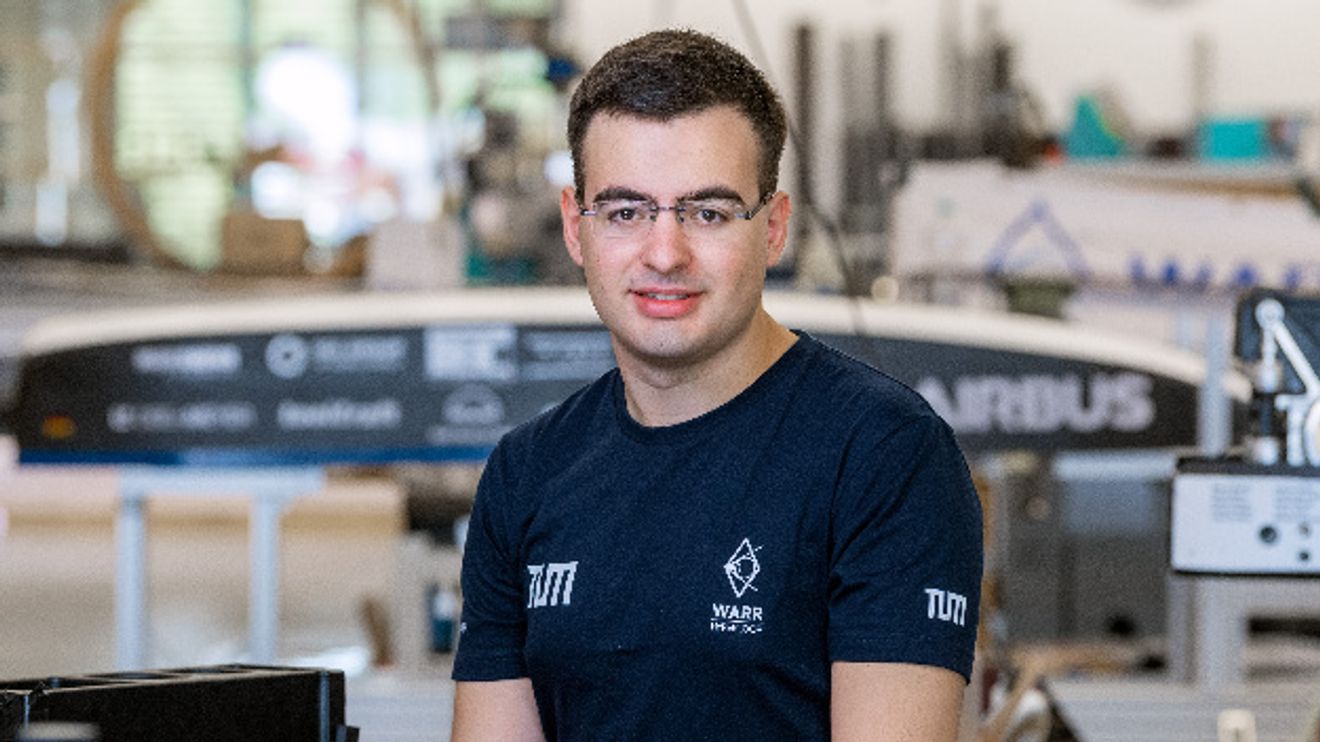
Mr. Semino, how much pressure is there to succeed after the victories in the first two competitions?
Gabriele Semino: We from the 'WARR Hyperloop' team take it sportingly. Of course, expectations are very high. We also want to be better than the competition this year. But this pressure doesn't lead to stress in the team, it increases our motivation.
You were already there last year. What motivated you to sacrifice another year of your free time for the Hyperloop project?
The project is indeed very time-consuming. But it's simply fun. What's more, you learn things that you don't learn in your normal studies: Project management, for example, or working with colleagues from other disciplines. I'm a physicist myself, but we also have a lot of mechanical engineers, electrical engineers, computer scientists and business economists in the team. More than 40 students in total. Only if everyone contributes their knowledge can we realize a pod that has a chance of winning.
Is this collaboration across disciplines the secret of success?
The fact that there are students from many different disciplines in the team is of course a great advantage, as everyone brings their own expertise from their studies to the table. However, our "secret" is primarily that many people in the team decide to invest a lot of time in the project. Building a capsule like this is very time-consuming and it wouldn't work if many people weren't working on it full-time despite their studies.
What have you done differently this year compared to last year?
The requirements of the competition are different: this year, all pods that travel through the tube on the test track in Los Angeles must have their own propulsion system - in previous years, this was optional and you could also use SpaceX technology. But we already had a motor in 2017. This allowed us to further develop our concept in principle. However, we have significantly revised and optimized the design and the drive.
What were the challenges?
We had to save weight and increase the engine power at the same time. We achieved this by manufacturing the new model from lightweight carbon fiber composites. We also replaced the 50 kilowatt electric motor from the previous year with eight small motors, each of which drives one wheel. This has increased the power output to 240 KW, or 320 hp. At less than two metres long, the new pod is shorter than its predecessor and has an aerodynamically optimized shape.
Where was the new pod built?
Like its predecessors, the new pod was built in the MakerSpace at UnternehmerTUM in Garching. In addition, many parts of the vehicle were manufactured by external partners. The collaboration with experts from the industry helped us a lot to improve the performance of the pod.
How fast is the third pod?
We will only really see that on the test track. So far, we have only carried out simulations and tests on the test stand. But we are hoping for up to 600 kilometers per hour.
That sounds fast, but it's still a long way from Elon Musk's goal of transporting passengers in the Hyperloop at 1200 kilometers per hour.
This goal cannot be achieved on the test track. The tube in front of the SpaceX building in Los Angeles is only 1.2 kilometers long. Over this distance, the pod has to accelerate to full speed and brake again. This is a huge challenge: our capsule accelerates five times faster than an airplane during take-off. This creates forces that no passenger would be expected to withstand.
With a length of almost 2 m and a height of just under 30 cm, the pod is also far too small for transporting passengers. Is the technology you have developed also suitable for building large passenger cabins?
Not without further ado. The technology is still in the development phase and our prototypes are initially being built with the aim of testing technologies. However, we can contribute to realizing the vision of a hyperloop one day. For this reason, we decided this year to build another prototype in addition to the pod for the competition. We wanted to use it to focus on hovering systems and smooth propulsion systems, which we believe will be of great importance for the competition and for the further development of Hyperloop technology in the future.
What else is there to win apart from congratulations?
A trophy. We already have two of them - 3D-printed models of the tube with a pod, signed by Elon Musk himself. We have them in our office. I hope we can add a third one soon.


You might also be interested in
Surfboard with battery and water jet drive
The electric surfboard 'Rävik' reaches a top speed of up to 56 km/h. It was developed by the Swedish company Awake Boards.
 read more...
'Hyperloop Pod Competition' 2018
Through the vacuum tube at 467 km/h
Traveling at almost the speed of sound with the Hyperloop superfast train - to make this vision a reality, SpaceX founder Elon Musk has launched the 'Hyperloop Pod Competition': the design by the team from the Technical University of Munich won for...
read more...Self-propelled transport vehicle
Lidl tests autonomous and electric T-Pod
Lidl is planning to test the self-driving T-Pod e-transporter from Swedish company Einride. The project is due to start in Halmstad (Sweden) in fall 2018. The T-Pod can carry 15 pallets and weighs around 20 tons when loaded - with a range of up to...
read more...Hyperloop Pod Competition from SpaceX
The fastest pod comes from Munich
The pod of the WARR Hyperloop Team of the Technical University of Munich almost reached the speed of sound at the final of the Hyperloop Pod Competition in Los Angeles.
read more...MTCON and Sensor-Technik Wiedemann combine expertise
MTConnectivity power2pcb (MTCON) has a new shareholder: Sensor-Technik Wiedemann (STW) has held a stake in the power element manufacturer since the end of 2019.
read more...Electromobility / green electricity
Intelligent charging saves fossil fuels
Charging electric cars can overload the electricity grid and lead to fossil fuel power plants having to step in. This is unnecessary and leads to high costs for grid operators. BMW and Tennet want to change this.
read more...Service robotics at Conrad Electronic
Sales robots in use around the clock
To provide its customers with a 24/7 shopping experience in Berlin Schöneberg, Conrad Electronic has now deployed a sales robot. The robot 'Alex' is designed to provide a high-tech shopping experience. It comes from the manufacturer pi4_robotics.
read more...Ridesharing field test in Paris
Renault tests Zoe as a robo-taxi
Renault launches a ridesharing field trial in Paris with two autonomous Zoe robo-taxis. The two prototypes have been specially modified. In addition to the technology for automated driving, they have a modified interior with multimedia and on-board...
read more...Robots for the hospital of the future
ABB has opened its first global Health Care Hub dedicated specifically to healthcare research on the campus of the Texas Medical Center (TMC) in Houston, Texas. A number of technology concepts were presented at the opening, including a mobile YuMi...
read more...