

SEW-Eurodrive
Control method for three-phase drives
Many control methods have been developed for three-phase motors, for which there are numerous terms. In order to bring clarity to the variety of terms and abbreviations, this article highlights basic properties using the Movi-C frequency inverter as an example.

The compact Movitrac advanced all-round inverter can control synchronous and asynchronous three-phase AC motors (pictured: DRN.. motor) with and without encoders. It is particularly suitable for conveyor and motion applications.
© SEW-EurodriveUntil the 1970s, the DC motor was practically the only way to continuously control speed and torque in industrial applications. From a control point of view, it is actually the ideal drive - if it weren't for the mechanical commutator. This makes the classic DC motor susceptible to wear, which in turn results in service costs. In contrast, the asynchronous motor is much more robust and practically maintenance-free. But it was nowhere near as easy to regulate. Especially when (three-phase) control technology and power electronics were still in their infancy. Today, controlled and regulated three-phase drives are indispensable. They continue to show the highest growth rates within electrical drive technology.
Adjusting voltage and frequency - simple (and) ingenious
Uncomplicated applications such as pumps, fans or simple conveyor technology are the domain of inverters with voltage/frequency control. It is the traditional method for driving three-phase motors with medium dynamics. Its core idea is the proportional adjustment of voltage and frequency. In this way, the flux in the machine remains constant and the maximum torque is maintained (Fig. 1). Because the nominal flux develops the highest torque per kilogram of machine, the raw materials used (steel, copper, insulating materials) are utilized most effectively. From the motor's point of view, the controlled inverter appears to be an 'adjustable socket' with regard to the mains voltage and frequency. For this reason, several smaller motors can be operated simultaneously on one inverter with this variant. Thanks to their simple principle and easy handling, frequency inverters with V/f control are ready for use after a short time. It has therefore established itself as the standard method without speed feedback for simple applications. This is why the V/f method has also been incorporated into all devices of the current Movi-C inverter platform.
This applies to the Movidrive application inverters - single-axis and multi-axis systems with single and double-axis modules - as well as the compact all-round inverter Movitrac advanced. They offer up to 250 % overload capacity for dynamic movements. Both as single-axis application inverters and in the modular version, the inverter technology from SEW-Eurodrive controls and monitors all motor types, synchronous and asynchronous three-phase motors with and without encoders, as well as asynchronous motors with LSPM technology or synchronous and asynchronous linear motors.
Field orientation for optimum operating behavior
If a simple speed adjustment is not sufficient for the drive task because high dynamics or a high torque are required, field-oriented control can be considered. This method, which was invented at the end of the 1960s, is based on the knowledge that the magnetic field in the air gap and the rotor geometry determine the operating behavior of the asynchronous machine. Its torque is proportional to the current and therefore to the magnetic flux. Because every change in the energy stored in a magnetic field requires time, the fastest torque control behaviour is obtained if the flux is kept constant via the magnetizing current in the base speed range, irrespective of the speed, and only the torque-forming current is changed. The flux constancy requires a constant excitation current. And to achieve the maximum torque, the angle between torque and magnetic flux must be 90°. This applies equally to DC and three-phase motors.
Equivalent circuit diagram simplifies control
To simplify calculations with complex expressions of the form ej2/3, a three-phase system with three windings offset by 120° (a, b and c) can be represented by a two-phase, orthogonal equivalent circuit diagram with α and β coordinates (Figure 2). In this way, the stator current (vector) IS rotating in the motor can be broken down into its components Iα and Iβ. If it is converted into field coordinates in relation to the rotating field, it can be split into the components Id and Iq, also known as the D(irect) and Q(uer) axes (Fig. 3). They are stationary in relation to the rotating system - similar to the riders on a merry-go-round. It can be shown that Id (in the direction of flow) corresponds to the excitation current of the DC machine and Iq (orthogonal to it) to the moment-forming armature current. If Id can be kept constant and Iq can be varied according to the desired torque, an asynchronous motor can be controlled just as well as a separately excited DC motor. Now you still need information about the position of the field in the motor, i.e. the angle of rotation δ. This can be used to calculate Id and Iq from the stator coordinates Iα and Iβ. This allows the field to be influenced indirectly via the terminal sizes, i.e. the stator current.
There is no direct access to the field coordinates inside the motor. Technical solutions in this direction, for example the installation of additional measuring windings, would be complex and uneconomical. They would also undermine the major advantage of asynchronous motors (ASM) - their simple and robust design. A rotary encoder is therefore (initially) absolutely essential for field-oriented control methods.
Current-guided flux control
In principle, it should be noted that operation with an encoder is the most accurate for all control methods. Especially in typical servo applications with high demands on speed stability, dynamics and peak torque, for example in packaging and filling machines, winders and handling applications such as gantries or robots, the use of a rotary encoder is absolutely essential. In the Movi-C generation of devices, the current-controlled flux control method CFC has a particularly high control quality and enables precise positioning. The V/f, VFCPLUS and ELSM methods, on the other hand, do not require information about the rotor position from an encoder system.
It also works without speed measurement
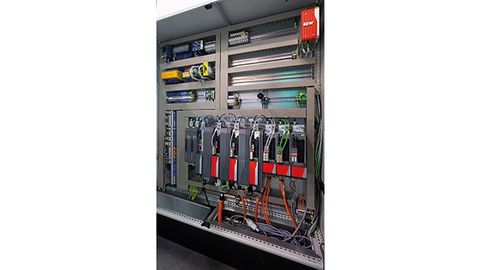
The compact 'Movidrive modular' multi-axis system consists of supply modules, regenerative modules and single-axis and double-axis modules. The power supply unit and drive controller are located in the control cabinet of the XYZ gantry, along with a storage unit for the intermediate buffering of released energy.
© SEW-EurodriveBecause the cost of a rotary encoder means additional work for the user, the demand for simpler solutions was the logical consequence. There were ideas to replace the angle measurement with a model-based calculation. Despite many approaches to sensorless speed determination, most of them initially showed poor performance - at low speeds and at standstill - due to the principle involved. Later, however, improved methods made sensorless operation possible for most industrial applications. SEW-Eurodrive developed the VFC (Voltage Flux Control) method for dynamically and precisely controlled three-phase drives with high speed stability.
The method was further developed in the Movi-C generation of inverters and resulted in the VFCPLUS method. By calculating additional parameters, this offers the possibility of controlling not only the speed control but also the torque relatively precisely and even without an encoder. This means, for example, that winding applications where material has to be kept under tension can also be carried out without an encoder. In addition, current flow optimization has been implemented to ensure that the ASM can generate the maximum torque with minimum current, which - depending on the application - can save considerable amounts of energy.
New motor types and control methods
Due to the high demands on energy efficiency, three-phase motors are also constantly being further developed. In order to improve the efficiency of the machine and thus comply with energy efficiency class IE5 in accordance with the IEC 60034-30-2 standard, it is now usually necessary to incorporate additional permanent-magnet materials into the rotor. These can either be inserted in addition to the asynchronous cage (LSPM) or make it completely dispensable (IPM). These machines then behave practically like synchronous motors. This means that there is no slip, i.e. no speed difference between the rotor speed and the rotating field of the stator. Such motors can be operated with control methods that are normally used for synchronous machines.
The new ELSM control method makes it possible to operate synchronous motors without an encoder. This method and the associated calculations are complex and require elaborate control structures. In order to determine the position of the rotor and the speed for the control, the values important for the calculation now come from a virtual encoder from the mathematical model of the drive. Determining the speed position at very low speeds is particularly difficult, which is why a controlled process is used here. Control is even more difficult when the machine is stationary. Here it is important to know the motor characteristics precisely and, if necessary, to carry out a simultaneous measurement of the motor currents in the inverter. This requires appropriately sensitive sensors and a sufficiently powerful microcontroller in the drive for the calculations.
Cost optimization through the right control method
When planning an electric drive system, it is important to identify the required control accuracy of the application. Once the requirements are transparent and specified, the drive system can be assembled and coordinated from the necessary components (gearbox, motor, encoder, inverter, controller). The aim here is to make a cost-optimized selection with regard to the requirements for control quality and compliance with current energy-saving regulations. If the requirements are estimated too high or too low from the outset, unnecessary additional costs are incurred.


You might also be interested in
Space-saving rotor position encoder for confined installation situations
For applications where the installation space in electric drives is extremely limited, Lenord+Bauer offers an inductive rotor position sensor for detecting pole position, angle and speed with extremely small dimensions.
 read more...
Bearingless, flexibly configurable encoder
Baumer is opening up new possibilities in drive technology with its 'LowHarmonics' encoder technology. The first product with this signal processing is the compact incremental magnetic ring encoder 'EB260'.
read more...Encoder offers multiturn absolute value position
Kollmorgen launches the 'SFD-M' (Smart Feedback Device, Multi-Turn). It provides machine builders with high-resolution multi-turn feedback with absolute position information that is available at system startup.
read more...VDMA large-scale plant engineering
New board elected
The VDMA Large Industrial Plant Manufacturers' Association (AGAB) has a new Executive Board. Jürgen Nowicki, CEO Linde Engineering, was re-elected as Chairman at the members' meeting on September 30 in Darmstadt. He has held this honorary position...
read more...Changes to the Executive Board
At its meeting on September 26, Schaeffler's Supervisory Board made two appointments to the Executive Board. There is also another change in the Executive Board. As a result, the Executive Board will consist of nine members from October 1, 2024...
read more...Sales growth in the first half of the year
Schaeffler increased its revenue by 2% excluding the impact of currency translation in the first half of 2024. This growth is primarily attributable to the Automotive divisions. The Industrial business had an offsetting effect.
read more...Relieving the load on large gearboxes with a new control strategy
The IMA at the University of Stuttgart has developed a new monitoring and control system that detects damage to large gearboxes and provides relief without affecting the overall performance of the system. Unscheduled maintenance is reduced.
read more...Mechanical engineering most important customer for the first time
The German machine tool industry supplied around 27% of its production to the automotive and supplier industry in 2023, according to the latest customer structure survey by the German Machine Tool Builders' Association - a decline of around 16...
read more...Expansion of the RoboDrive business unit
TQ is expanding its RoboDrive division. The focus is on series production and the development of complete drive systems. The aim is to leverage potential in the growth markets of humanoid and collaborative robotics as well as industrial automation.
read more...