
Electromobility
All-wheel drive developed for electric motorcycles
After three years, the joint project 'Safety chassis with electric all-wheel drive for e-bikes and e-motorcycles' has been successfully completed. The University of Ulm, together with Gigatronik and the companies ID-Bike and ipdd, presented a functional prototype.
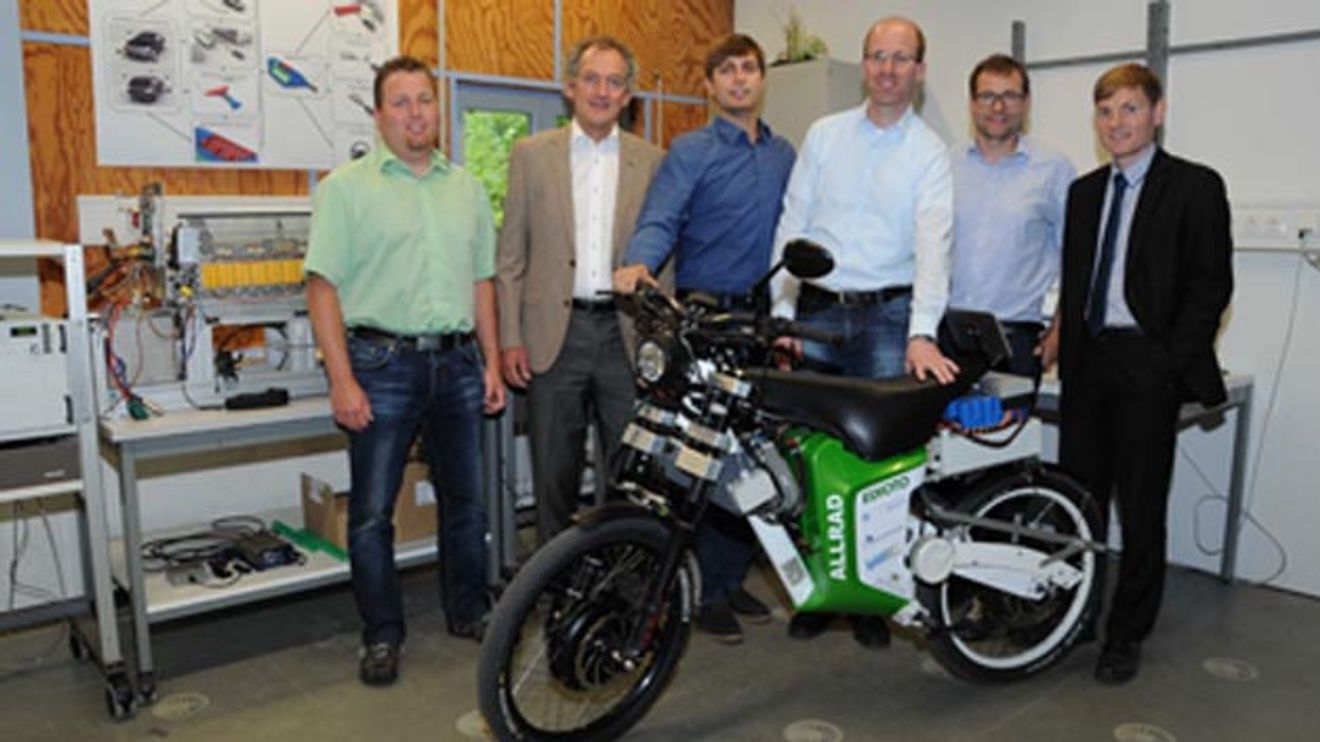
Martin Werz, Dr. Achim Wohnhaas (both Gigatronik), Matthias Baumann, Dr. Michael Buchholz (both University of Ulm, MRM), Stefan Lippert (ipdd & ID-Bike), Dr. Markus Decker (Ministry of Economic Affairs, Labour and Housing Baden-Württemberg) with newly developed prototype (from left to right).
© Thomas Löffler / University of UlmWhile all-wheel drive is highly valued in cars in adverse road conditions, it has not yet been able to establish itself in two-wheelers - although the drive principle has enormous advantages here too. Mainly due to problems with the design, an additional motor on the front wheel has not yet been able to establish itself in series production.
Engineers at the Institute of Measurement, Control and Microtechnology at the University of Ulm have now developed an all-wheel drive for electric motorcycles and other electrically powered two-wheelers that increases driving safety in all driving situations and optimizes energy management. A light electric motorcycle with a hub motor based on the Elmoto moped from vehicle manufacturer ID-Bike, which can reach speeds of up to 45 km/h, was used as a prototype and modified for the all-wheel drive. Gigatronik equipped the test vehicle with a hybrid energy storage system and implemented a new current control system for the electric motors so that energy can be recovered during braking. In the event that the storage unit is full or the driver has to brake at low speeds, the product design and development agency ipdd has provided an electromechanical brake unit with which the classic friction brake can also be used via an electrical control system.
The prototype has an overall control system that distributes the driver's request for drive or braking to the wheels. Using a sensor-based process, the control unit also records the current driving status and then specifically adjusts the distribution of braking or drive torque to the front and rear wheels. Another advantage of the two wheels driven and braked by the electric motor: Significantly more and more efficient braking force can be generated and stored as energy. This increases the range and there is hardly any wear and tear when braking. The MRM used the resulting additional degree of freedom compared to electric motorcycles with individual motors to increase energy efficiency: the developers programmed an intelligent algorithm that calculates the optimum control of the two motors in real time. At the same time, the algorithm still takes into account any braking or accelerating performed by the driver. With this system, the Ulm scientists were also able to increase safety while driving: in addition, they developed a two-wheel ABS that also works via the electric motors. This offers a simple and cost-effective way of implementing this technology in all performance classes, especially for light and small motorcycles, where such systems are not yet available. Safety is also increased: the intelligent algorithm takes over the correct dosage of braking force to both wheels in critical situations. This counteracts the dangerous brake steering torque, which can lead to accidents, especially when cornering.
The results of the joint project can be applied to all classes of two-wheeled vehicles with an electric drivetrain. Even conventionally powered motorcycles can benefit from the findings and become significantly safer. If they are equipped with so-called brake-by-wire systems, the algorithms developed can also be easily integrated into these two-wheelers.


You might also be interested in
Germany's most popular electric car is...?
"Chic, clean, unpopular" is how Die Zeit rated the electric car in Germany. The online marketplace AutoScout24 has evaluated the most popular electric car models in its database and compiled a top ten ranking.
 read more...
Drive train becomes a 'universal charger'
At the IAA 2017, Continental is presenting the 'AllCharge' charging system and thus a way out of the inconsistent charging infrastructure for electric cars. The highlight: instead of packing charging technology for different charging stations into...
read more...German racing teams in front
The teams at the 10th 'Formula Student Germany' brought the asphalt to the boil in August. German students demonstrated the most engineering skill with their racing cars. They also prevailed with their concepts in the 'Driverless' discipline planned...
read more...Students invent the 'wheel 2.0'
The 'Ourobot' from Bielefeld University of Applied Sciences resembles a thick bicycle chain. Each link in the chain has its own drive that enables the robot to move over obstacles. But the 'Ourobot's' journey does not end here.
read more...Electric airplane with record-breaking motor takes off
Siemens researchers have developed a new type of electric motor for airplanes: Weighing just 50 kg, it delivers a continuous output that is five times higher than that of comparable drives. Installed in an aerobatic airplane, it has now completed...
read more...Electric all-wheel drive for handcarts
Students at Saarland University have developed a handcart that is easy to pull, even with a heavy load and on a steep path. Thanks to intelligent all-wheel drive and sensors in the handle, the handcart knows when the wheels need to provide thrust.
read more...New gear technology increases productivity
No backlash and extremely high torsional rigidity - thanks to these properties of a new gear technology, the Lower Saxony-based company Broetje-Automation has been able to improve the productivity of its riveting machines by up to 20 %.
read more...Innovations in drive technology
Without drive technology - in the truest sense of the word - nothing would turn in most machines and systems. Computer&AUTOMATION presents the latest innovations in this automation discipline in a series of pictures.
read more...MTCON and Sensor-Technik Wiedemann combine expertise
MTConnectivity power2pcb (MTCON) has a new shareholder: Sensor-Technik Wiedemann (STW) has held a stake in the power element manufacturer since the end of 2019.
read more...