
Drive technology
New gear technology increases productivity
No backlash and extremely high torsional rigidity - thanks to these properties of a new gear technology, the Lower Saxony-based company Broetje-Automation has been able to improve the productivity of its riveting machines by up to 20 %.
Broetje-Automation from Wiefelstede near Oldenburg has been active in the international aircraft industry for over 36 years. In addition to its core business with machines and systems for riveting, joining and assembling complete aircraft structures, the Lower Saxony-based company manufactures systems for the production and processing of components made of carbon fiber reinforced plastics (CFRP), for robot applications and for process-monitoring image processing. Leading European and American aircraft manufacturers and their suppliers are currently showing great interest in the so-called MPAC (Multi Panel Assembly Cell) systems in particular: "These systems connect the fuselage components with tens of thousands of rivets," explains Dr. Christian Heyers, Head of Control Technology at Broetje-Automation. The MPAC systems can rivet almost all shells of the various sections of all common aircraft models directly from the CAD model. And with extreme precision: the highly complex end effector of an MPAC with its five positioning axes each for the lower tool and riveting head achieves an electronically controlled and sensor-monitored accuracy of ±0.1 mm when drilling, applying sealant, setting rivets and upsetting.

The complete MPAC system: It uses hundreds of thousands of rivets to connect the fuselage components of the Airbus A380 or the Boeing 787 Dreamliner, for example.
© Broetje-AutomationIn order to achieve these values, Broetje-Automation fully exploited the potential for optimizing the gearbox technology, among other things. "On the so-called A2 axis of the MPAC, we were looking for a gearbox solution that would simultaneously achieve more speed, higher axis dynamics and also more positioning accuracy thanks to less backlash," recalls Dr. Christian Heyers, adding: "The aim was to significantly improve the control of the swivel axis and thus accelerate the movement of the lower tool in order to achieve significantly better productivity in the overall process."
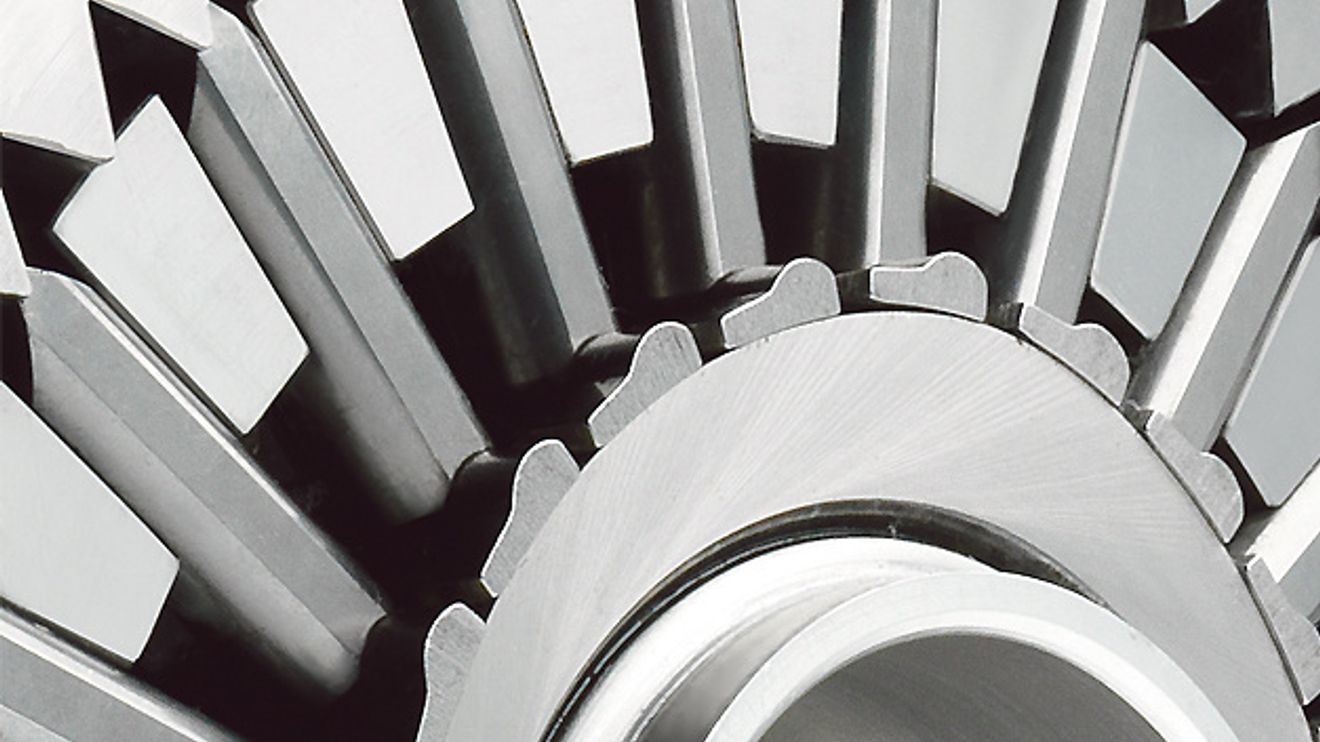
In the search for a suitable solution, those responsible at Broetje-Automation became aware of the new Galaxie drive system from Wittenstein at a very early stage of market maturity. The special thing about it: instead of a gearwheel, Galaxie has 48 dynamized individual teeth, which are grouped around a polygon of 2 or 3 and are guided along the internal teeth of the hollow gearwheel. Almost all teeth are involved in torque transmission and stiffness formation at the same time. In addition, this multi-tooth meshing is not a line contact, but a surface contact based on the logarithmic spiral. "The performance data specified at the time suggested that the new type of right-angle gearbox would outperform the previously used low-backlash planetary gearboxes in terms of the key characteristics of backlash and rigidity under high loads or when changing flanks by reversing the direction of movement," says Dr. Christian Heyers. In fact, Galaxie enables very precise control of the axis movement even at low loads thanks to the linear stiffness curve.

This linearity is achieved not only by the full-surface multi-tooth engagement, but also by the fact that there is virtually no gap between the tooth carrier and the internal toothing of the ring gear - and therefore hardly any bending length. In addition, the flat tooth contact ensures optimum load distribution across the width. Last but not least, the Galaxie kinematics are completely backlash-free because the teeth - thanks to their cylindrical guidance in the tooth carrier - automatically optimize their alignment and engagement with the internal gearing. At the same time, the hydrodynamic lubrication ensures that the round tooth bodies slide smoothly into the tooth carrier bores. The zero backlash therefore remains constant and permanent.
Overall, the Galaxie kinematics achieve up to 6.5 times more load-bearing tooth surface than helical planetary gears - as previously installed by Broetje-Automation on the process-leading A2 axis of its MPAC riveting machines. All in all, the new technology offers up to 170% more maximum torque compared to other common gearbox kinematics of a comparable size, up to three times greater overload protection and a hollow shaft diameter that is up to 70% larger.

One feature of the backlash-free Galaxie drive that should be emphasized is the very high rigidity under alternating load at zero crossing, which does not change during operation.
© Wittenstein"The decisive factors for us were the improved torsional rigidity of the kinematics and their absolute freedom from backlash, even with alternating loads in zero passage," says Dr. Axel Peters, Executive Vice President Fastening at Broetje-Automation, referring to the specific benefits when used in the company's own MPAC riveting machines. "This allows us to achieve significantly more precise motion control, even at reversal points, as well as around 30% faster positioning of the lower tool." In other words, whereas the machine previously needed one second to move one inch between two riveting points, it now takes just 0.7 seconds. This in turn has increased the riveting cycle from 18 to 21 rivets per minute. According to Dr. Axel Peters, this is not the end of the story: "Even 0.5 seconds now seems feasible to us. This is possible because Galaxie has doubled the speed of movement of the axis, acceleration is now 140% better and the rate of change of acceleration - the jerk - has even been increased by 250%."
Installation space compatibility simplifies integration
Despite the significantly improved performance data, the new drive system is very compact due to the short individual teeth and the flat polygon bearing - comparable hollow shaft gearboxes would have to be at least two sizes larger for the same torque. Another advantage is that Broetje-Automation no longer needs a separate bearing for the A2 axis thanks to the gearbox's high-performance output bearing - which simplifies assembly and reduces costs. "Galaxie was therefore a perfect fit for the installation situation in the MPAC," concludes Dr. Christian Heyers.
Get the hang of it
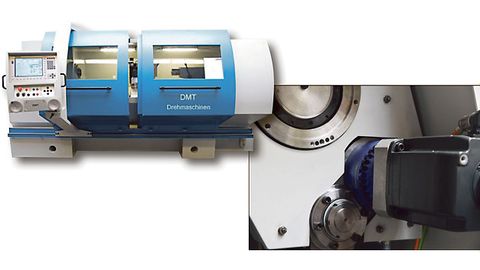
Thanks to the new drive system, DMT lathes achieve significantly better performance values when milling. The detailed image shows the installation situation of the Galaxie unit.
© DMTThe Lörrach-based company DMT is a manufacturer of lathes for manual, cycle and CNC machining - also with interactive contour machining if required. The machine portfolio covers performance ranges with maximum swing diameters from 280 mm to 1100 mm, center distances between 500 mm and 6000 mm and drive powers between 11.5 kW and 46 kW. "In addition to the standard machines from the various CD series, some of which can also be upgraded with tool turrets, driven tools and power clamping devices, we also manufacture special turning machines with individual performance requirements," explains Friedrich Spohn, Managing Director at DMT.
As the machining of high-quality materials and the ever-increasing precision requirements of customers are placing new demands on the existing machine technology, the company set out to find a drive system that would enable it to meet requirements such as improved machining quality and higher productivity. The analysis of the milling processes revealed that the torsional rigidity and the backlash of the main motor-gear unit were the decisive variables, as they have a significant influence on the dynamic positioning accuracy. "This in turn affects the machining quality, tool life and cutting performance of the machines during machining operations with the C-axis, among other things," says Friedrich Spohn, explaining the correlations.


You might also be interested in
Wittenstein at the Hannover Messe 2024
Focus on digitalization
The motto of Wittenstein's trade fair appearance is "Shaping the world of cybertronic motion". The focus will be on cybertronic and mechatronic drive technology in the context of advancing digitalization in industrial innovation segments.
 read more...
Wittenstein at the Logimat 2024
Secure communication for AGVs, AMR and co.
The safety-certified 'cyber simco drive 2' servo controller from Wittenstein cyber motor is now available with a Profisafe interface.
read more...The e-paper special: looking for products of the year 2024
They've earned it: all 96 nominated products from 12 categories in their own e-paper. Browse through the individual areas and make your personal selection. You can also find out more about the companies and their solutions in the accompanying video...
read more...Designed for high-precision applications
Wittenstein introduces the precision-oriented 'Galaxie accuracy line' product family to the market. The kinematics, bearings, gear ratios and even larger hollow shaft diameters of the gearboxes have been specially designed to meet the requirements...
read more...Differential drive in a new design
Wittenstein launches the 'cyber iTAS system 2' servo drive system.
read more...The Intelligent Manufacturing Award 2021
Under the motto "Bring Value to Data", Microsoft and Roland Berger called on companies to take part in the Intelligent Manufacturing Award 2021. The winners have now been announced.
read more...Available in four sizes
No motor housing, no bearings and a large number of configurable design variants are features of the housingless servomotors in the cyber kit line series from Wittenstein.
read more...The top dialog
The future-oriented Industry 4.0 project was officially launched at Hannover Messe 2011. The Industry 4.0 platform's research advisory board has now met for a top-level dialog and drafted a twelve-point communiqué on the work still to be done.
read more...Current drive technology products
Without drive technology - in the truest sense of the word - nothing would turn in most machines and systems. Computer&AUTOMATION presents the latest innovations in this automation discipline in a series of pictures.
read more...